
The difference between geo audit and seo audit comes down to one question: are you optimizing for search engines or AI answer engines? A seo audit, short for search engine optimization audit, checks how well your site ranks on Google and Bing. A geo audit, short for generative engine optimization audit, checks how often AI tools mention, cite, or recommend your brand. SEO stands for search engine optimization. GEO stands for generative engine optimization. Both matter for businesses, marketers, SEO professionals, agencies, content creators, website owners, and publishers. Whether you run an ecommerce store, a SaaS company, a local business, or a B2B brand, understanding geo audit vs seo audit helps you spend your budget wisely.
GEO Audit vs SEO Audit: The Short Version
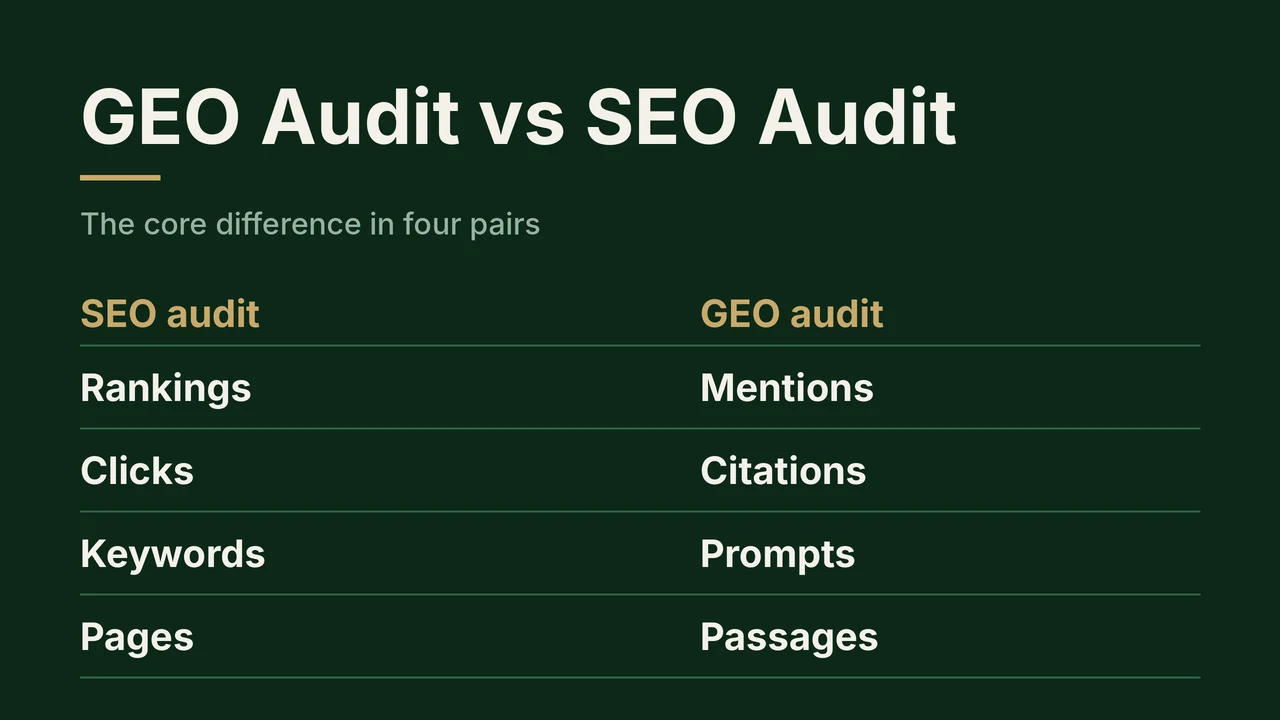
Here's the short version of geo audit vs seo audit, and the difference between geo audit and seo audit isn't complicated once you break it into pairs. Think rankings vs mentions: SEO chases a ranking spot, GEO chases a mention inside an AI answer. It's also clicks vs citations, since SEO wants a click and GEO wants a citation. Links vs mentions works the same way, SEO builds backlinks, GEO earns brand mentions across the web. SEO runs on keywords vs prompts, since people now type full questions instead of short search terms. That shifts focus to keywords vs entities, because AI models care more about what your brand is than which word you typed. SEO ranks whole pages, but GEO works on pages vs passages, pulling one useful paragraph at a time. The bigger shift is search engines vs AI engines: a crawler vs LLM retrieval system work differently, one indexes pages, the other generates answers on the spot. That's why SEO gives deterministic vs probabilistic results, stable day to day, while GEO shifts with every prompt. Even so, there's real overlap between SEO and GEO. Treat them as complementary approaches, build a hybrid strategy, and let SEO vs GEO work together.
What Is an SEO Audit?
A seo audit, also called a search engine optimization audit, reviews your website like a health check. It combines a technical SEO audit, a content audit, and a site audit into one website audit, often nicknamed a SEO health check. The goal is simple: find out why you rank where you do on Google Search, Bing, or any search engine results pages (SERP). A good audit scope covers organic traffic, organic visibility, and organic rankings. The audit process looks at every ranking factor and ranking signal search engines use to pick a winner.
Technical SEO (Crawlability and Indexability)
Technical SEO checks whether search engines can even find your pages. Crawlability means bots can crawl your site, and indexability means those pages can get indexed. Crawling and indexing depend on your crawl budget, so a clean XML sitemap and clear robots.txt file matter. Site architecture and internal linking guide bots through your pages, while a tidy URL structure and correct canonical tags stop confusion. Broken links, messy redirects, and bad HTTP status codes waste crawl budget fast. Duplicate content and thin content hurt your standing too. Core web vitals, page speed, and page experience shape rankings. Mobile-friendliness and mobile-first indexing are no longer optional. HTTPS keeps your site secure, and proper JavaScript rendering or server-side rendering makes sure bots see the same page a visitor sees.
On-Page SEO (Metadata, Search Intent, and Content Relevance)
On-page SEO looks at what's written on each page: meta titles, meta descriptions, title tags, header tags, and your H1. Keyword research shapes keyword targeting, which later shows up in your keyword rankings. Keyword density still matters, but matching search volume to real search intent matters more. Some pages need informational intent, others need commercial intent, so intent matching keeps visitors happy after they click. Content relevance and content quality decide if people stay. Structured data and schema markup help search engines understand a page beyond plain text. Keyword alignment across title, headers, and body ties it together, and picking the right keyword per page avoids internal competition.
Off-Page SEO (Backlinks and Trust)
Off-page SEO measures trust earned outside your own site. Backlinks still drive rankings, so link building and a healthy link profile matter. Referring domains, anchor text, and overall domain authority tell search engines how much to trust you. Digital PR turns unlinked mentions into real brand authority over time. Brand reputation grows through third-party mentions across news sites, forums, and review pages, feeding into E-E-A-T, the trust signals Google uses to judge a top spot.
What Is a GEO Audit?
A geo audit checks how your brand performs inside generative engine optimization. Instead of chasing rankings, it's an AI search optimization check, also called an AI search audit or AI visibility audit. It measures your AI visibility, meaning how often large language models and LLMs mention your brand. LLM optimization, shortened to LLMO, looks at how generative AI, AI chatbots, AI assistants, and AI answer engines pull information from your site. Google's AI overviews now sit above traditional results, so this audit matters more every month.
What Does GEO Audit Mean?
A geo audit, short for generative engine optimization audit, looks at how your content shows up across AI search tools: ChatGPT, Perplexity, Gemini, Claude, Microsoft Copilot, and Bing Copilot. It also covers Google SGE, the search generative experience that grew into Google AI Overviews and AI Mode. ChatGPT search works through conversational search, answering natural language queries instead of short keywords. Most tools run on retrieval-augmented generation, or RAG, pulling fresh facts on top of older training data. Grounding ties an AI answer back to a real source. Before answering, many systems run a query fan-out, splitting one question into smaller searches. This prompt-based search style favors long-form conversational queries over short, choppy ones.
Why GEO Audits Matter: How Much Traffic Are You Losing to AI?
Zero-click search is growing fast, and zero-click results mean users get an answer without visiting your site. AI referral traffic and LLM referral traffic exist, but flow differently than normal clicks. Many site owners notice a traffic decline or plateaued traffic and can't explain why, until they check their share of voice in AI answers. A low AI share of voice often means weak brand visibility in AI tools. Your citation rate tells the real story behind any traffic loss. This evolving search landscape, this search behavior shift toward AI-driven search, isn't slowing down, and ignoring it means falling behind the future of search.
GEO Audit vs SEO Audit: Key Differences
The difference between geo audit and seo audit shows clearly once you line them up. Geo audit vs seo audit share some similarities, like caring about content quality and trust. Understanding core GEO vs SEO differences helps decide where to spend your next hour.
Primary Goal: What "Winning" Looks Like
The primary goal of an seo audit is rankings, clicks, and organic traffic. The primary goal of a geo audit is citation rate and share of voice in AI answers. SEO wants you ranked first. GEO wants brand mentions and AI mentions inside the answer itself, sometimes called your share of model.
Success Metrics and Measurement
Success metrics for SEO come easily from Google Search Console, Google Analytics, or GA4. KPIs like click-through rate, CTR, impressions, and average position give clean numbers. Key performance indicators for GEO are trickier. Measurement for AI mentions brings real measurement challenges, since answers change by prompt. Attribution gets harder too, because a user might read an AI answer and never click through at all.
Content Strategy and Format
An SEO strategy favors long pages built around content structure that keeps readers scrolling. A GEO strategy favors answer-first content, direct answers, and concise answers AI tools can lift fast. Snippet-ready content and quotable content work for both, but GEO leans harder on extractable content. Chunking content into clear sections supports passage-level optimization and passage ranking, since AI often grabs one paragraph, not the whole page. Scannable formatting, bullet points, and tables help humans and machines both.
Technical Focus
SEO's technical focus centers on Googlebot and Bingbot. GEO's technical focus centers on technical AI accessibility, meaning AI crawlers like GPTBot, OAI-SearchBot, PerplexityBot, ClaudeBot, and Google-Extended. Bot access depends on your robots.txt AI crawlers rules and, increasingly, a llms.txt file. Crawler access sounds simple, but one wrong noindex tag can erase your brand from every AI answer overnight. Consult the official Google AI features documentation to verify how search systems crawl and qualify content for generative answers.
Authority and Trust Signals
Authority signals matter to both, but work differently. SEO leans on E-E-A-T, short for experience, expertise, authoritativeness, and trustworthiness, backed by trust signals like author credentials and source credibility. GEO cares about the same brand authority, but checks third-party mentions across the open web more than backlinks alone. Domain authority still helps GEO indirectly, since AI systems trust sites that already rank well.
Where the Buyer Decides
The buyer decision used to happen on a SERP, right before conversion. Buying intent now often gets satisfied inside a zero-click answer, never reaching your SERPs at all. AI Overviews shape the first recommendation a buyer sees. Getting on that shortlist, or earning inclusion in the AI's answer, can matter more than ranking first.
Side-by-Side Comparison
Here's a side-by-side comparison of geo audit vs seo audit that makes the deterministic vs probabilistic results gap clear:
- Result Type: SEO Audit provides deterministic rankings; GEO Audit produces probabilistic, AI-generated answers.
- Personalization: SEO Audit shows low personal variation; GEO Audit shows high variation by user, location, and prompt wording.
- Consistency: SEO Audit remains stable over weeks; GEO Audit outputs fluctuate daily.
- Output: SEO Audit targets a fixed link position; GEO Audit aims for brand inclusion within synthesized responses.
Where SEO and GEO Audits Overlap
The overlap between SEO and GEO is bigger than most think, built on complementary approaches sharing one foundation. Technical SEO still matters, since AI engines need a crawlable, fast site just like Google does. Content quality and trust never go out of style, no matter who or what reads your page. E-E-A-T signals that help you rank also help AI systems decide you're worth quoting. Structured data supports both audits by making content machine-readable. Entity optimization connects your brand, products, and people in a way both search engines and AI engines understand. Build topical authority once, and both audits benefit.
What a GEO Audit Checks
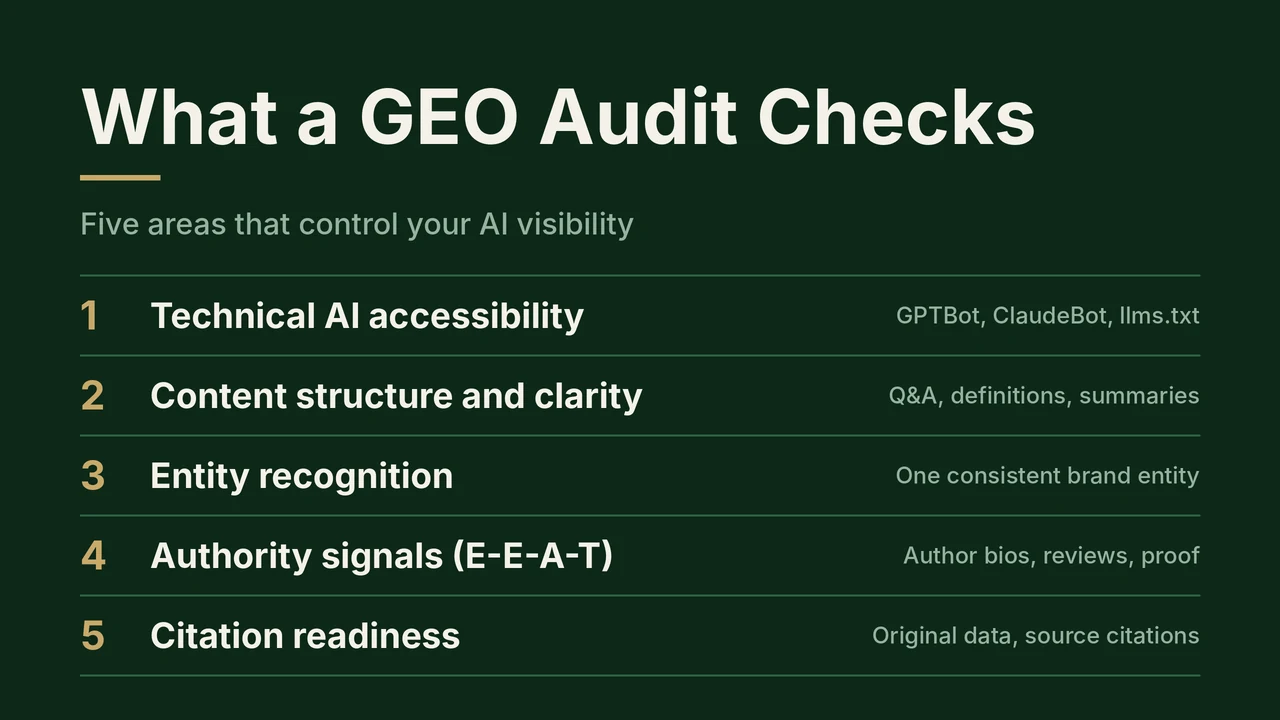
A geo audit follows its own audit framework, separate from a normal seo audit. Good audit methodology checks five areas that control your AI visibility, one piece at a time.
Technical AI Accessibility
Technical AI accessibility starts with crawlability and indexability. A geo audit checks whether AI crawlers can reach your pages, reviewing crawler access for GPTBot, OAI-SearchBot, PerplexityBot, ClaudeBot, and Google-Extended inside robots.txt, plus an llms.txt file. XML sitemaps and canonical tags help bots find your best pages. Core Web Vitals, page speed, and mobile usability still count. JavaScript rendering causes trouble, since some AI crawlers can't read content that loads late. The audit flags blocked pages, bad HTTP status codes, and confirms your site stays secure with HTTPS.
Content Structure and Semantic Clarity
Content structure decides how easily an AI system can lift your words into an answer. The audit checks semantic relevance and contextual relevance, making sure each section answers one clear question. Extractability and answer clarity go together, so question coverage matters more than keyword count. Good structure and extractability comes from format: Q&A sections in conversational syntax, clear definitions, real statistics, numbered steps, and step-by-step explanations. Summary blocks give AI tools a quotable chunk. Heading hierarchy and simple scannable formatting make pages easier to parse.
Entity Recognition and Brand Consistency
Entity recognition checks whether AI systems know exactly who you are. Entity salience measures how strongly your brand stands out among named entities on a page. A clear brand entity needs entity clarity, tied to solid entity SEO and entity-based search rooted in semantic search. One common problem: inconsistent entity names across your site, socials, and directories confuse AI models. The audit checks your sameAs property, linking your site to your knowledge panel and the wider knowledge graph. Consistency across every mention builds trust, and a detailed About page gives the clearest signal of who you are.
Authority Signals (E-E-A-T) and Public Proof
Authority signals under E-E-A-T need public proof, not just a homepage claim. The audit checks author bios and credentials on every article, plus reviews, testimonials, and case studies. Customer mentions, partner listings, and integration listings prove real companies trust you. Documentation shows depth and source credibility marketing copy can't fake. Strong examples, real numbers, real names, real results, give AI systems something solid to quote.
Citation Readiness
Citation readiness measures how easy it is for an AI system to quote you by name. The audit checks for source citations, footnotes, and clear citations and references. Original research, original data, and unique data give you something no competitor can copy. Expert quotes add a human voice that boosts fact-checking and factual accuracy. AI tools lean on multi-source synthesis, pulling facts from reputable sources and third-party sources at once, so grounding claims in real data raises your odds. Even unlinked mentions across the web feed into how often AI engines cite you.
SEO vs. AEO vs. GEO
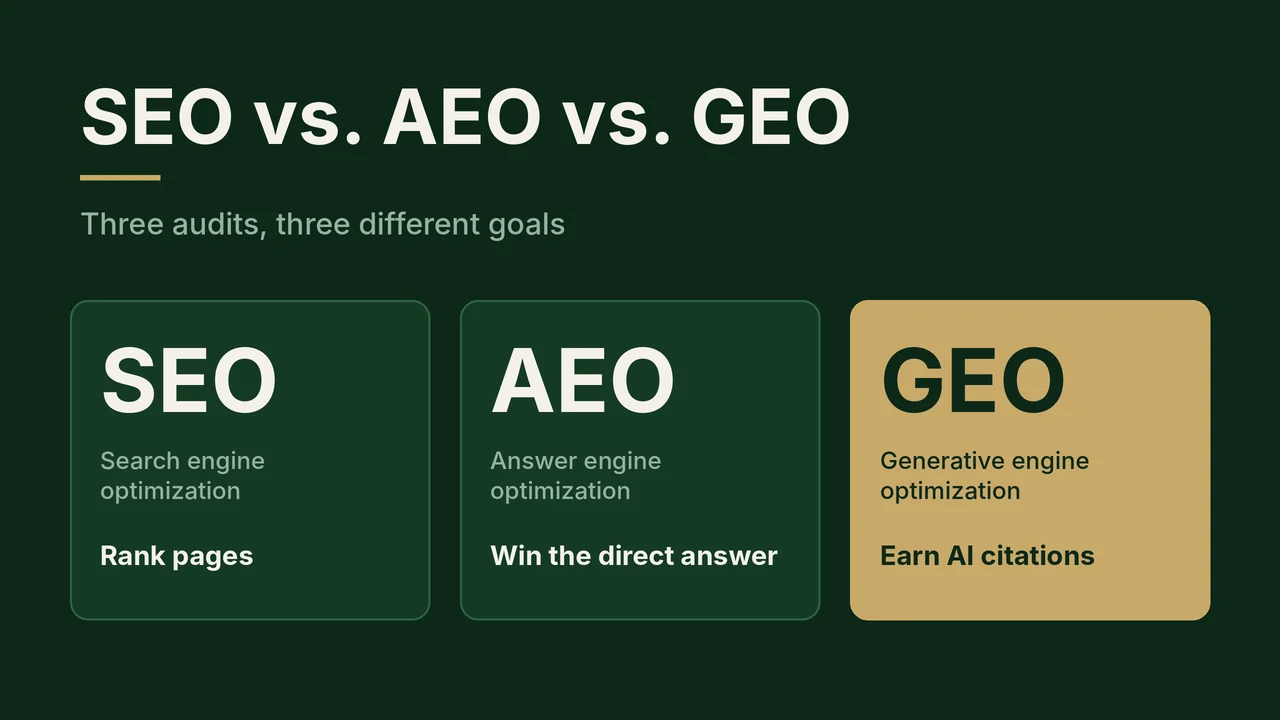
SEO vs AEO vs GEO confuses people, so let's clear it up. Answer engine optimization, or AEO, focuses on winning the direct answer to a question. AI engine optimization, sometimes called AIO, is a broader label covering both AEO and GEO. Reviewing our GEO vs AEO vs LLMO breakdown shows how scope differs: AEO targets a single answer box, while GEO targets your overall AI presence across conversational models.
What an AEO Audit Checks
An AEO audit checks readiness for answer engine optimization. It reviews whether answer engines pull clean AI-generated answers straight from your page, checking your odds of winning featured snippets and People Also Ask boxes. It also checks compatibility with voice assistants, since spoken search demands short, direct answers. Answer clarity decides whether your content gets picked over a competitor's.
How the Three Audits Differ
The three differ in what they measure. SEO cares about ranking vs citation, chasing position one. GEO and AEO chase citation, not position. SEO uses keywords vs prompts, built for typed search boxes. GEO and AEO think in pages vs passages, since AI tools grab small text chunks. Search engines vs AI engines use different retrieval methods entirely. Each has its own benefits and limitations, which is why running all three gives the full picture.
SEO, AEO, and GEO Audit Checklist
A combined audit checklist saves time. Build one audit framework running your seo audit, AEO audit, and geo audit together. A smart audit process checks:
- Crawlability and indexability
- Content structure and answer clarity
- Entity consistency
- Authority signals and citations
- Keyword and prompt coverage
Good audit methodology ends with clear audit deliverables: a report, a scorecard, and a fix list your team can use.
When to Do an SEO Audit
Knowing when to do an SEO audit saves you from guessing why traffic dropped. Run one right after a site migration or once you've replatformed to a new CMS. Any time Google rolls out an algorithm update, check rankings within days. A sudden traffic decline or long plateaued traffic deserves a full review. Indexing issues, pages dropping from Google's index for no clear reason, need fast attention. Built-up technical debt from years of quick fixes also calls for a fresh audit.
When to Do a GEO Audit
Knowing when to do a GEO audit matters just as much. Run one the moment you spot brand misrepresentation in an AI chat, where the tool gets your product, price, or policy wrong. Inaccurate answers and outright hallucinations about your company spread fast once an AI model repeats them. Track your AI mentions regularly, especially as emerging AI features roll out across Google, Bing, and chat tools. Unstable rankings inside AI answers, appearing one day and vanishing the next, signal it's time to dig in.
SEO vs GEO in 2026: Do You Need Both?
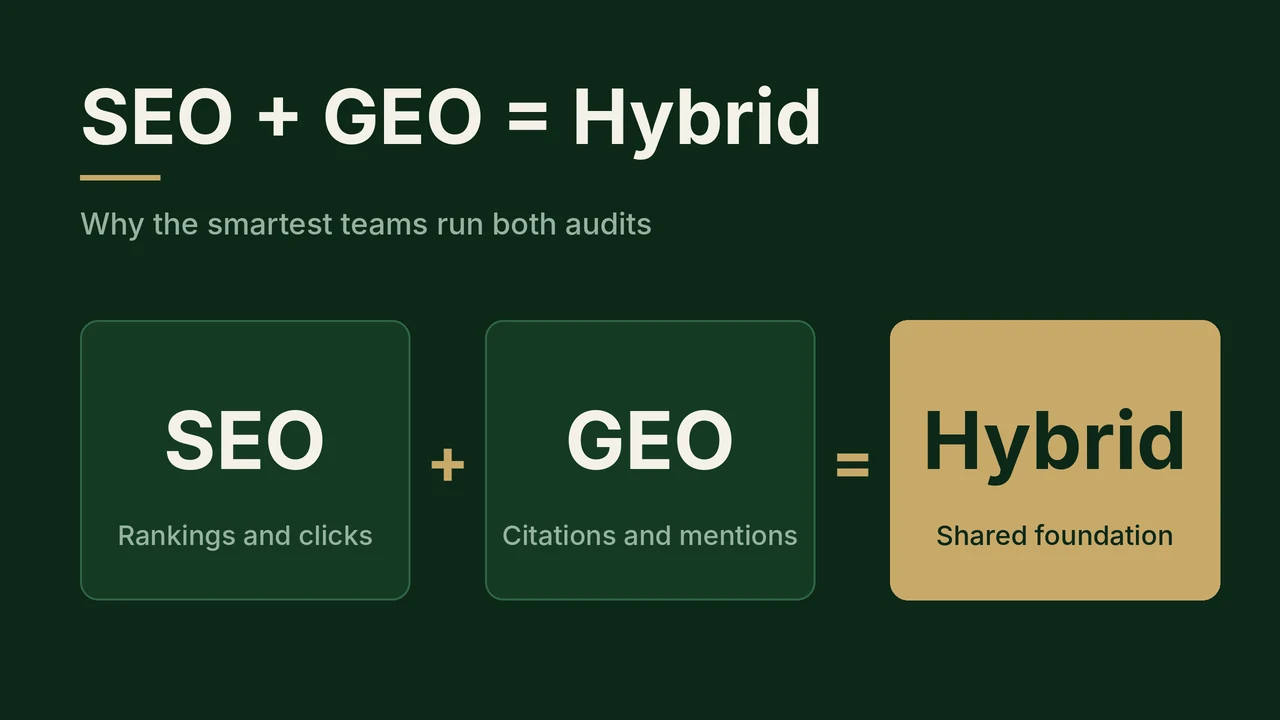
SEO vs GEO isn't really a competition. The smartest teams build a hybrid strategy that runs SEO and GEO together from day one. The future of search belongs to AI-driven search just as much as traditional results pages, so any digital marketing strategy built for 2026 needs both working side by side.
Which Is Better, SEO or GEO?
Asking which is better misses the point. Each has its own benefits and limitations. SEO still drives the most total traffic. GEO drives trust and visibility where clicks can't happen. Best practices call for running both on a schedule instead of picking a winner.
Is SEO Still Worth It in 2026?
Yes. Organic traffic from SERPs still sends more visitors than any AI tool today. Google Search and other traditional search engines remain the starting point for most buyers, even ones who later turn to AI for a second opinion.
Is GEO Replacing SEO?
GEO is not a replacement for SEO. Treating GEO as a replacement for SEO is one of the fastest ways to lose both rankings and AI visibility. GEO vs AEO and GEO vs LLMO are simply different lenses on the same shift, built on the SEO work you've already done.
If Your SEO Is Good, Is Your GEO Automatically Good?
No. You can rank first on Google and still get skipped by AI answers if your citation readiness is weak. Entity clarity, structured data, and schema markup need separate attention, since they speak directly to how AI systems read and trust pages.
What Should You Prioritize First?
Prioritization depends on your current traffic mix. Start with quick wins, fixing broken crawl access or missing schema, before bigger projects. Build a simple optimization roadmap listing what to fix first, second, and third. Implementation matters more than planning, so move fast, then set up monitoring to track what changes.
Early-Stage Startups
Early-stage startups rarely have a big budget for audits. DIY checks work fine here. Focus on foundation fixes first: indexing, basic schema, and a clear About page. Get the fundamentals right before spending on advanced tracking.
Seed to Series A
Companies from seed to Series A usually have some growth to show off. A budget-friendly audit combining SEO and GEO basics works well. Add simple competitive benchmarking to see where competitors already beat you in AI answers.
Growth-Stage Companies
Growth-stage companies need deeper audits, since scaling content without direction wastes money. A full competitor analysis shows what's working for others. Pair it with a gap analysis to find where your SEO and GEO coverage falls short.
Mature or Multi-Product Companies
Mature or multi-product companies carry more complexity. Enterprise sites juggle dozens of templates across product lines, so a site migration needs careful planning. Information architecture gets messy over time, and old templates pile up unused. Regular content pruning keeps performance from quietly declining.
GEO Audit vs SEO Audit Cost
Geo audit vs seo audit cost depends heavily on scope and who does the work. Audit cost ranges based on budget and the price an agency charges. A bigger scope costs more, but should bring bigger ROI. Audit frequency matters too, since a one-time check loses value fast. Most teams set an audit timeline of once or twice a year, with lighter monitoring between.
Traditional SEO Audit Costs
A traditional seo audit cost varies by agency and project scope. Smaller sites pay less, while larger ecommerce or SaaS platforms with hundreds of pages pay more. Price usually reflects how deep the audit goes.
GEO Audit Costs
A geo audit cost is still settling since the field is new. Some agencies bundle it with SEO work, others offer it through fractional marketing services. Pricing often depends on how many AI platforms and prompts get tested.
Budget-Friendly Options for Startups
Budget-friendly options exist for startups that can't afford a full agency package. DIY testing, running your own prompts through AI tools, costs nothing but time. Several free tools also track basic AI visibility without a monthly fee.
Free and Paid GEO Audit Tools
AI visibility tracking tools have grown fast. Platforms like Profound, Otterly, and Peec AI now offer rank tracking built for AI answers, not just Google. These tools handle prompt tracking, prompt testing, and ongoing prompt research so you don't retype questions into five chatbots weekly. Citation tracking shows exactly when your brand gets quoted. Sentiment analysis checks brand sentiment and AI sentiment, meaning whether the AI talks about you positively or negatively, which helps judge the accuracy of AI answers about your own company.
Manual Checking
Manual checking still works if you're starting out. Build a DIY prompt set, a list of 20 to 30 real questions buyers might ask. Turn that into a simple prompt map covering each product or service. Run sampling weekly, testing the same prompts across AI tools to track changes over time.
Google Search Console and Bing Webmaster Tools
Google Search Console and Bing Webmaster Tools still matter for the SEO side. Both show indexing status, crawl errors, and search queries for free. Pair them with Google Analytics or GA4 to see how organic traffic moves after changes.
Budget-Friendly Paid Options
For a tighter budget, paid tools like Screaming Frog, Ahrefs, Semrush, and Moz still cover most technical SEO and backlink needs, even if they don't yet track AI citations.
Can ChatGPT Do an SEO Audit?
ChatGPT can help with parts of an SEO audit, but it can't crawl your live site on its own. It works best for drafting checklists, explaining terms, or reviewing AI-generated content for clarity. Manual checking still matters, since ChatGPT can't see real crawl errors or server data. Treat it as a DIY helper, not a full replacement.
What a Good Audit Output Should Include
Good audit deliverables go beyond a long problem list. Look for audit scoring that ranks issues by impact, with clear audit metrics you can track. A strong report ends with a prioritized fix list, not just a data pile. Every deliverable should include actionable recommendations. Set a baseline before starting, so you measure progress later. A proper gap analysis and competitor benchmark show where you stand. Remember, a point-in-time audit only shows one moment, so pair it with continuous monitoring.
Common Mistakes
Common mistakes show up again and again across both audits. Spotting these failure points early saves time and money.
Treating GEO as a Replacement for SEO
Treating GEO as a replacement for SEO is a costly mistake. GEO isn't a replacement, it builds on SEO fundamentals like topical authority. Drop your SEO work to chase AI visibility, and you'll likely lose ground in both places.
Thinking Schema Alone Solves AEO and GEO
Thinking schema alone solves AEO and GEO is another trap. Schema markup and structured data help, but don't fix weak content. Adding JSON-LD for FAQ schema, organization schema, article schema, or product schema gives machines helpful hints, not a citation guarantee. The actual words on your page still need to answer the question clearly.
Publishing "AI Content" Instead of Useful Content
Publishing AI-generated content without editing rarely earns citations. AI tools and search engines both reward useful content, also called people-first content or helpful content. Authoritative content needs real depth, so comprehensive content that fully answers a topic beats a short page every time. Content depth takes effort but pays off. Content freshness matters too, so regular content updates keep pages accurate as facts change.
Measuring Only Traffic
Measuring only traffic gives an incomplete picture now. Organic traffic and clicks still matter, but attribution has gotten harder with zero-click answers in the mix. Impressions alone don't tell you if an AI tool quoted you correctly or sent a buyer your way without a single click.
Frequently Asked Questions
What Is the Difference Between a GEO Audit and an SEO Audit?
The difference between geo audit and seo audit is simple. A geo audit checks AI citations and mentions. A seo audit checks search engine rankings and organic clicks.
What Is the Difference Between Google SEO and GEO?
SEO targets Google Search rankings on a traditional results page. GEO targets how AI tools, including Google's own AI features, describe and cite your brand.
Is GEO Just SEO for AI?
GEO isn't just SEO for AI, though people call it that. It's closer to AI search optimization combined with LLM optimization, focused on citations instead of rankings.
Is AEO the Same as GEO?
AEO and GEO overlap but aren't identical. AEO, short for answer engine optimization, targets a single answer box. GEO vs AEO comes down to scope, one answer versus overall AI presence.
Can the Same Agency Do Both SEO and GEO?
Yes, many agencies handle both now. When hiring, look for SEO professionals who already track AI citations, not just rankings, so one team covers both audits.
Which Should You Do First if You Can Only Afford One?
With a tight budget, start with an SEO audit first. Prioritization matters here, since fixing technical and content basics helps your GEO results later too.
How Much Does a GEO Audit Cost Compared to an SEO Audit?
Audit cost for a geo audit often runs similar to or slightly higher than a seo audit, mainly because tracking tools and prompt testing are still newer.
Will a GEO Audit Help Your Google Rankings Too?
Often, yes. Many fixes from a geo audit, like clearer content and stronger entities, also support your Google Search rankings and organic rankings over time.
How Long Does GEO Take to Show Results Compared to SEO?
GEO can show results faster in some cases, sometimes within weeks, since AI answers update often. SEO usually needs a longer timeline, often three to six months, before rankings settle.
Final Takeaway: Audit the Failure Points, Not the Acronyms
Don't get stuck chasing acronyms like SEO, GEO, or AEO. Focus on the real failure points holding your site back. The difference between geo audit and seo audit matters less than fixing what's actually broken. Look for evidence in your data, not guesses, before deciding what to fix next. Confidence comes from real numbers, not trends read once. Start with foundation fixes, set clear audit goals, and build simple reporting you check monthly. That's how real visibility, on Google and inside AI answers, gets built over time.
Frequently Asked Questions
What Is the Difference Between a GEO Audit and an SEO Audit?
The difference between geo audit and seo audit is simple. A geo audit checks AI citations and mentions. A seo audit checks search engine rankings and organic clicks.
What Is the Difference Between Google SEO and GEO?
SEO targets Google Search rankings on a traditional results page. GEO targets how AI tools, including Google's own AI features, describe and cite your brand.
Is GEO Just SEO for AI?
GEO isn't just SEO for AI, though people call it that. It's closer to AI search optimization combined with LLM optimization, focused on citations instead of rankings.
Is AEO the Same as GEO?
AEO and GEO overlap but aren't identical. AEO, short for answer engine optimization, targets a single answer box. GEO vs AEO comes down to scope, one answer versus overall AI presence.
Can the Same Agency Do Both SEO and GEO?
Yes, many agencies handle both now. When hiring, look for SEO professionals who already track AI citations, not just rankings, so one team covers both audits.
Which Should You Do First if You Can Only Afford One?
With a tight budget, start with an SEO audit first. Prioritization matters here, since fixing technical and content basics helps your GEO results later too.
How Much Does a GEO Audit Cost Compared to an SEO Audit?
Audit cost for a geo audit often runs similar to or slightly higher than a seo audit, mainly because tracking tools and prompt testing are still newer.
Will a GEO Audit Help Your Google Rankings Too?
Often, yes. Many fixes from a geo audit, like clearer content and stronger entities, also support your Google Search rankings and organic rankings over time.
How Long Does GEO Take to Show Results Compared to SEO?
GEO can show results faster in some cases, sometimes within weeks, since AI answers update often. SEO usually needs a longer timeline, often three to six months, before rankings settle.
Need a Technical SEO Audit or Strategy Call?
Connect directly on WhatsApp to review your site speed, topical architecture, and organic growth roadmap.