
Search used to send you through ranked links. Now an AI-generated answer may appear before you choose a result, or a chatbot may handle the question entirely. If you want your brand to show up in those experiences, GEO vs AEO vs LLMO offers three ways to describe the work.
The terms overlap, but their usual goals differ: earn a direct answer, become a cited source, or improve how a language model describes your brand. Those differences can help you decide what to publish and measure.
GEO vs AEO vs LLMO Explained: What Each Term Means
These aren't three official standards. People use the labels differently, and one page can support all three. The clearest way to compare GEO vs AEO vs LLMO is by the visibility each approach seeks.
AEO Helps Your Content Become a Direct Answer
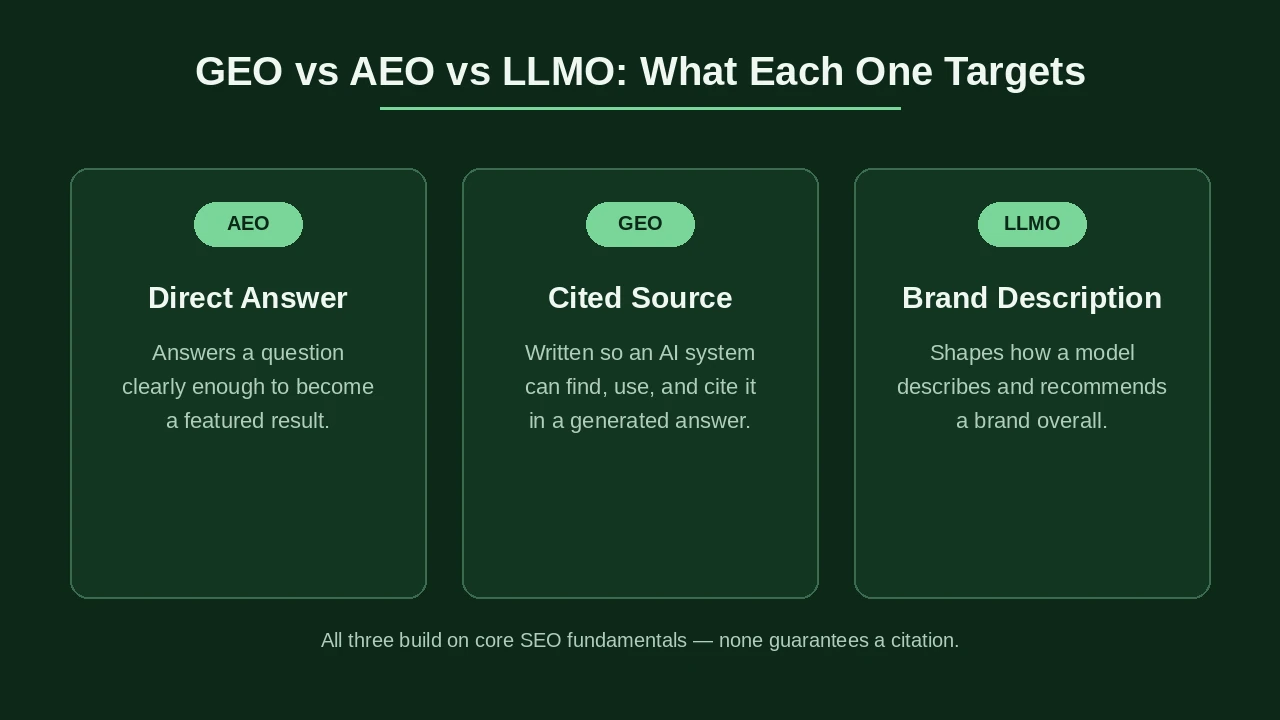
Answer Engine Optimization (AEO) focuses on answering a user's question clearly enough to appear as a direct response. That might mean an answer box, a featured snippet, or another question-led result.
For example, a page explaining how to calculate a conversion rate should give the formula plainly before exploring exceptions. AEO aims to make that explanation useful where the question is answered, rather than relying solely on a click from a ranked results page.
GEO Makes Your Content Easier to Cite in Generated Answers
Generative Engine Optimization (GEO) focuses on whether an AI system can find, use, and cite your content while composing a response. Relevant experiences include Google AI Overviews and AI Mode, ChatGPT Search, Perplexity, and Bing Copilot. Reviewing our generative engine optimization breakdown illustrates how multi-source synthesis works in practice.
These responses may combine information from multiple sources. A clear comparison, original finding, or well-explained process gives a system something identifiable to draw on. Still, a useful page may never receive a citation for a particular prompt. Official Google AI features guidance explains eligibility for its own search experiences, not a formula for guaranteed inclusion. Understanding the broader GEO vs SEO difference helps teams balance traditional rankings with citation visibility.
LLMO Broadens the Focus to Visibility in Language Models
Large Language Model Optimization (LLMO) is often a broader label for how language models find, describe, and recommend a brand across chat and search. Someone asking for software options may see a brand mentioned even when the answer doesn't cite its website.
Some practitioners use LLMO as an umbrella term for AEO and GEO. Others reserve it for brand representation beyond individual search results. In either case, the practical concern is accuracy: your name, products, and relationships should be easy to verify across reliable sources.
How to Improve Visibility Across AI Search and Answer Engines
The GEO vs AEO vs LLMO distinction is useful for setting goals, but it doesn't replace SEO. Google emphasizes that its AI search features have no special optimization requirements beyond standard search quality standards. Following official Google helpful content guidelines provides the most dependable foundation before adopting unproven tactics.
Make Useful Information Easy to Find, Understand, and Trust
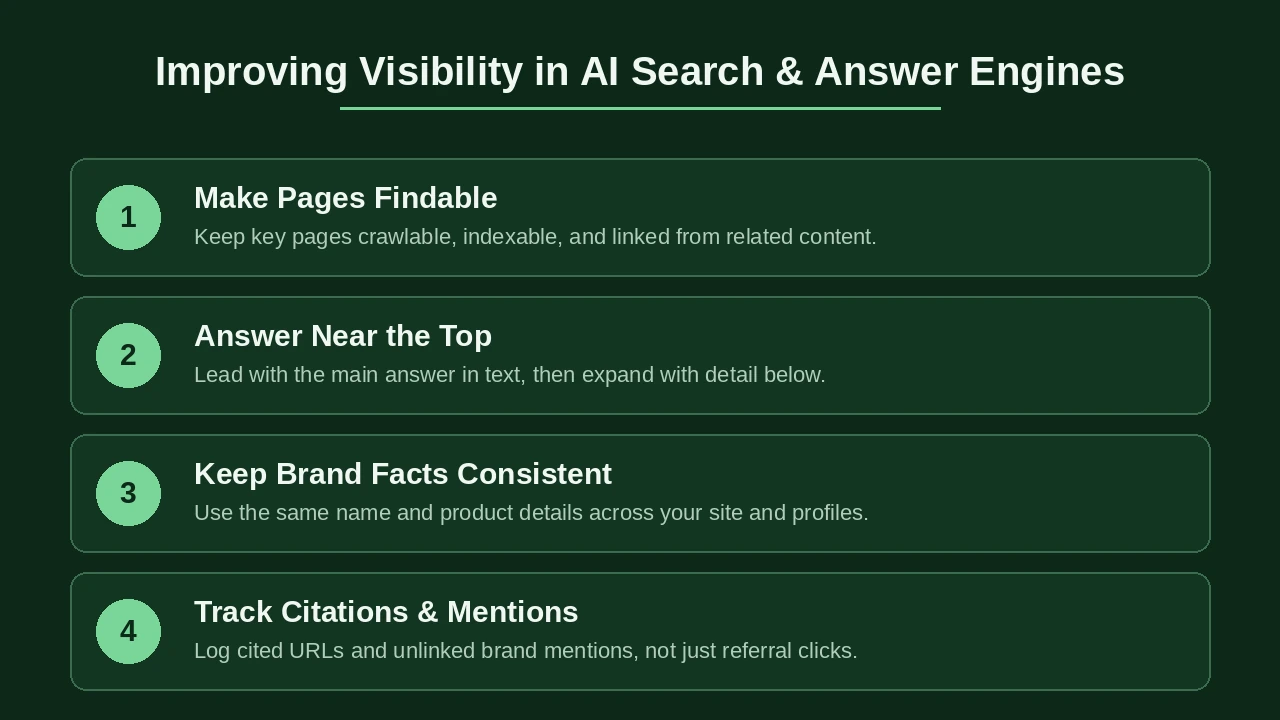
First, check that important pages are crawlable, indexable, and linked from relevant pages on your site. Solid technical SEO ensures search bots and LLM scrapers can access your underlying HTML effortlessly. Put essential information in text rather than hiding it inside an image. Then answer the main question near the top, using headings that tell readers what follows.
Go beyond a tidy definition when the subject calls for more. Incorporating structured data and semantic content writing allows machines to map relationships between entities clearly. An original survey with its method stated, a comparison with clear criteria, or instructions that address common mistakes can give readers more to use. These details may also make a source easier to understand, though they can't guarantee a citation.
Keep brand facts consistent, too. Use the same company name and clear product descriptions on your site and other profiles so language models can correlate information across diverse platforms.
Track Citations and Mentions, Not Just Clicks
An AI answer can include your information without sending a visit. It might cite your page, mention your brand without a link, or answer the question without naming you. So website traffic alone gives an incomplete picture.
Review a consistent set of relevant prompts and record cited URLs and brand mentions. Look at referral visits and search performance alongside those observations. Platforms expose different data, and answers can change, so treat any share-of-answer figure as a directional measure rather than a standardized score.
Keep the prompts and review schedule consistent. That makes changes easier to spot without mistaking one answer for a lasting trend.
Frequently Asked Questions
Does an AI mention count if there's no link?
Yes, a mention can put your brand in front of a potential customer. But it isn't the same as a citation: readers may have no direct route to your site. Record linked citations and unlinked mentions separately so you don't confuse awareness with referral traffic.
How can you correct an inaccurate AI description of your company?
Start with the information you control. Update outdated product pages and company profiles, and use the platform's feedback option when available. You can also ask third-party publishers to correct factual errors on their pages. An AI answer may not change immediately after any of these updates.
Can a small site appear in an AI-generated answer?
Yes, but size alone doesn't decide whether a page appears. A focused resource with firsthand details may be useful for a narrow question, even when larger sites cover the broader topic. Keep expectations realistic: relevance and quality improve the resource, not guarantee its selection.
Should every customer question get its own page?
Usually, related questions belong together on a substantial page that helps someone complete a task or make a decision. Give a question its own page when it calls for a distinct, detailed answer. Publishing many near-identical pages can make the useful information harder to find.
Conclusion
AI-generated answers have changed what visibility can look like. A direct response, a cited source, and an accurate brand mention are different outcomes, even when the work behind them overlaps.
Start with useful, accessible content and dependable brand facts. Then measure the outcome that fits your goal, rather than expecting every AI appearance to produce a click.
Frequently Asked Questions
Does an AI mention count if there's no link?
Yes, a mention can put your brand in front of a potential customer. But it isn't the same as a citation: readers may have no direct route to your site. Record linked citations and unlinked mentions separately so you don't confuse awareness with referral traffic.
How can you correct an inaccurate AI description of your company?
Start with the information you control. Update outdated product pages and company profiles, and use the platform's feedback option when available. You can also ask third-party publishers to correct factual errors on their pages. An AI answer may not change immediately after any of these updates.
Can a small site appear in an AI-generated answer?
Yes, but size alone doesn't decide whether a page appears. A focused resource with firsthand details may be useful for a narrow question, even when larger sites cover the broader topic. Keep expectations realistic: relevance and quality improve the resource, not guarantee its selection.
Should every customer question get its own page?
Usually, related questions belong together on a substantial page that helps someone complete a task or make a decision. Give a question its own page when it calls for a distinct, detailed answer. Publishing many near-identical pages can make the useful information harder to find.
Need a Technical SEO Audit or Strategy Call?
Connect directly on WhatsApp to review your site speed, topical architecture, and organic growth roadmap.