
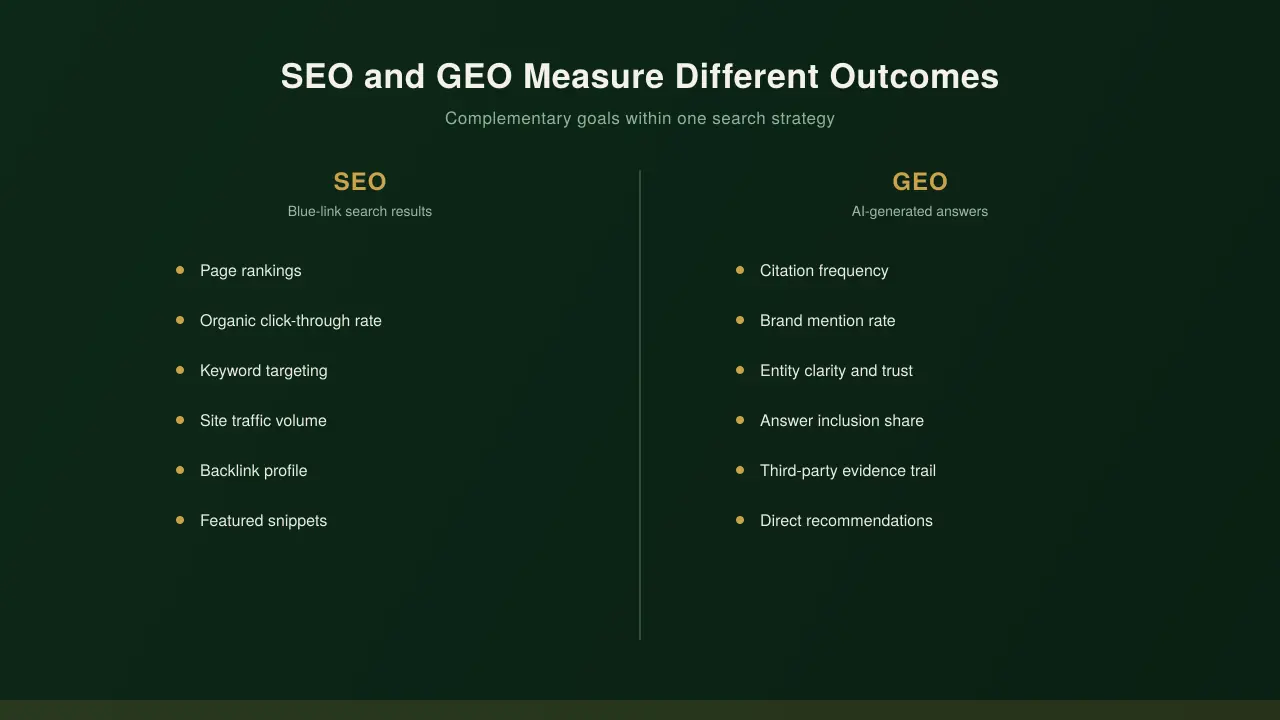
Google AI Overviews, ChatGPT, Perplexity, Gemini, Claude, and Copilot are changing how people find answers, so marketers are comparing GEO with SEO. The two approaches overlap, but they focus on different outcomes: SEO helps pages rank in traditional search results, while GEO helps content earn visibility in AI-generated answers.
You'll see how GEO and SEO differ, where their tactics and foundations meet, and how to measure rankings, clicks, citations, and brand mentions. Most businesses need both, because strong SEO supports discoverable content while GEO extends that content into AI search experiences.
GEO vs. SEO: What's the Difference?
SEO is the practice of improving a website's visibility and rankings in traditional search results. GEO, or generative engine optimization, helps AI search systems understand, mention, cite, or recommend a brand in generated answers. The simplest comparison is this: SEO aims to win a visible search result and click, while GEO aims to become part of the answer itself.
How SEO Earns Rankings and Organic Traffic
SEO starts with crawlability. Search engines need to find, render, and index your pages before they can rank them. Clear internal links, accessible navigation, sound technical health, and a usable site structure support that process. Reviewing Google's guide to how search works highlights how crawling, indexing, and ranking connect.
Once a page is discoverable, its content must match search intent. Use the language your audience searches for, answer the main question directly, and provide useful information that meets the visitor's expectations. Keyword relevance matters, but repeating terms won't replace depth or accuracy.
Internal links help search engines understand relationships between pages. Relevant backlinks can also strengthen a site's authority and discovery. Meanwhile, HTTPS, mobile usability, fast loading, accessible content, and clean technical implementation support page experience.
Trust ties these signals together. Accurate claims, transparent authorship, original insights, and reliable references give readers and search systems more reasons to value a page. Common SEO outcomes include:
- Higher rankings and more impressions.
- Increased organic visits and qualified clicks.
- More leads, purchases, and other conversions.
How GEO Earns Mentions and Citations in AI Answers
GEO focuses on helping AI systems retrieve, understand, summarize, and cite information. Answer-first writing, descriptive headings, short sections, direct facts, and expert semantic content writing make important details easier to identify.
Original research, expert bylines, clear evidence, and reliable third-party mentions can also strengthen a brand's inclusion in generated answers. AI platforms may draw information from websites, reviews, Reddit, YouTube, Wikipedia, LinkedIn, and other sources they consider useful and trustworthy.
SEO still supports GEO because AI systems need accessible, understandable source material. However, GEO measures visibility differently: citations, brand mentions, recommendations, prompt coverage, and referrals from AI platforms matter alongside traditional rankings and clicks.
SEO and GEO Have Different Goals, but Share the Same Foundation
SEO and GEO target different search experiences, yet they rely on many of the same content and technical practices. SEO helps your page earn a position among traditional results, while GEO helps your information appear in an answer generated from several possible sources.
The Biggest Differences Between Traditional Search and AI Search
Traditional SEO usually targets specific queries and measures success through rankings, impressions, clicks, and organic traffic. GEO also considers natural-language prompts, follow-up questions, and broader buyer concerns that may not match one exact keyword. AI systems also look for topical depth and semantic SEO principles to understand entities and relationships.
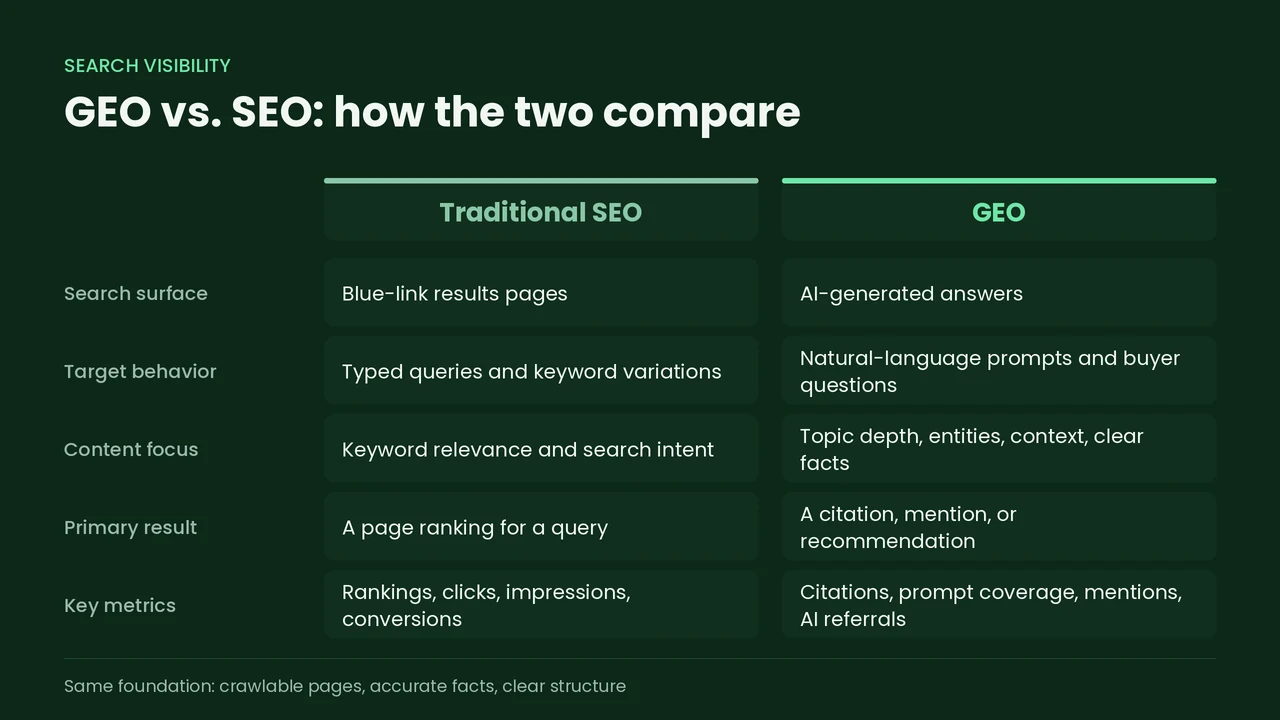
- Search Surface: Traditional SEO targets blue-link results pages; GEO targets AI-generated answers.
- Target Behavior: Traditional SEO targets typed queries and keyword variations; GEO targets natural-language prompts and buyer questions.
- Content Focus: Traditional SEO targets keyword relevance and search intent; GEO targets topic depth, entities, context, and clear facts.
- Primary Result: Traditional SEO aims for a page ranking for a query; GEO aims for a citation, mention, or recommendation.
- Common Metrics: Traditional SEO tracks rankings, clicks, impressions, and conversions; GEO tracks citations, prompt coverage, mentions, and AI referrals.
A traditional search result often presents a relatively stable list of pages. An AI system may retrieve information from several sources, synthesize it, and produce a different answer after a new prompt, platform update, or date change. That makes GEO visibility less fixed than a blue-link ranking.
Why Strong SEO Still Supports GEO
AI systems still need to discover and evaluate trustworthy information. Crawlable pages, consistent canonical URLs, clear navigation, useful headings, accurate claims, and strong user experience help both search engines and AI systems process your content.
Authority and freshness matter as well. Keep important pages updated, identify authors when expertise matters, and support claims with reliable evidence. Schema markup can help search engines understand content, but Google confirms there is no special markup required solely for generative AI features.
GEO is an added layer on top of solid SEO, not a replacement for it. Build an accessible, credible website first, then expand your content to answer the broader questions people ask across Google AI Overviews, ChatGPT, Perplexity, Gemini, and other platforms.
How to Build a Strategy That Improves Both SEO and GEO
SEO and GEO work best as one workflow. First, fix technical barriers and improve the page itself. Then, make its facts easier for AI systems to retrieve, compare, and cite.
Content and Technical Improvements That Help Both Channels
Start with solid technical SEO, a crawlable page, a search-friendly title, descriptive headings, useful internal links, and a clear page purpose. Rewrite the introduction so it answers the main question within the first few sentences. Then support the answer with short paragraphs, comparison tables, FAQs, descriptive links, and concrete examples.
Use schema markup when it accurately describes the page. Structured data helps search engines interpret content relationships, but schema cannot repair inaccurate or thin information.
Support important claims with primary sources, updated statistics, visible citations, and a named author. Add an expert review when the subject affects health, money, safety, or major business decisions. Trusted third-party coverage can also give AI systems more consistent evidence about your brand and expertise.
Avoid publishing thin AI-generated pages, stuffing keywords into awkward sentences, or making claims without proof. A page with fewer words and stronger evidence is more useful than a long page built from vague marketing language.
How to Track Rankings, Traffic, Citations, and Brand Visibility
Track both channels with one reporting system. For SEO, monitor rankings, impressions, organic traffic, conversions, and revenue in Search Console and analytics. For GEO, measure:
- Coverage across your target prompts.
- Brand mention rate, citation rate, and answer position.
- Source consistency, sentiment, and share of voice.
- Referral traffic from AI platforms, where analytics can identify it.
Create a fixed set of 20 to 50 buyer prompts and test them every month across Google AI Overviews, ChatGPT, Perplexity, Gemini, Claude, and Copilot. Manual checks still matter because generated answers can change by platform, location, date, and wording.
Compare visibility with qualified traffic and revenue, since a mention without action may have limited business value.
Common GEO and SEO Mistakes That Limit Visibility
Many visibility problems come from choosing one channel too early. Businesses often abandon SEO for GEO, focus only on keywords, assume ChatGPT is the only AI platform, or judge success by website visits alone. A brand mention also needs a fact check, because incorrect information can damage trust rather than create value.
What Businesses Should Prioritize First
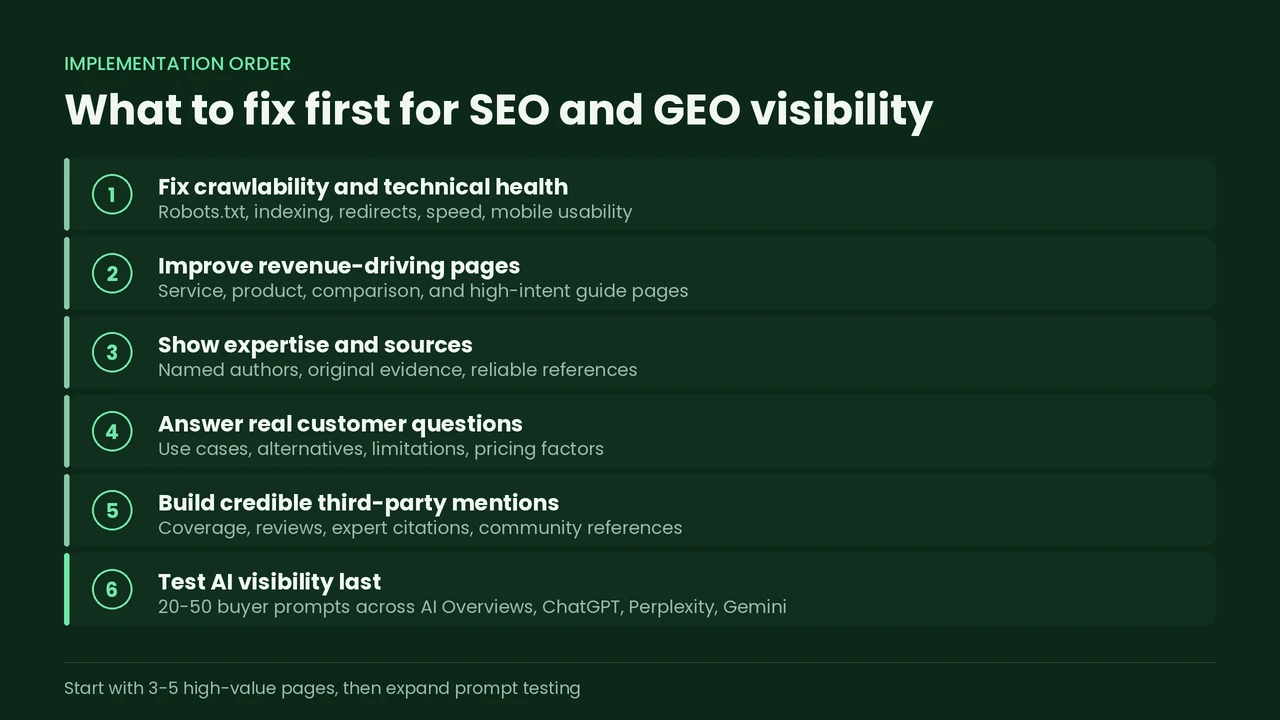
Use this order to avoid scattering your time and budget:
- 1. Fix crawlability and technical problems first: Check robots.txt, indexability, broken links, redirects, page speed, mobile usability, and server responses. Google AI Overviews and AI Mode use the same core eligibility requirements as regular Search, with no separate AI index or special markup.
- 2. Improve important pages: Start with pages that support revenue, including key service pages, product pages, comparison pages, and high-intent guides. Make each page answer its main question clearly.
- 3. Show expertise and sources: Add accurate author details, review information where appropriate, original evidence, and links to reliable references.
- 4. Answer real customer questions: Keywords still help, but they cannot replace clear answers to the concerns customers raise before buying.
- 5. Build credible third-party mentions: Earn coverage, reviews, expert citations, and relevant community references. Link building alone cannot compensate for weak content or poor technical health.
- 6. Test AI visibility last: Track a focused prompt list across Google AI Overviews, ChatGPT, Perplexity, Gemini, Claude, and Copilot. Check whether mentions are accurate, current, and supported by the right sources.
Smaller businesses can begin with three to five high-value pages and a focused list of buyer prompts. You don't need to optimize every URL or test every possible question at once. This approach also prevents a common measurement mistake: treating more mentions or visits as success when the answer misstates your pricing, services, location, or expertise.
GEO raises practical questions because AI visibility changes with the platform, prompt, source selection, and user intent. These answers clarify where GEO fits with SEO and what businesses can realistically expect.
Frequently Asked Questions
Is GEO the same as AEO?
GEO and AEO overlap, but marketers don't always use the terms in the same way. Answer Engine Optimization (AEO) often focuses on earning a direct answer, featured snippet, or selected response for a specific question. GEO usually covers a wider goal: visibility in generative search systems through citations, brand mentions, recommendations, and inclusion in synthesized answers. AEO can be part of a GEO strategy, especially when an AI tool extracts a direct answer from your page.
Can a website rank well in SEO but have low GEO visibility?
Yes. A page can rank for a narrow keyword while offering too little context for the broader prompts people ask AI tools. For example, it may target one product term but fail to explain use cases, alternatives, limitations, pricing factors, or related entities. AI systems also look for clear facts, recognizable entities, reliable sources, and content that addresses connected questions. Therefore, a strong traditional ranking doesn't automatically produce citations or recommendations in generative answers.
Can GEO guarantee that an AI tool will cite my business?
No provider can guarantee consistent citations or recommendations. AI answers depend on the platform, prompt wording, source selection, location, information freshness, and model updates. GEO can improve the likelihood that an AI system finds and understands your business. However, you can't control every generated answer, and eligibility still depends on standard Search requirements rather than a guaranteed AI placement.
How long does it take to see results from GEO?
Timing depends on your website's authority, content quality, crawlability, industry, and how often each platform refreshes its information. A site with strong technical health and trusted references may gain visibility sooner than a newer site with limited coverage. Set a baseline before making changes, then test the same prompts regularly across your target platforms. Look for improving mention frequency, citation quality, source consistency, and prompt coverage instead of expecting one sudden result.
Does GEO matter for local businesses and small companies?
Yes, especially when people ask AI tools to recommend nearby providers, compare services, or find products in a specific area. Accurate business details can help systems connect your company with the right location, service category, and customer need. Keep your name, address, phone number, hours, services, and other details consistent across your website and trusted directories. Genuine reviews, local expertise, and clear answers to common customer questions also support visibility.
Will appearing in an AI answer always bring website clicks?
No. An AI answer may satisfy a user's question without requiring a visit to your website, so visibility and traffic won't always rise together. A citation can still influence later research, branded searches, direct visits, or a purchase that analytics doesn't attribute to the original AI interaction. Track citations and brand mentions alongside referral traffic, branded searches, direct traffic, conversions, and assisted sales. Google explains that AI features are included in its broader Search reporting, so businesses should compare those signals instead of judging GEO only by traditional click-through rates.
Need a Technical SEO Audit or Strategy Call?
Connect directly on WhatsApp to review your site speed, topical architecture, and organic growth roadmap.