
We tested the 40 best AI SEO tools for enterprise teams in 2026. This list covers the best AI SEO tools for large organizations. Some SEO AI tools write content. Others crawl sites or track AI answers. Every AI SEO platform here is AI-powered SEO software that fits one clear job. These AI SEO tools for enterprise teams and other enterprise SEO tools sit with the top SEO tools in their class. Use the 40 best AI SEO tools for enterprise teams to build a short list fast.
Best AI SEO Tools for Enterprise Teams at a Glance (Quick Comparison Table)
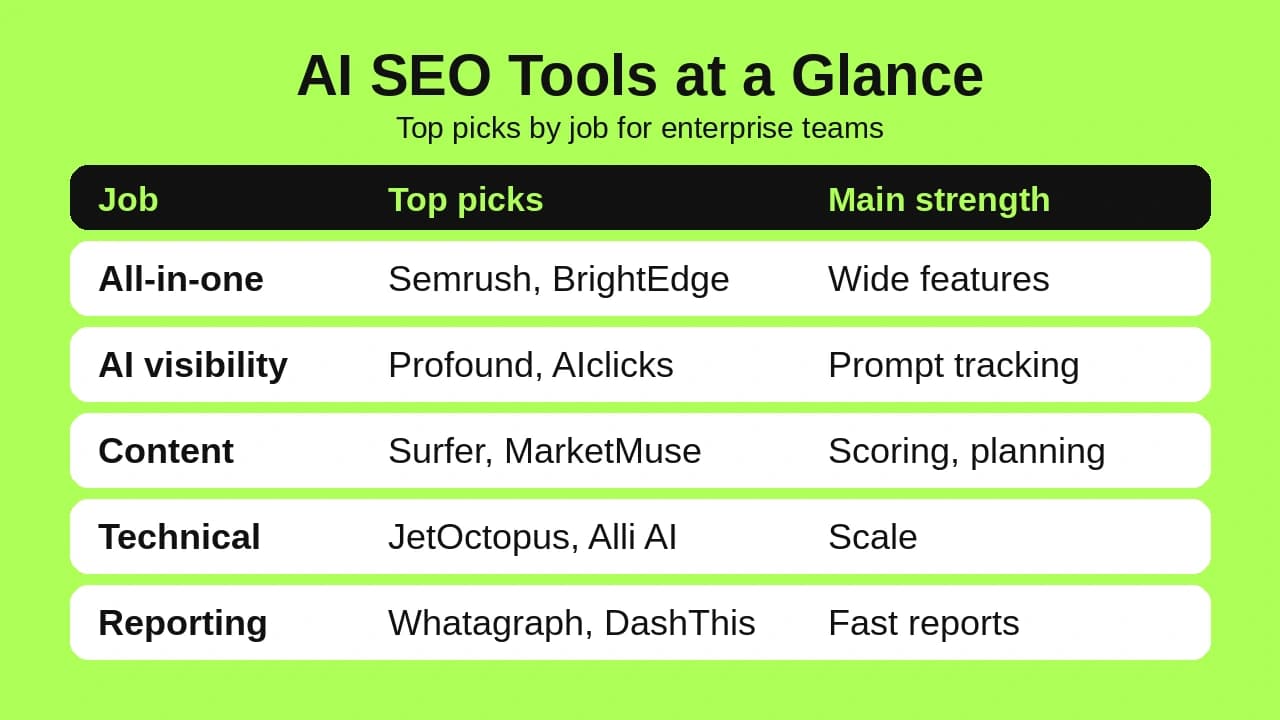
This comparison table groups the leading platforms by job. Use it as a quick tool comparison before you read the full feature comparison:
- All-in-One (Semrush, BrightEdge): Main strength: Wide features. Watch out for: Cost.
- AI Visibility (Profound, AIclicks): Main strength: Prompt tracking. Watch out for: New category.
- Content (Surfer, MarketMuse): Main strength: Scoring and planning. Watch out for: Needs editors.
- Technical (JetOctopus, Alli AI): Main strength: Scale. Watch out for: Setup time.
- Reporting (Whatagraph, DashThis): Main strength: Fast reports. Watch out for: Data limits.
These comparisons show strengths and pros and cons side by side. Check G2 reviews and ratings before you buy. Then look at alternatives in the same row. The right enterprise SEO solutions depend on your goals. Good SEO software also depends on your team.
What Are AI SEO Tools for Enterprise Teams?
Enterprise SEO software helps big teams run enterprise search engine optimization. An enterprise SEO platform uses machine learning to find fixes. Many enterprise SEO platforms now add generative AI and GenAI writing help. An AI-powered or AI-driven tool should be enterprise-grade. It should also be enterprise-ready for enterprise organizations and other large organizations. Purpose-built options beat generic apps. SEO automation software removes slow manual work.
AI SEO Tools vs. Traditional Enterprise SEO Platforms
Traditional SEO tools track traditional search results. Newer tools follow search engines and AI search engines too. Many vendors now sell a hybrid of both. Pick the one that matches how your buyers search engine optimization today.
Core Capabilities of Enterprise AI SEO Software
AI automation handles repeat tasks. Automated recommendations rank your next move. SEO copilots answer questions in plain words. Scalability matters most. Scalable SEO means the tool works at scale. SEO at scale needs an end-to-end flow. Large-scale SEO also needs predictive reports.
How We Evaluated the Best Enterprise AI SEO Tools
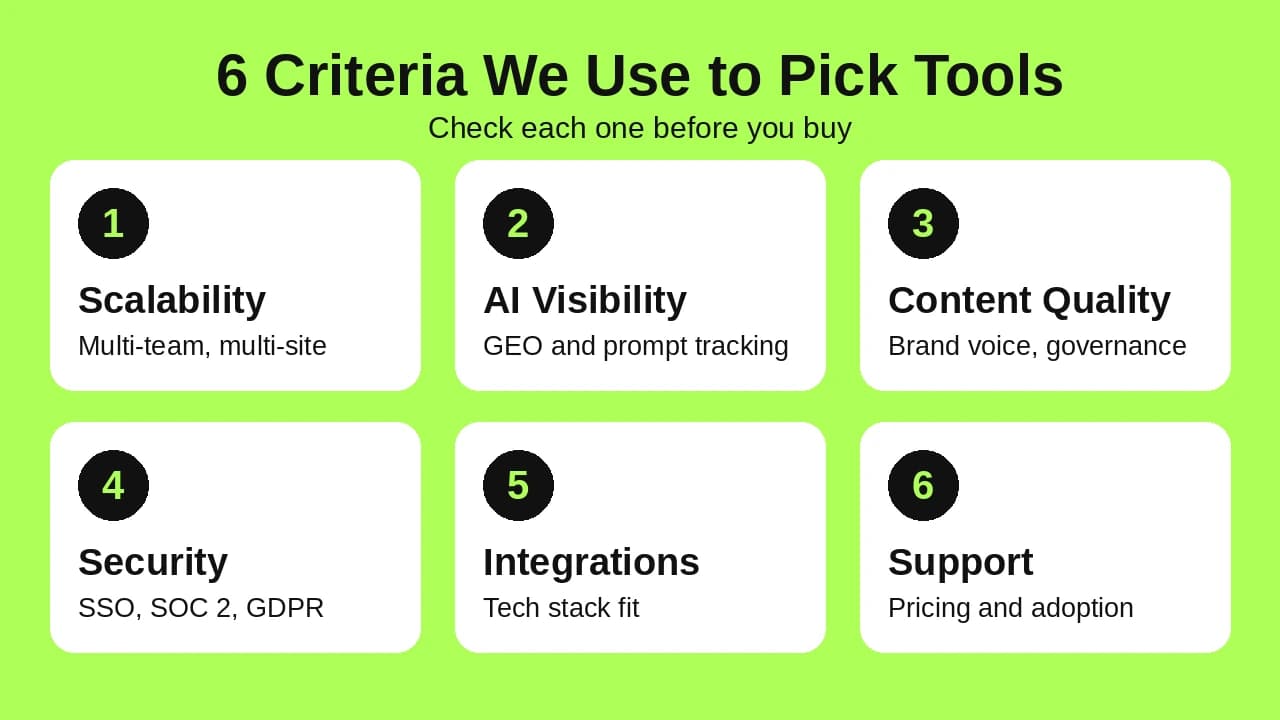
Our evaluation used six selection criteria. Buyers often read Gartner and Forrester analyst reports during vendor evaluation. Read them next to case studies and user reviews. The evaluation criteria below follow.
Scalability and Multi-Team, Multi-Site Support
Enterprise teams rarely run one site. Check multi-team and multi-site support first. Ask about multi-brand and multi-location setups. Strong multi-site management and multi-domain management keep every domain in one view. Large websites and large-scale websites need fast crawls. Shared workspaces give each team its own projects. Workspaces also help cross-functional collaboration.
AI Search Visibility and GEO Tracking
Good tools show AI search visibility in one view. AI visibility tracking logs where your brand appears. AI brand visibility and AI mentions show your share. AI Overviews tracking is a must. Reviewing official Google AI search documentation helps teams evaluate how AI answer engines crawl and summarize web sources. Prompt-level visibility shows which questions trigger you. It also lifts online visibility.
Content Quality, Brand Voice, and Governance
Content quality comes first. Look for a brand voice setting. It protects brand consistency across writers. Content governance and governance rules keep drafts safe. An editorial step adds a human check.
Security, Compliance, and Access Controls (SSO, SOC 2)
Security review comes early. Look for SSO, single sign-on, and SAML. Ask for SOC 2 and ISO 27001 reports. GDPR and GDPR compliance matter for EU data. Audit logs show who changed what.
Integrations and Tech Stack Fit
Integrations decide daily use. Map each integration to your tech stack. A clean stack needs tech stack integration, not extra copy-paste. Workflow integration saves hours. Look for connectors, Webhooks, Zapier, and MCP.
Pricing, Support, and Ease of Adoption
Support decides success. Ask for dedicated support and a dedicated account manager. Check the SLA and uptime. Ease of use and setup time shape adoption.
Best Enterprise SEO Platforms with AI Capabilities
These platforms back your SEO strategy. A solid enterprise SEO strategy needs an SEO roadmap. Many SEO strategies fail without SEO governance. Each tool below runs an SEO audit. Repeat SEO audits keep organic search growth steady on Google and Bing.
Semrush – Best All-in-One Platform with AI Features
Semrush covers the full workflow. The Semrush AI Toolkit adds AI help. It supports multi-brand SEO. Its site audit finds issues fast.
Ahrefs – Best for Keyword Research and Competitive Intelligence
Ahrefs shines in research. Ahrefs Brand Radar tracks AI mentions. It reports keyword difficulty and search volume. Use it for competitor analysis and competitive intelligence. Backlink analysis is a core strength.
BrightEdge – Best for SEO Automation and AI Recommendations
BrightEdge drives automated optimization. It uses SEO prioritization to rank tasks. Prioritized recommendations come with opportunity sizing.
Conductor – Best for Organic Marketing Intelligence
Conductor tracks organic visibility and organic performance. It supports competitor benchmarking and competitive benchmarking. Market share and market share analysis come with clear insights.
seoClarity – Best for Content Analytics and AI Search Optimization
seoClarity pairs AI search optimization with analytics. Use it for a content audit. Its SERP analysis shows what ranks.
SE Ranking – Best for Multi-Location SEO and AI Overview Tracking
SE Ranking suits multi-location SEO. It supports local SEO at scale. Local rank tracking and daily rank tracking cover each local market. It also tracks AI Overviews.
Best AI Visibility and GEO Tracking Tools
These tools follow your brand monitoring inside AI answers. AI brand monitoring shows brand sentiment and overall sentiment. It protects brand reputation and brand presence. Track ChatGPT search and Google AI Mode. Check brand mentions in AI answers every week. Peec AI, Otterly.AI, Scrunch AI, Athena, and Goodie AI also do this work.
Profound – Best for Tracking Brand Visibility in AI Search
Profound tracks Gemini, Perplexity, Claude, Copilot, and Microsoft Copilot. It also covers Grok and DeepSeek. Use it to count brand mentions.
AIclicks – Best for AI Prompt and Citation Tracking
AIclicks does prompt tracking. Review prompts and each prompt that names you. Citation tracking shows AI citations.
Rankscale – Best for Tracking AI Search Rankings
Rankscale logs rankings and each ranking move. Check rank changes with SERP tracking. Daily tracking builds historical data.
Yotpo Discover – Best for E-commerce AI Visibility
Yotpo Discover helps ecommerce SEO and e-commerce SEO. It serves ecommerce brands and retail teams. Commerce shoppers and loyalty data feed insights.
Best AI Content Optimization and Strategy Tools
Enterprise content needs content optimization and a content strategy. An enterprise content strategy uses content scoring. A content score or content grading shows quality. Content gap analysis finds content gaps. Content research feeds each plan. Run a content refresh when content decay hits. Use content pruning to cut weak pages. Content depth wins in long-form content, blog posts, and articles.
Surfer – Best for Content Optimization at Scale
Surfer, also called Surfer SEO, has a strong editor. It builds outlines for on-page SEO.
MarketMuse – Best for Topical Authority and Content Planning
MarketMuse measures topical authority and topical coverage. It builds topical maps and topic clusters, helping teams build topic authority in LLMs so language models reference brand expertise. Topic clustering supports content clusters and pillar pages. Content planning and topic research follow. It builds authority over time.
Clearscope – Best for Simplicity and Team Adoption
Clearscope keeps drafts simple. It scores semantic keyword use. Each keyword gets a clear target.
Frase – Best for AI Content Briefs and Research Automation
Frase builds content briefs. AI content briefs use question-based queries and People Also Ask data. The SERP guides each brief.
Rankability – Best for Optimizing Content for AI Search
Rankability targets AI answers. It handles conversational queries and natural language queries. Queries and voice search shape each draft.
Dashword – Best Lightweight Option for Enterprise Sub-Teams
Dashword is lightweight. It is an entry-level, affordable pick for small units.
Best AI Content Creation and Governance Tools
Content creation moves fast with content generation. AI content generation and AI-generated content need rules. AI-assisted content creation speeds content production. Pictory turns text into video.
Slate – Best for Enterprise Content Governance and Multi-Team Workflows
Slate supports collaboration and team collaboration. It fits an SEO workflow and content operations.
Jasper – Best for Brand-Aligned AI Content Generation
Jasper keeps copy on-brand. It holds tone and stays consistent. It ranks among AI writing assistants.
Writesonic – Best for AI Writing with Agency-Friendly Pricing
Writesonic offers Chatsonic and AI writing. This AI writer has agency-friendly plans. Agencies use it for article generation.
Scalenut – Best for End-to-End Content Workflows on a Budget
Scalenut covers the content workflow on a budget. It adds keyword clustering and keyword mapping.
NeuronWriter – Best for NLP-Based Content Optimization
NeuronWriter uses NLP and natural language processing. It supports semantic search, semantic relevance, and semantic SEO.
ChatGPT – Best for Flexible Research and Drafting Support
ChatGPT, from OpenAI, helps with research and first drafts.
Best AI Tools for Technical SEO and Workflow Automation
Technical SEO and each technical SEO audit surface technical issues and errors. The fixes follow. Some tools offer auto-fix. A disciplined programmatic content strategy needs this base. Crawlers like Screaming Frog, Sitebulb, Lumar, Botify, OnCrawl, ContentKing, DeepCrawl, and Ryte are well known. Datadog-style monitoring adds alerts.
Alli AI – Best for Automated On-Page Optimization at Scale
Alli AI runs bulk and bulk optimization jobs. It edits title tags, meta titles, and meta descriptions. It updates header tags, H2s, and alt text. Templates and template pages scale the work.
AirOps – Best for Content and SEO Workflow Automation
AirOps drives workflow automation. Its AI agents and each AI agent run set tasks.
JetOctopus – Best for Large-Site Crawling and Log Analysis
JetOctopus is a fast site crawler. Each crawl checks crawlability, crawl budget, and indexability. Screaming Frog log file analyser and Oncrawl log analyzer are alternatives for logs. It handles JavaScript rendering and JavaScript SEO.
Indexly – Best for Faster Indexing
Indexly speeds up indexing and indexation. It works with XML sitemaps and Bing Webmaster Tools. Check robots.txt, canonical tags, and redirects too. Mobile-first indexing still applies.
Link Whisper – Best for AI Internal Linking
Link Whisper handles internal linking. Internal links get AI internal linking suggestions. Good anchor text passes link equity. Linking stays tidy.
DataForSEO – Best for API-Driven SEO Data
DataForSEO offers an API and API access. Use the REST API for pulls. It feeds BigQuery and any data warehouse integration.
Best AI Tools for Link Building and Outreach
Link building and digital PR grow off-site SEO. Outreach needs steady work.
Pitchbox – Best for Outreach at Scale
Pitchbox runs outreach automation. It sends email outreach and follow-ups. It also supports prospecting.
Linkee – Best for Link Prospecting
Linkee finds link prospecting targets. It lists new link prospects fast.
Best AI Tools for SEO Reporting and Dashboards
Reporting proves value. Stakeholder reporting and executive reporting need clean views. Executive dashboards, custom dashboards, and plain dashboards help. Connect Looker Studio, Tableau, and Power BI.
Whatagraph – Best for Cross-Channel Reporting
Whatagraph builds custom reports. It offers automated reporting and data connectors.
DashThis – Best for Automated Client and Executive Reports
DashThis sends client reporting on a schedule. It supports white-label and white-label reporting.
AgencyAnalytics – Best for Multi-Client Reporting
AgencyAnalytics serves clients of any size. An SEO agency or SEO consultants use it daily.
Other Enterprise SEO Tools Worth Considering
These tools round out the list. Raven Tools, Searchmetrics, Rank Ranger, STAT Search Analytics, AccuRanker, Mangools, and Yext also deserve a look.
Similarweb
Similarweb shows traffic and competitors. It helps discoverability.
Moz Pro
Moz Pro, from Moz, handles keyword tracking. It also finds long-tail and long-tail keywords.
Serpstat
Serpstat has a SERP tracker. It lists opportunities.
SEO PowerSuite
SEO PowerSuite covers backlinks.
Seobility
Seobility checks site health. It flags broken links, Core Web Vitals, page speed, and site speed.
Silktide
Silktide tracks digital marketing metrics and performance.
Visualping
Visualping does change tracking with alerts. Real-time and real-time monitoring catch issues early. General monitoring flags anomalies. Anomaly detection and migration monitoring protect site migrations.
How to Choose the Right AI SEO Tool for Your Enterprise Team
Vendor selection takes steps. This buyer's guide, or buying guide, helps with choosing and selecting. Follow the steps below.
Map Your Content Operations Maturity and Team Structure
List who will use the tool. Include SEO managers, SEO directors, and heads of SEO. Add CMOs and content marketers. Include digital marketing teams and your in-house SEO team. In-house marketing teams and marketers need simple screens. Product teams, developers, IT teams, and IT need access rules.
Identify Your Primary Use Case
International SEO needs extra checks. Multilingual SEO and global SEO need localization and hreflang. Count your languages, regions, and countries. International and global teams need the same view.
Evaluate CMS and Analytics Integration Requirements (WordPress, HubSpot, Contentful, GSC, GA4)
Your CMS matters. Check WordPress, HubSpot, and Contentful. Add Salesforce and your CRM. Connect Google Analytics, GSC, and GA4.
Assess Governance, Security, and Compliance Needs
Compliance and data governance come first. Procurement will ask for proof.
Build an AI SEO Tool Evaluation Checklist
Write your requirements first. Use prioritization to rank them. Test issue prioritization. Score recommendations as actionable or not.
Single Platform vs. Multi-Tool Stack
Think build vs buy. An all-in-one tool is simple. A standalone tool goes deeper.
Match Tools to Team Size and Growth Stage (Enterprise, Mid-Market, B2B SaaS, E-commerce)
Startups and small businesses need light tools. The best AI SEO tools for small businesses are cheap. The best SEO tools for beginners are easy. Mid-market teams grow into enterprise-ready tools. B2B SEO and SaaS SEO need pipeline views.
Enterprise AI SEO Tool Pricing: What to Expect
Pricing varies widely. Enterprise pricing is often a quote.
Common Pricing Models (Per-Seat, Credits, Custom Enterprise Quotes)
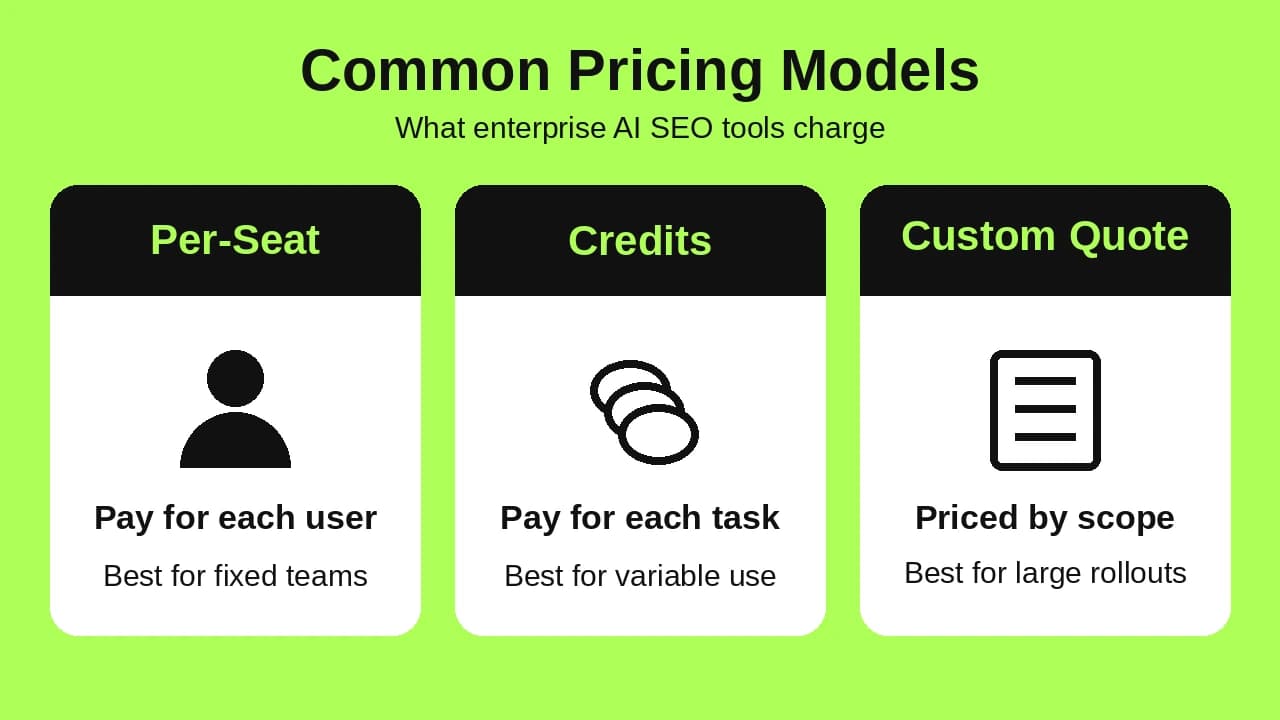
Common pricing models include per-seat, credits, and custom pricing. A subscription often has tiers and plans. More seats cost more. An add-on may be extra. Some offer unlimited use. Ask about annual billing. A starter plan or pro plan may exist.
Free Plans, Trials, and Demos
Try free options first. A free trial shows fit. Always request a demo.
Calculating Total Cost of Ownership
Total cost of ownership, or TCO, goes beyond licensing. Add training and setup hours.
How to Implement AI SEO Tools Across Enterprise Teams
Implementation needs SEO operations support.
Onboarding, Training, and Adoption
Start with onboarding and training. Adoption grows if the learning curve is short. Customer success helps.
Integrating AI Tools into Content Workflows
Fit content workflows into Slack, Jira, and Asana. Use Google Sheets and Google Docs. Superblocks can build small internal apps.
Setting Up Approval Workflows, Roles, and Permissions
Set approval workflows and permissions. Use role-based access and role-based access control. Define user roles and user roles and permissions. User management and an audit trail add safety.
Keeping Humans in the Loop: The Hybrid Strategist Approach
Keep human-in-the-loop checks. Mix human-written text with AI help. Strategists lead the plan.
How to Measure the ROI of Enterprise AI SEO Tools
ROI and ROI measurement start with a baseline. SEO ROI measurement needs the same.
Key KPIs and Metrics to Track
Track SEO KPIs and KPIs. Watch organic traffic, impressions, clicks, and CTR. Count conversions and organic conversions.
Connecting AI SEO to Revenue and Business Impact
Tie revenue and organic revenue to your work. Use revenue attribution and attribution modeling. Pipeline attribution shows business impact.
Running a Pilot and ROI Assessment
Run a 90-day pilot. Use forecasting and traffic forecasting. Predictive analytics supports the review.
AI Search Optimization for Enterprise Teams: GEO and AEO Essentials
AI search is growing. Generative engine optimization (GEO) and answer engine optimization (AEO) both matter.
The Shift from Traditional Search to Answer Engines
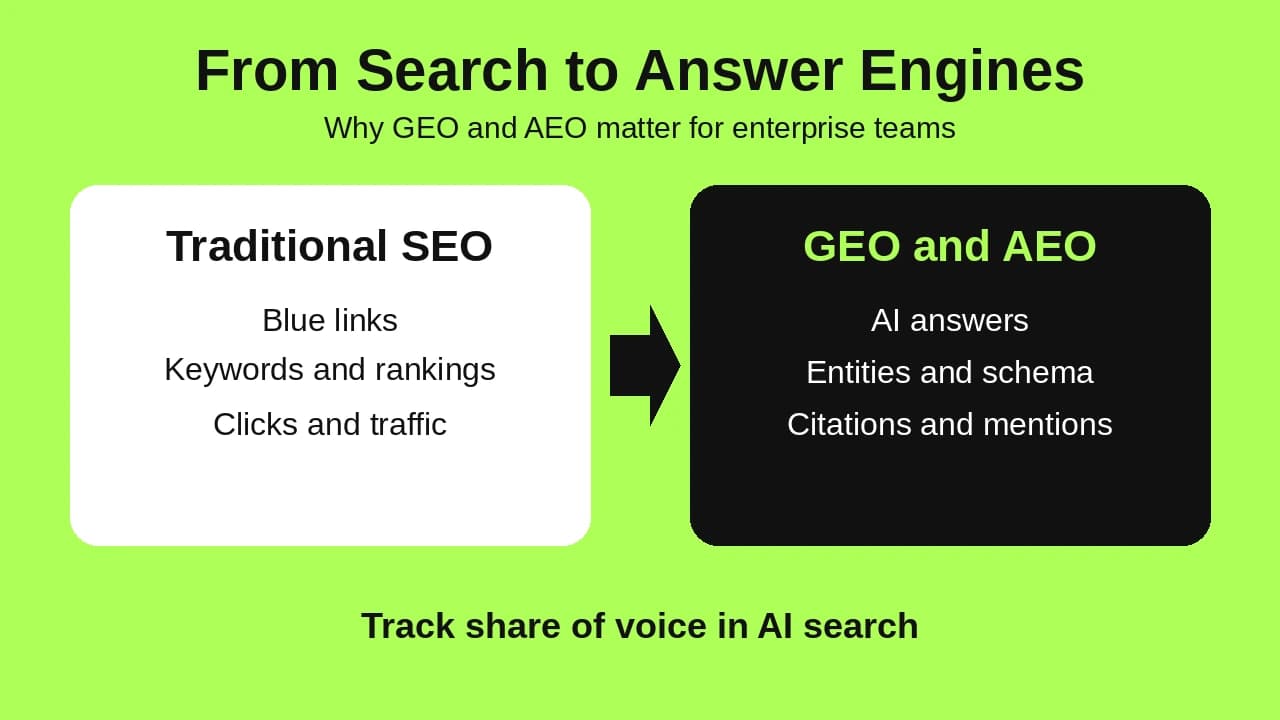
Answer engines drive zero-click and zero-click search. Featured snippets, a knowledge panel, and SERP features take clicks.
What Is Generative Engine Optimization (GEO)?
LLMs and each LLM, or large language models, build answers. Applying comprehensive generative engine optimization helps ensure search engines and conversational models retrieve accurate brand facts. Retrieval-augmented generation, RAG, and vector embeddings help. Query fan-out splits a question.
Answer Engine Optimization (AEO), Entities, and Structured Data
An entity helps entity SEO. Entity recognition, entity extraction, and entity optimization matter. Link to a knowledge graph. Structured data, schema, schema markup, and structured JSON-LD help. Automated schema generation gives machine-readable pages. Schema App and WordLift help.
Tracking AI Share of Voice and Citations
AI share of voice and share of voice show reach. Share of voice in AI search and share of search add context. LLM citation tracking lists cited sources. Third-party sources and listicles often win.
Topic-by-Topic Expertise and E-E-A-T in the AI Era
E-E-A-T means experience expertise authoritativeness trustworthiness. YMYL topics need extra care. Helpful content survives Google algorithm updates. Brand authority grows from depth.
Optimizing Product Pages and Customer Reviews for AI Agents
Product pages and your product catalog need SKU-level detail. Customer reviews and user-generated content build trust. Verifiable facts help buyers and customers. Amazon and marketplaces compete.
Risks and Limitations of AI SEO Tools
Limitations exist. AI-generated content risks, responsible AI, ethics, and transparency all matter.
AI-Generated Content Quality and Hallucinations
Hallucinations hurt accuracy. Add fact-checking.
Brand Voice Consistency and Human Oversight
Human oversight protects brand reputation.
Data Privacy and Security Concerns
Data privacy and privacy rules apply. Data security needs review.
The Future of Enterprise AI SEO: Agentic and Autonomous Workflows
Agentic and autonomous tools are rising. Agentic SEO and autonomous SEO agents lead the future of SEO. Trends and AI search trends shifted since 2025. Emerging trends point to 2027. Search everywhere optimization spans multi-platform search. Social search, TikTok search, and YouTube SEO grow. YouTube, Reddit, and LinkedIn extend digital presence and omnichannel visibility.
Which AI SEO Tool Is Right for Your Enterprise Team? (Final Recommendations by Use Case)
Pick top-rated, best-in-class tools by use case. Start with one all-in-one choice. Add a visibility tracker next. These 40 best AI SEO tools for enterprise teams give you a clear start.
Frequently Asked Questions
What is the best AI SEO tool for enterprise teams?
The best SEO tool depends on your goal. An SEO platform or SEO suite should match your needs.
What features should enterprise teams look for in an AI SEO tool?
Look for capabilities like crawling and reporting. Enterprise-grade features include SSO.
How much do enterprise AI SEO tools cost?
Price and cost vary by seats.
Are there free AI SEO tools for enterprise teams?
Best ai seo tools for enterprise teams free options are limited. Free AI tools for SEO optimization and SEO software tools free work for tests.
Can ChatGPT be used for SEO?
Yes. SearchGPT may help too.
Do AI SEO tools integrate with Google Search Console and Google Analytics 4?
Most connect to Google Search Console and Google Analytics 4.
How do AI SEO tools integrate with enterprise CMS platforms?
CMS integration may support headless CMS, Adobe Experience Manager, Sitecore, WordPress VIP, and Webflow. Adobe options exist.
How do AI SEO tools improve keyword research and search rankings?
AI keyword research and keyword research use intent. User intent, intent classification, and search intent guide topics.
Can AI SEO tools help optimize for AI Overviews and large language models?
Yes. LLM optimization, or LLMO, helps.
Do I need an LLMs.txt file?
LLMs.txt may guide crawlers and AI crawlers.
How do AI Overviews affect traditional organic traffic?
They change search engine results.
Are traditional rank-tracking tools still relevant?
Yes. Rank tracking stays useful.
Can AI SEO tools replace human writers and SEO strategists?
No. Writers still lead.
Need a Technical SEO Audit or Strategy Call?
Connect directly on WhatsApp to review your site speed, topical architecture, and organic growth roadmap.