
Programmatic content is reshaping how sites publish content at scale. This guide covers programmatic SEO and pSEO the right way, with honest tradeoffs instead of hype.
What Is Programmatic Content?
Programmatic content means building many pages from one template and a dataset, instead of writing each page by hand. It's also called pSEO or programmatic SEO. Programmatic content creation pulls structured data into a page shell, while programmatic content generation fills in the blanks. This is template-based content paired with dynamic content, built through dynamic content generation, database-driven content, and data-driven content.
Automation drives all of it. Content automation and automated page generation turn datasets into live pages through automated content creation, which enables scalable content production. The core building blocks stay simple: structured data, datasets, variables, placeholders, and merge fields. Clear definitions matter here, since these words get used loosely.
How Programmatic Content Actually Works
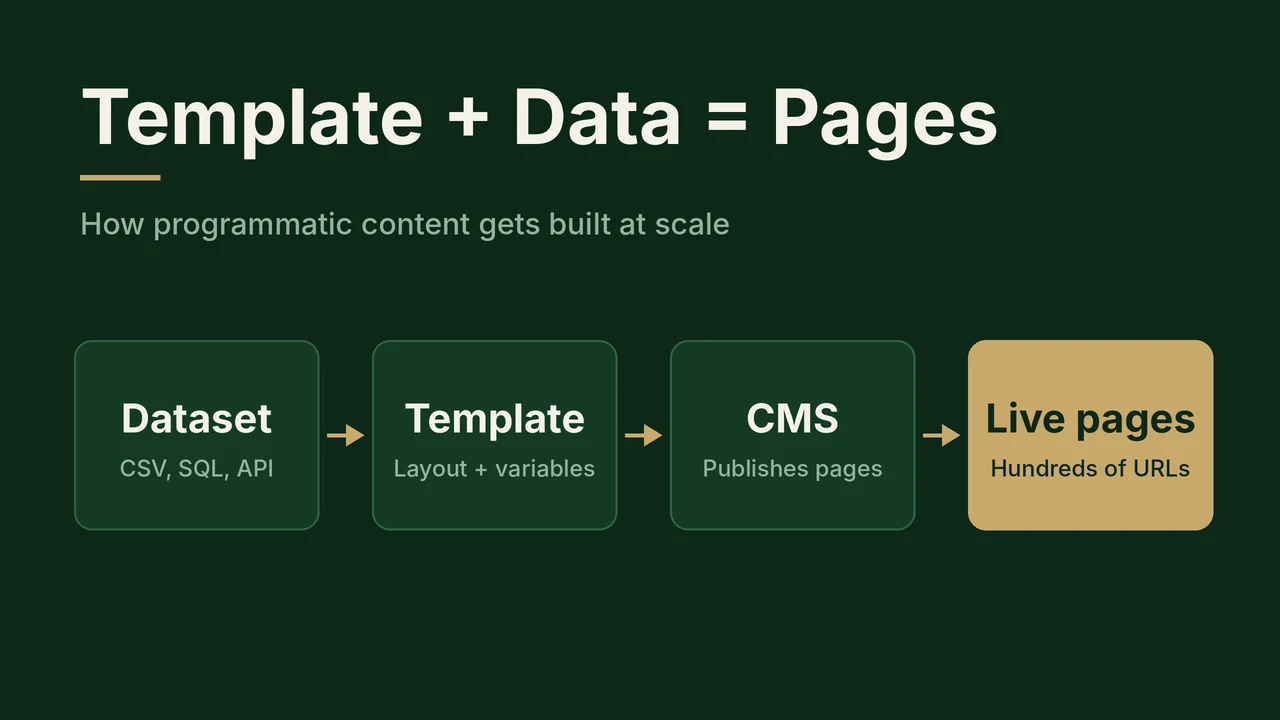
A template holds the layout. A variable pulls facts from a database or an API. A CMS publishes the finished page. A generator runs through combinations, generating pages that are auto-generated, assembled, and mass-produced in bulk. Once a schedule or trigger hits a set threshold, rendering turns data into output through one repeatable workflow, process, and pipeline.
Every template also needs on-page SEO and technical SEO built in:
- Title tags and meta descriptions pulled from variables
- H1 headings with one consistent heading structure
- Schema markup, structured data markup, and JSON-LD
- FAQ schema, breadcrumbs, and breadcrumb schema
The Three Ingredients of Programmatic Content
Every page needs three ingredients: structured data that holds facts, a variable that slots facts into sentences, and reliable data sources like a spreadsheet, CSV, JSON, a SQL database, or APIs.
The Template-Based Approach to Mass Content Production
Template-based content reuses page templates and content templates built once. Dynamic templates hold slots that get populated with row data, staying templated but repeatable. Good ones follow set patterns, consistent word counts, and one framework with clear heading structures.
The Three Things People Call Programmatic
Three different things share one word. Programmatic SEO pages and programmatic landing pages come from data and templates. AI-generated content comes from a model instead. Programmatic advertising is separate entirely: real-time ad buying, inventory, media reach, and ads across any channel.
Programmatic Content vs. Programmatic SEO
Programmatic content is the production method. Programmatic SEO is the goal, usually ranking programmatic SEO pages for traffic. The differences between programmatic and manual content come down to speed versus judgment. In programmatic vs traditional SEO, strategy still matters: real content strategy, keyword research, keyword clustering, and search intent. Skip that groundwork, and every challenge, risk, and pitfall follows close behind.
Programmatic Content vs. AI-Generated Content
AI-generated content comes from generative AI, built on LLMs and large language models like ChatGPT, Claude, and Gemini. It relies on prompt engineering and prompts, plus NLP, natural language processing, and NLG, natural language generation, to write sentences from scratch.
Programmatic content can use AI writing tools inside its AI content workflows, but the structure comes from data, not a guess. AI-assisted content still needs human-in-the-loop checks. Human review and editorial oversight catch what AI-assisted drafting misses, since language models can't replace real judgment.
Programmatic Content vs. Strategic Content
Programmatic content scales what already works. Strategic content decides what's worth saying in the first place. Real content strategy starts with topic fit and human judgment, not a spreadsheet. Human input brings content differentiation, unique value, and expert semantic content writing a template can't fake. Originality needs genuine insight and a real perspective, which makes a page differentiated, not just unique in word count.
Programmatic Content vs. Strategic Content: A Side-by-Side Comparison
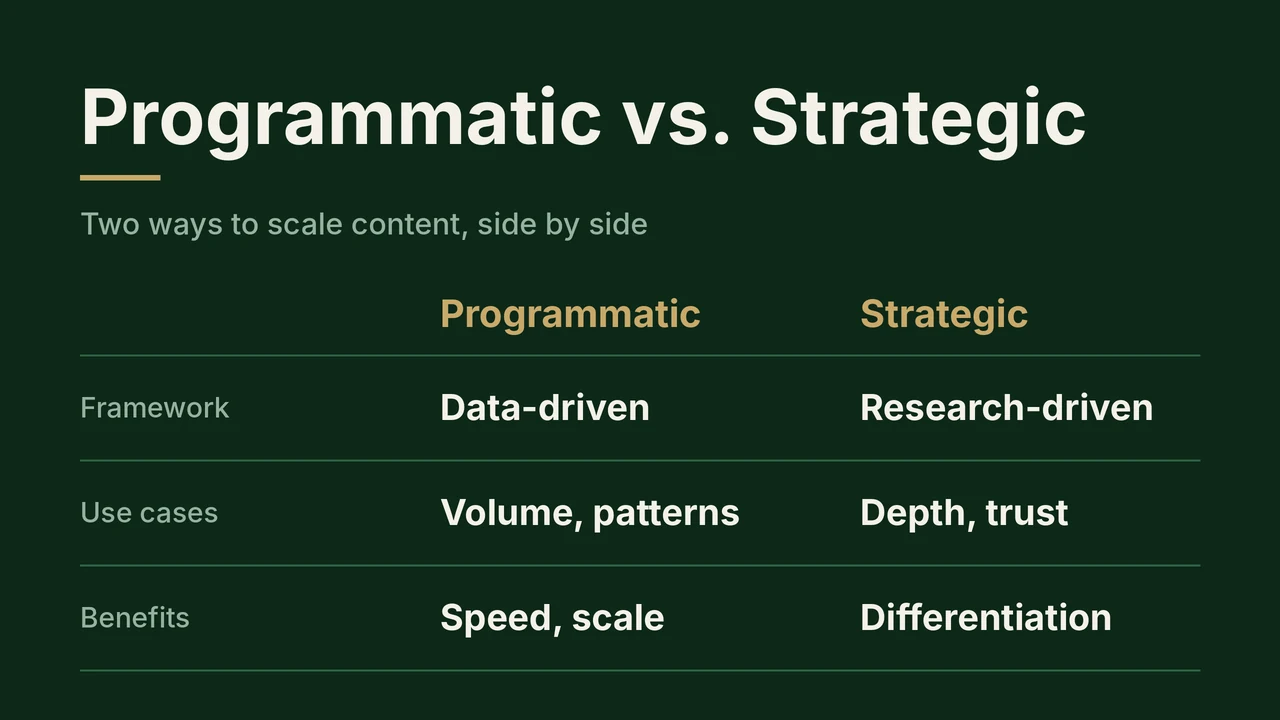
- Framework: Programmatic is data-driven; Strategic is research-driven.
- Use Cases: Programmatic targets volume and repeating patterns; Strategic targets depth, authority, and trust.
- Benefits: Programmatic delivers speed and scale; Strategic delivers differentiation and brand moats.
Run this checklist against your own examples before you choose a path.
Where Programmatic Content Works
Programmatic content fits patterns that repeat across hundreds of rows:
- Location pages, city pages, "[service] in [city]" pages
- Local landing pages, geo-targeted pages, near me pages
- Comparison pages, "X vs Y" pages, alternatives pages
- Best-of lists, listicles, directory pages, listing pages
- Category pages, collection pages, product pages, programmatic product pages
- Integration pages, use case pages, glossary pages, definition pages
- How-to pages, statistics pages, calculator pages, tools pages
- Template pages, review pages, profile pages, aggregator pages, marketplace pages
What Types of Websites Commonly Use Programmatic Content?
Case studies make this easy to picture. Tripadvisor, Zillow, Yelp, Airbnb, Nomad List, Wise, Canva, G2, Capterra, Booking.com, Expedia, Indeed, and Glassdoor all run this way. Zapier built its integration pages the same way. These are aggregators, portals, and directory sites by design.
Use Cases Beyond Landing Pages
Landing pages are just the start. Teams build a pricing matrix by feature, product, software category, or vertical like cybersecurity or analytics, comparing platforms and vendors by job-title. Other uses include calculators, newsletters, sales one-pagers, CRM views, community boards, and answers pulled from an objection library, plus integration, location-based, category-based, comparison-pairs, geographic, city, local, industry, listing, and portal pages.
Does Your Topic Actually Suit Programmatic Content?
Check topic fit first. Pull keywords and modifiers, then check search demand and search volume across keyword permutations, combinations, and variations. Not every modifier combination earns a page. Look for long-tail keywords branching off seed keywords and head terms, following clear keyword patterns and modifiers, matched to real user intent.
Is Programmatic Content Penalized by Google?
Programmatic content itself isn't penalized. Google spam policies don't ban templates or data. What gets penalized is low-value output that breaks Google Search Essentials. The helpful content system rewards people-first content, backed by SpamBrain, manual actions, penalties, and algorithm updates like core updates and the latest spam update.
Where Google Draws the Line on Scale
Scale isn't the problem. Scalability built on real principles and guidelines is fine. The line gets crossed when pages exist for manipulating rankings. Doorway pages get caught in filters, get flagged, and face a direct crackdown.
What the March 2026 Spam Update Targets
The March 2026 spam update targets scaled content abuse directly, enforcing Google spam policies on scaled content abuse. Scaled content built without editorial value, doorway pages, spam, and spammy pages fall under SpamBrain's watch, with notifications sent as part of wider algorithm updates.
Why Scaled Content Is Now a Ranking Liability
Scaled content built on shortcuts becomes a liability fast. Thin content and duplicate content send a negative signal, leaving sites vulnerable instead of resilient. Low-quality pages can drag an entire site down.
How Can You Tell if Your Site Has Been Penalized for Scaled Content Abuse?
Check Google Search Console first. A manual action for scaled content abuse means your site got penalized. Watch for notifications, sharp drops in rankings, steady decline in traffic, pages that disappear, and falling visibility and indexation.
How to Build a Programmatic Content Strategy
A solid programmatic content strategy follows best practices, not shortcuts. Here's a practical guide, a real framework, and the implementation steps that actually work.
Start Small Before Scaling
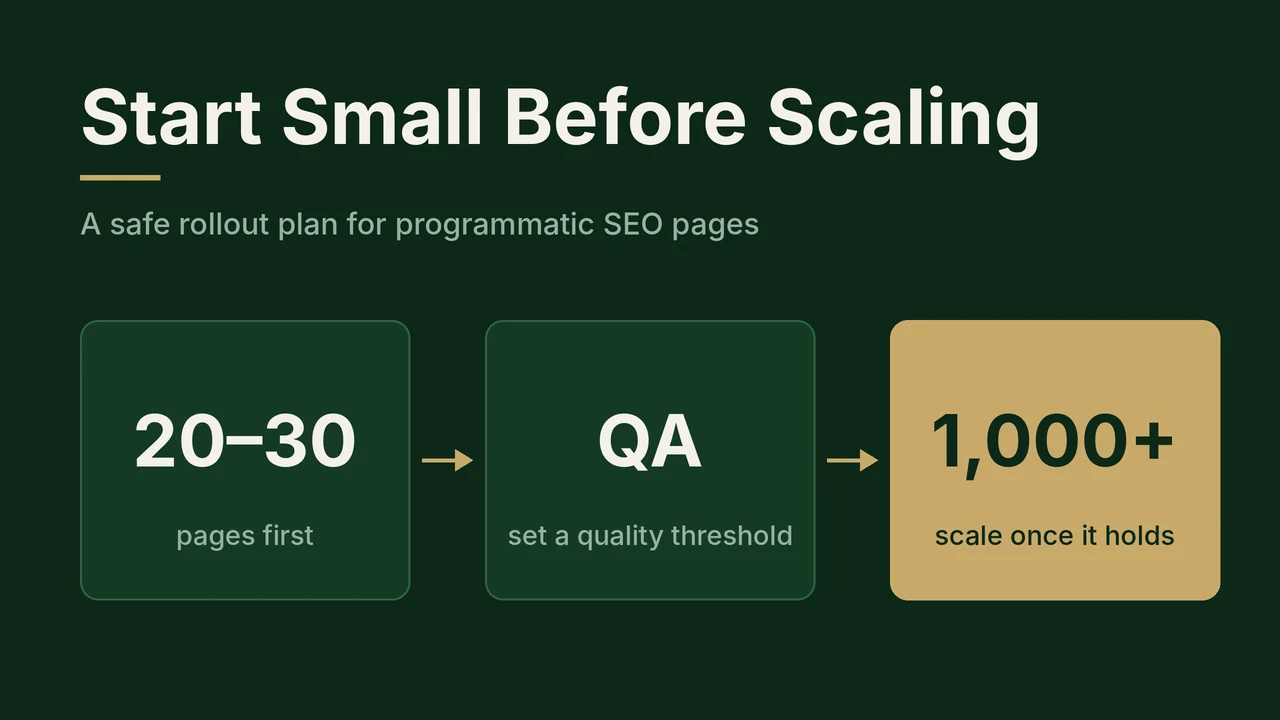
Don't publish a thousand pages on day one. Start with 20 to 30, set a quality threshold, then build a schedule and trigger for scaling once efficiency and speed hold up.
Build the Data Layer
Your data layer is the foundation. Use data sources you trust, ideally proprietary data or first-party data over public or scraped data. Run data enrichment and data modeling on datasets before they hit a catalog. Mix in third-party sources only if licensed and verified. Support tickets and transcripts often hold the best raw material.
What Tools Do You Need for a Programmatic Content Strategy?
Tools depend on your setup. For publishing: a CMS or headless CMS like WordPress, Webflow, or Next.js. For logic: Python and JavaScript, connected through Make, Zapier, or n8n. For auditing: Screaming Frog, Ahrefs, and Semrush. For data: Google Sheets, Airtable, CSV, JSON, a SQL database, and APIs or a single API. Collaborating with a specialized SEO web developer ensures your templates maintain optimal Core Web Vitals, clean architecture, and ultra-fast static site generation.
Write a Template That Survives 500 Rows
A good template survives 500 rows without breaking. Test odd rows early, not just clean ones. Swaps, placeholders, merge fields, and variables need to handle missing data, built for real scalability and maintainability.
Build the Skeleton From the Reader's Question
Build the skeleton from the reader's actual question. Match queries to intent: informational intent needs an answer, commercial intent needs a comparison, transactional intent needs a next step, and navigational intent needs the right page fast.
Make Sections Conditional, Not Universal
Not every row needs every section. Use conditional logic so dynamic content only shows when it's relevant. Dynamic pages built this way feel tailored instead of forced, adding real variation.
Vary Sentence Structure at the Row Level
Fixed sentence structure gets spotted fast. Rotate phrasing across the body copy so pages avoid feeling predictable. Swapping synonyms is cosmetic; real sameness lives in the sentence pattern. Repetitive, generic, uniform pages end up near-identical even with different facts.
Leave Room for the Handwritten Part
Every template needs one handwritten section. A hand-crafted verdict or short piece of prose, built from human input, adds what data can't. Human review and editorial oversight keep it sharp, giving pages personality, a brand voice, consistency, specificity, and relevance.
The Quality Gate for Programmatic Content
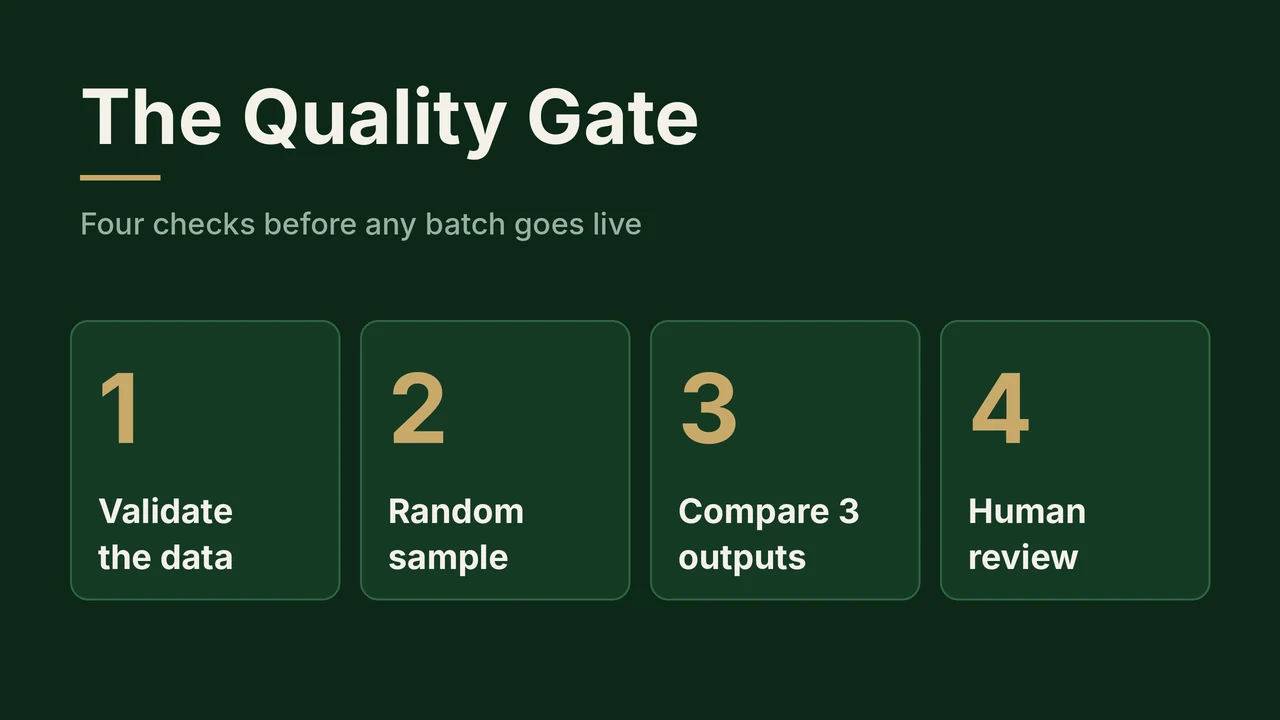
Programmatic content needs a quality gate before anything goes live. Quality control and quality assurance aren't optional. Run content QA, fact-checking, and a full content audit on every batch.
Check the Data Before It Renders
Bad data makes bad pages. Run validation for completeness, freshness, and plausibility before anything hits render. Catching errors before rendering saves you from fixing five hundred pages later.
Read a Random Sample, Not the First Ten
Don't just check the first ten pages. Pull a random sample instead. A true review needs reviewers checking pages from the middle and end of the batch too.
Read Three Outputs Side by Side
Open three outputs side-by-side. Any defect shows up fast, and a quick sanity check reveals pages that look identical instead of distinct. If they pass, mark the batch review-ready.
Ask What a Reader Gets That a Search Result Does Not
Ask one question per page: what does the reader get here that a search result doesn't already show? Real value and user value come from genuine usefulness that's helpful, backed by first-hand insight and real originality, not a repackaged perspective.
Why the Quality Gate Still Has to Be a Person
Software alone misses too much. Human-in-the-loop judgment brings governance and clear ownership. E-E-A-T stands for experience, expertise, authoritativeness, and trustworthiness, and none build credibility alone. Trust signals need an experience-backed person checking the work.
How to Avoid Duplicate Content Issues in Programmatic SEO
Duplicate content is the biggest risk in programmatic SEO. Near-duplicate content and thin content happen when boilerplate content fills most of the page. Fix it with canonical tags, canonicalization, a clean URL structure, and readable URL slugs.
Watch index bloat closely. Not every page deserves indexability. Noindex low-value pages, manage pagination and faceted navigation, and protect your crawl budget and crawl depth. Crawlability matters because Googlebot needs a clear path, so keep XML sitemaps current, use sitemap segmentation for large batches, and set robots.txt rules correctly.
Internal linking ties it together. A strong internal link architecture, built on contextual links, anchor text, and related links, supports both site architecture and site structure.
Does Programmatic Content Sacrifice Quality for Speed?
Speed and efficiency don't have to cost you content quality. The real risk is content depth and content usefulness getting skipped. User value and user experience, or UX, depend on readability and clean page layout, especially above the fold. A volume-first, keyword-targeted approach brings short-term gains in output, but it rarely helps you outrank sites built on depth, and that's the real tradeoff.
What Programmatic Content Cannot Do
Programmatic content isn't built for link building. It rarely produces linkable assets, so backlinks stay thin. It won't build brand authority or brand visibility on its own either. What it does offer is market coverage and niche coverage across long-tail terms, creating compounding traffic over time, but real competitive advantage still needs trust behind it.
Five Reasons Programmatic Content Fails to Convert
Traffic doesn't always mean conversion. Five common reasons programmatic pages fail:
- High bounce rate and low dwell time signal weak user engagement.
- Low CTR means the page never earns the click.
- Visitors never become qualified leads because the funnel is missing.
- The buyer journey gets ignored, so objections, decision criteria, and pain points go unanswered, and that failure shows.
- Messaging stays generic, filled with filler and surface-level claims.
Fix these, and conversions follow.
How to Audit and Replace Programmatic Pages
Old programmatic pages need regular care. Run an audit, then cleanup through pruning and content pruning for pages beyond saving. Some need rebuilding, others just a replace, consolidate, or rewrite, as repair and restoration work meant to stabilize rankings. Content decay is real: pages that decays or go stale need maintenance. A content refresh keeps content freshness alive, since every page has a lifespan, and neglect compounds as quality degrades.
What Does Programmatic Content Cost to Run?
Programmatic content promises cost reduction, but it isn't free. Real cost-effectiveness depends on ROI and resource optimization across your budget and headcount, plus assets, a content calendar, and content briefs. Content operations, or ContentOps, ties content workflow and content pipeline together through content production. Expect spend on tooling and scripts. Standardization and consistency cut long-term cost, but maintainability and updating content at scale still need real content governance.
ICP-Aligned Content vs. Programmatic Content Marketing
Programmatic content marketing often skips the one thing that matters most: your ICP. Building around an ideal customer profile and a real persona means every page speaks to one actual buyer. This matters more in B2B and SaaS, where one segment or audience needs sharp targeting, positioning, and messaging that fits your brand voice. Pages built this way drive better outcomes, revenue, and qualified leads.
Building Content Around Your Buyer, Not Around Templates
Start with the buyer, not the templates. Run real interviews, collect customer stories and customer wins, backed by research and benchmarks. Map pain points, objections, decision criteria, and tradeoffs into an objection library. Turn that into case studies, articles, and blog posts your buyer actually searches for.
How Long Does It Take to Recover After Removing Low-Quality Programmatic Pages?
Removing low-quality programmatic pages isn't instant. Recovery timelines usually run 4 to 12 weeks, though most sites are recoverable once the decline stops. Expect drops before pages disappear, followed by a slow climb in visibility and rankings. Watch organic traffic, backlinks, and performance closely. Monitoring engagement, indexing, and indexation confirms what's indexable again, while solid internal linking helps search engines process new publishing faster.
Frequently Asked Questions
Is programmatic content penalized by Google?
Programmatic content itself is not penalized. Google penalizes low-value output that violates scaled content abuse policies. When pages provide accurate proprietary data, solve real search intent, and maintain technical quality, they rank sustainably.
Can Next.js handle programmatic SEO at scale?
Yes. Next.js App Router using Static Site Generation (SSG) with generateStaticParams is ideal for programmatic SEO because it pre-renders thousands of database-driven pages into ultra-fast, pre-compiled static HTML.
What is the biggest difference between pSEO and AI-generated content?
Programmatic SEO creates pages by feeding verified database facts into a structured template. AI content uses language models to generate prose from scratch. Combining verified database facts with editorial human oversight produces the most reliable results.
How long does it take to recover after removing low-quality programmatic pages?
Recovering from scaled content penalties typically takes 4 to 12 weeks after removing thin pages, adding canonical tags, consolidating content, and allowing Googlebot to recrawl the cleaned index.
Key Takeaways: What to Do Instead of Publishing at Scale
Before publishing another batch of programmatic pages, step back. Scaled content only works at scale with real best practices. Use this as your final checklist and framework for a lasting strategy.
Build topical authority through a real topical map, covering topical coverage and topical depth instead of raw volume. A content hub built on hub pages, pillar pages, cluster pages, and spoke pages, following the hub and spoke model, creates topic clusters that stay interconnected and high-quality.
Semantic SEO, semantic relevance, and semantic search matter more each year. Entity SEO means mapping entities, attributes, and related entities the way a knowledge graph like the Google Knowledge Graph already does.
Marketers should also plan for GEO, generative engine optimization, and AEO, answer engine optimization, since zero-click search and AI Overviews now answer queries directly. Make content AI-citable so assistants cite it, complete with citations, definitions, and figures that get quoted as a reference.
SERP features, featured snippets, and rich results still drive organic growth, organic visibility, search visibility, impressions, and clicks. For marketers, that's the real goal of content marketing: depth over volume, built on programmatic content done right.
Frequently Asked Questions
Is programmatic content penalized by Google?
Programmatic content itself is not penalized. Google penalizes low-value output that violates scaled content abuse policies. When pages provide accurate proprietary data, solve real search intent, and maintain technical quality, they rank sustainably.
Can Next.js handle programmatic SEO at scale?
Yes. Next.js App Router using Static Site Generation (SSG) with generateStaticParams is ideal for programmatic SEO because it pre-renders thousands of database-driven pages into ultra-fast, pre-compiled static HTML.
What is the biggest difference between pSEO and AI-generated content?
Programmatic SEO creates pages by feeding verified database facts into a structured template. AI content uses language models to generate prose from scratch. Combining verified database facts with editorial human oversight produces the most reliable results.
How long does it take to recover after removing low-quality programmatic pages?
Recovering from scaled content penalties typically takes 4 to 12 weeks after removing thin pages, adding canonical tags, consolidating content, and allowing Googlebot to recrawl the cleaned index.
Need a Technical SEO Audit or Strategy Call?
Connect directly on WhatsApp to review your site speed, topical architecture, and organic growth roadmap.