
Direct vs indirect competitors shape every business plan. A direct competitor sells what you sell. An indirect competitor solves the same problem a different way. Readers with informational intent get clear definitions here. Readers with commercial investigation intent get steps to compare rivals. This guide matches that search intent. It also supports topical authority and brand authority with competitive research on every type of competition, principles detailed in our guide on how to build topic authority.
What Are Direct and Indirect Competitors?
Direct competition and indirect competition describe two ways a business fights for a customer. This concept helps you sort business competitors. Rivals in one industry compete head-on, while others compete from the side. Companies in any marketplace face both.
What Is a Direct Competitor?
A direct competitor sells the same product or a similar service to the same target audience. The direct competition definition rests on matches. Both firms work in the same industry, the same niche, and the same market. They share the same customer base and the same customer segment. The result is a shared audience.
What Is an Indirect Competitor?
An indirect competitor offers a different product for the same need. The indirect competition definition rests on one idea. Customers have the same problem and pick a different solution. Alternative products and alternative services solve customer problems. They pull sales away without matching your features.
Why Understanding Competition Matters for Business
Businesses that study market dynamics lower risk. This work supports strategic planning and risk assessment. Your business plan needs a market analysis section. Analyzing the Porter's Five Forces framework adds structure through five forces, including competitive rivalry. Success and long-term growth follow, along with market expansion.
Direct vs Indirect Competitors: Key Differences
Direct vs indirect competitors differ in six areas. Each comparison uses a head-to-head lens. Market forces like the bargaining power of buyers and the bargaining power of suppliers shape each one.
Product and Service Similarity
Direct rivals match on product features and offerings. Indirect rivals differ in form but share benefits. This is product form competition, a kind of generic competition.
Target Audience and Customer Needs
Direct rivals chase the same target market. Indirect rivals meet the same customer needs through other segments. Audience overlap is high for the first group and partial for the second. Consumer preferences and customer pain points drive the buying decision. Customer choice then shapes the consideration set.
Pricing and Price Determination
Direct rivals match price point against price point. A pricing strategy must weigh price sensitivity. Indirect rivals fight for the same budget. This budget competition decides share of wallet. Cost leadership protects profit margin when discounting starts.
Market Conditions and Market Share
Market leaders and established players hold most market share. Challengers and followers push for more. Niche players guard small corners. Market saturation limits everyone. Share of voice and share of mind matter too.
Relationship With Customers
Direct rivals fight over brand loyalty. Indirect rivals win through brand switching when switching costs stay low. Strong customer experience improves customer retention. Customer lifetime value grows with customer engagement.
Effects on Your Business
Direct rivals hit sales fast and lower your conversion rate. Indirect rivals build competitive pressure slowly. New entrants can turn them into a competitive threat. Barriers to entry limit that risk.
Direct vs Indirect Competitors Comparison Table
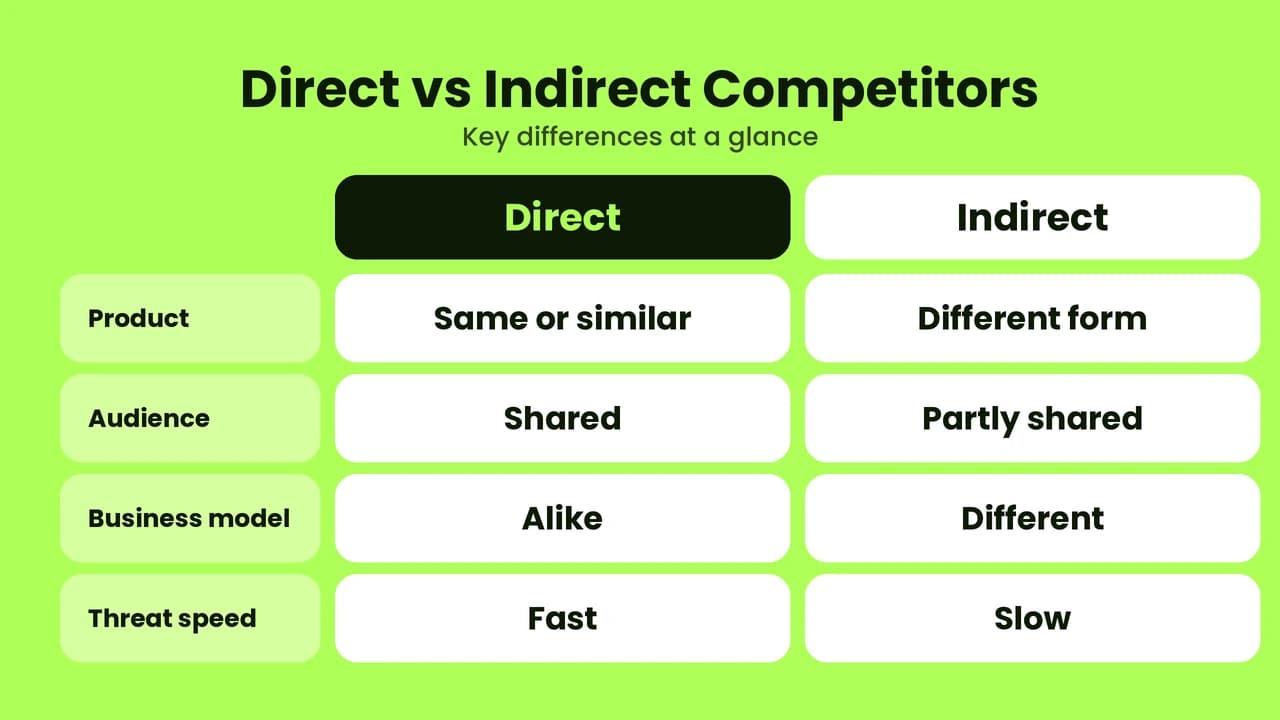
Use this comparison table as a quick competitor matrix:
- Product: Direct: Same or similar | Indirect: Different form
- Customer Need: Direct: Same | Indirect: Same
- Audience: Direct: Shared | Indirect: Partly shared
- Business Model: Direct: Alike | Indirect: Different
- Threat Speed: Direct: Fast | Indirect: Slow
Types of Competitors
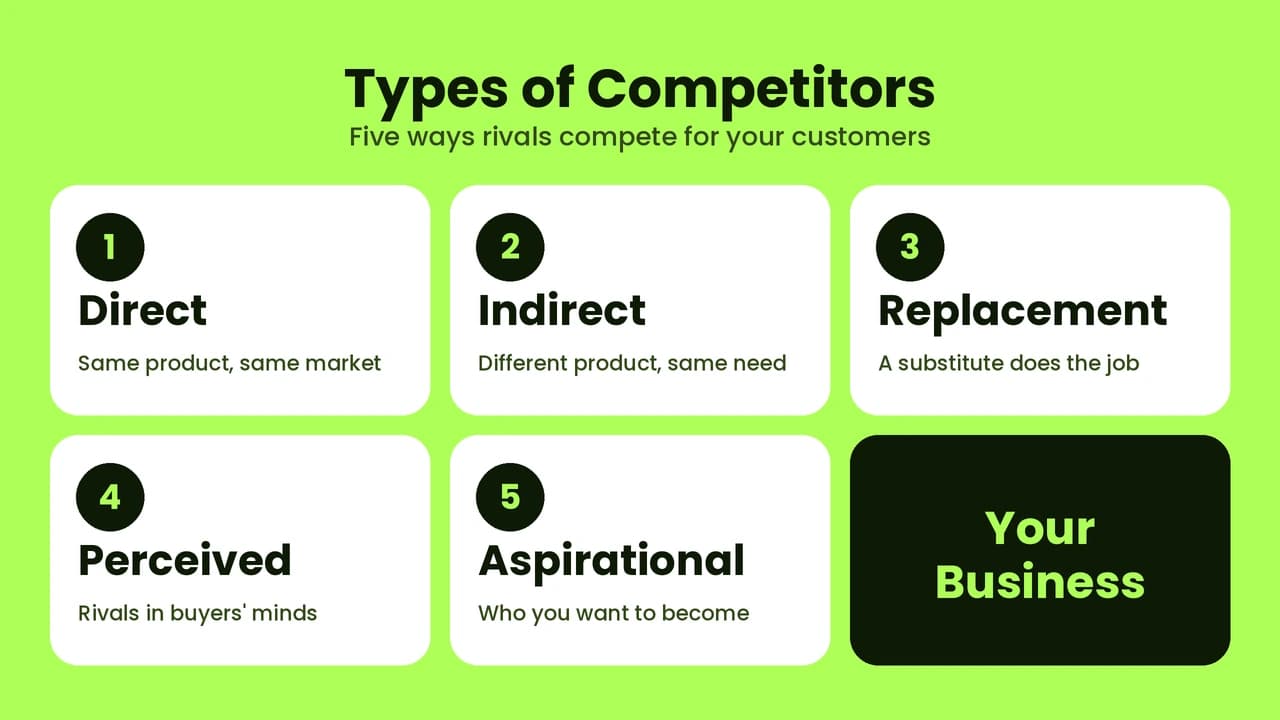
Competitor classification sorts rivals into types. Each type needs its own plan.
Direct Competitors
Direct competitors, also called primary competitors, fight in your category. Local competitors win nearby buyers. Online competitors win buyers anywhere.
Indirect Competitors
Indirect competitors, or secondary competitors, sit in adjacent markets. Cross-industry competition is common. A café can lose lunch sales to a grocery shop.
Replacement (Substitute) Competitors
Replacement competitors swap your product out. Substitute products and substitute services meet the same goal. The threat of substitutes grows as prices rise.
Perceived Competitors
Perceived competitors live in the customer’s mind. Brand perception drives this view, and marketing myopia hides it.
Aspirational Competitors
Aspirational competitors show who you want to become. They often sit upmarket, in enterprise, or in mid-market tiers. Studying them sharpens brand strategy.
Types of Competitors Compared
Competitor categories fall into five groups:
- True competitors fight you today.
- Potential competitors could enter soon.
- Future competitors arrive later.
- Emerging competitors start small.
- Disruptors bring disruptive ideas.
Direct Competitor Examples
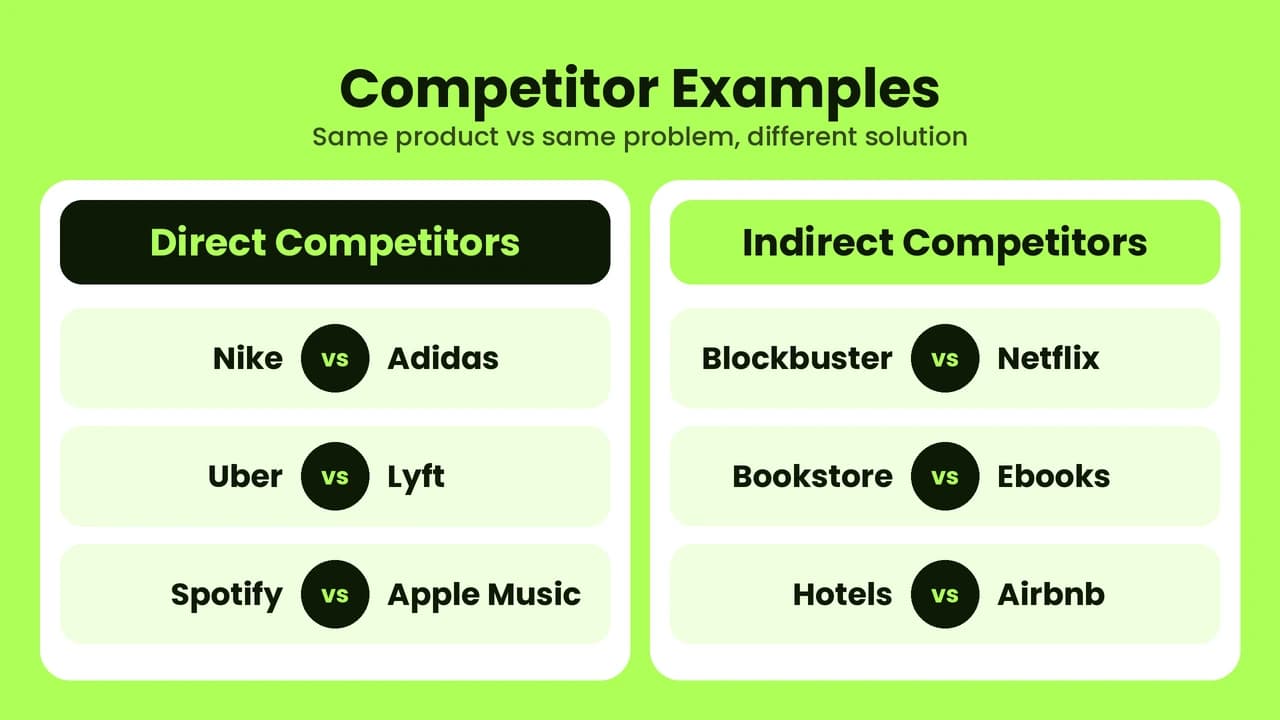
These examples show direct competition:
- Nike vs Adidas. Both sell sports gear.
- McDonald’s vs Burger King. These fast food chains sell burger meals. Taco Bell and fried chicken restaurants join the fight.
- Starbucks vs Dunkin. Starbucks and Dunkin’ Donuts both sell coffee.
- Uber vs Lyft. Both sell rides.
- Amazon vs Walmart. Both sell goods.
- Spotify vs Apple Music. Both stream music.
- Zoom vs Microsoft Teams. Both host video calls.
Netflix vs Amazon Prime Video
Netflix and Amazon Prime Video both stream TV and movies online. Netflix vs Hulu and HBO add choices. Digital media pulled viewers from cable.
Coca-Cola vs Pepsi
Coca-Cola vs Pepsi shows brand differentiation. Both run large advertising campaigns. Promotion and distribution channels matter as much. Retail stores become the battleground.
Asana vs Monday.com
Asana and Monday.com are B2B SaaS platforms in the cloud. Both serve teams.
Intercom vs Drift
Intercom and Drift both sell customer chat tools.
BlackBerry vs iPhone
BlackBerry lost ground when the iPhone arrived. Apple’s iOS then met Samsung’s Android. Apple vs Samsung now shapes the phone market. Innovation decides who stays ahead, so firms must innovate.
Wayfair vs IKEA
Wayfair sells furniture through ecommerce. IKEA built its name in brick-and-mortar stores.
Casetify vs Caseable
Casetify and Caseable both sell custom phone cases. This competitor analysis example shows one niche with two brands. Each runs an online shop.
Indirect Competitor Examples
These examples show indirect competition:
- Pizza restaurant vs burger restaurant. Both feed the dinner crowd.
- Pizza vs frozen meals. A pasta night at home replaces delivery.
- Local bakery vs supermarket bakery. Both sell bread.
- Bookstore vs ebooks. Books move from bookshops to screens.
- Hotels vs Airbnb. Both sell a bed.
- Spotify vs radio. Both fill the commute.
- Zoom vs in-person meetings. One replaces travel.
- Amusement park vs movie night. Both sell weekend fun.
Blockbuster vs Netflix
Blockbuster vs Netflix is the classic case. Blockbuster rented movies in stores. Netflix vs YouTube and Netflix vs gaming show the same pattern, as game consoles also take viewing time. Cinema vs streaming follows, since cinema fans can watch movies at home. Kodak vs digital cameras shows how a traditional firm can miss a shift.
Smartphones vs Desktop Computers
Smartphones now do tasks that once needed computers and laptops. Intel and Microsoft watch this shift.
Indian Motorcycle vs Ridgeback Bicycles
Indian Motorcycle sells motorcycles. Ridgeback sells bicycles. Electric bikes blur the line. Cars and luxury cars compete for travel money, and so do airlines. Taxi vs ride-sharing and Uber vs public transportation follow the same logic.
Ice Baths vs Meditation Apps
Ice baths and meditation apps both target wellbeing.
Notion vs Google Workspace
Notion and Google both sell workspace tools. This is platform competition. It is also ecosystem competition, since each pulls users into more products.
HubSpot vs WordPress
HubSpot and WordPress both host marketing content. Salesforce and social media marketing also draw budget.
Nike's Indirect Competitors
Nike also faces fitness rivals. Gym vs home workout apps is one example.
Coca-Cola's Indirect Competitors
Coca-Cola’s rivals include coffee, chocolate, cookies, and other food. Starbucks vs home brewing coffee shows a similar fight.
How to Identify Your Direct and Indirect Competitors
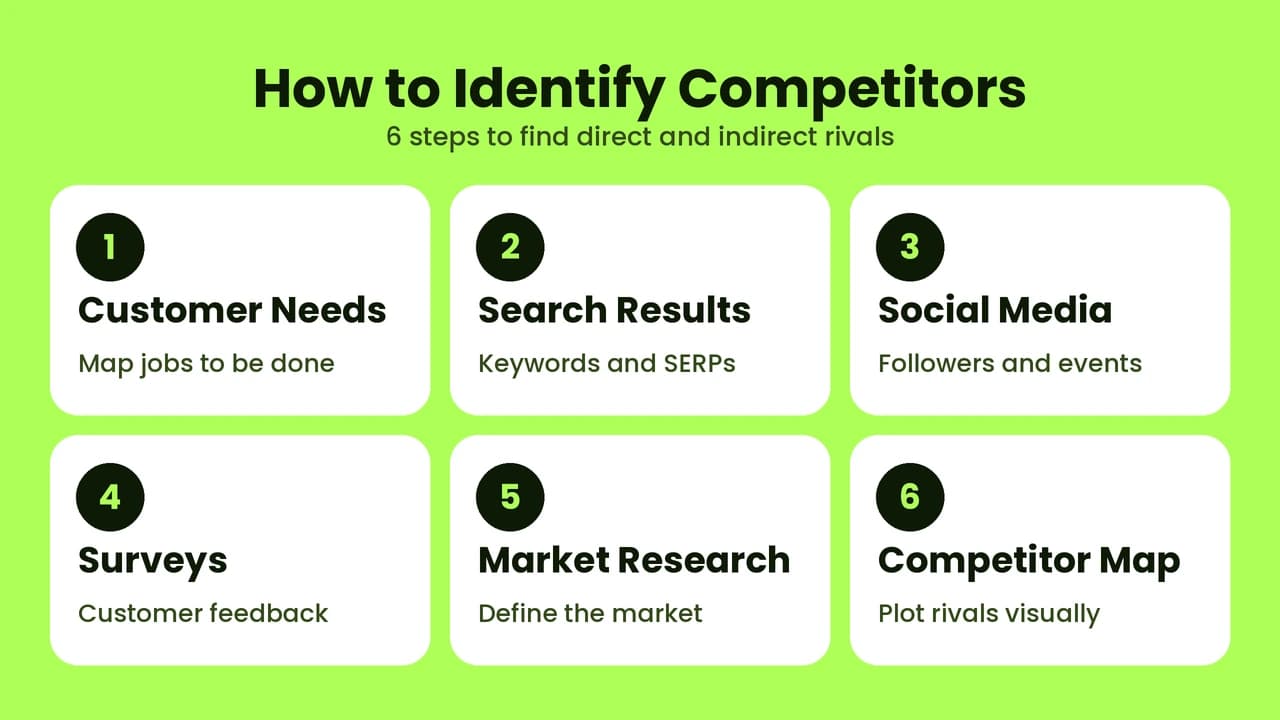
Competitor identification takes six steps. Use them to identify, find, and uncover rivals. Each step helps you discover new names.
Start With Customer Needs and Jobs to Be Done
Ask what job a customer hires your product to do. Each customer job points to need-based competition. Problem-aware buyers know their pain. Solution-aware buyers already compare options. List all jobs, then list every rival for each job.
Use Search Results, Keyword Research, and SERP Monitoring
Type your target terms into a search engine. The SERPs show SEO competitors fast. Keyword research reveals keyword competition, keyword overlap, and any keyword gap. Sort rivals into organic competitors, paid search competitors, and content competitors. Search competitors and SERP competitors may differ from sales rivals. Check search visibility and AI search visibility, including who gets cited across generative engine optimization platforms. Google Search, Google Maps, and Google Business Profile matter for local rivals.
Use Social Media and Industry Events
Social media shows who your audience follows. Check each rival’s social media presence. Social listening reveals what fans say. Industry events show who else exhibits.
Run Customer Surveys and Gather Feedback
Surveys and interviews show which brands customers consider. Customer feedback, customer reviews, ratings, and testimonials add detail. Read sentiment for patterns.
Conduct Market Research
Market research and competitive research replace guesses with data. Competitor research and industry analysis build market intelligence. Start with market definition and market scope. A narrow market definition hides threats. A broad market definition hides focus. Check industry boundaries. Insights follow. Each insight should lead to one action.
Build a Competitor Map
Competitor mapping places rivals on a positioning map. A perceptual map shows how customers see each brand.
How to Perform a Competitive Analysis
A competitor analysis follows clear steps. This step-by-step guide shows how to analyze competitors. Use a competitor analysis template or build your own competitor analysis framework. Many frameworks work. These tips fit any competitive analysis.
Set Clear Objectives
Define your goal first. Tie it to your go-to-market strategy, or GTM plan. Your business strategy and competitive strategy should agree. Pick one strategy per analysis.
Start With the Customer
Customers decide who wins. Ask each customer what they use and why.
Gather Competitor Data
Gather data from public sources. Pull pricing, features, and traffic for each rival. Add your own analytics.
Analyze Strengths and Weaknesses
List each rival’s strengths and weaknesses. A SWOT analysis adds opportunities and threats. Use a SWOT template to keep notes short. Benchmarking and competitive benchmarking compare results with yours. A competitive audit, content audit, and competitive gap analysis finish the job.
What to Analyze and Monitor During Competitor Research
Track these items for each rival:
- Backlink profile, domain authority, and domain rating, applying proven backlink management best practices to see where competitors earn authority.
- Organic traffic and traffic share.
- Paid ads, PPC, and SEM.
- Content gap.
- Competitive moves, competitive tactics, and marketing tactics.
- Marketing mix and the 4Ps, including place.
- Marketing channels, sales channels, and other channels.
Use AI and Competitive Intelligence Tools
AI and AI agents sort rival data fast. Competitive intelligence, or CI, tools collect it in one place. Free tools suit small teams. Compare tools for competitor analysis by cost and fit.
How to Beat Direct Competitors
Learn how to compete with direct competitors through a clear competitive response. Know how to outrank competitors in search too.
Establish Your Value Wedge
Pick one wedge, a single unique edge. List your unique selling points. Shape one unique selling proposition, or USP, from them. A strong value proposition says what you do better. Test two value propositions side by side. Then keep the best unique value proposition.
Differentiate Your Positioning and Pricing
Positioning tells buyers where you stand. Choose a competitive positioning and brand positioning that rivals cannot copy. Let your positioning strategy and differentiation strategy guide your messaging. Learn how to differentiate from competitors, and differentiate on price only when costs allow.
Handle Direct Competitors in Sales Conversations
Sales teams need sales enablement. Give reps battlecards and battlecard reports. Run win/loss analysis on closed deals. Review lost deals for objections and patterns.
Strengthen Your Competitive Advantage
A competitive advantage lasts when rivals cannot copy it. Build a sustainable advantage and a strategic advantage over time. A competitive moat protects both.
How to Beat Indirect Competitors
Here is how to compete with indirect competitors.
Own Your Lane: Specialist vs All-in-One
Pick a lane. A specialist wins on depth, while an all-in-one rival wins on convenience. Move upstream to reach buyers earlier. B2C brands and SMB sellers both gain from a clear lane.
Educate Customers and Position Around Their Needs
Content marketing explains why your approach works through structured semantic content writing. Email marketing keeps buyers close. Clear communication ties each message to a need.
Address the Status Quo Head-On
The status quo is often your biggest rival. Doing nothing feels safe. A manual process or workaround costs more over time. DIY alternatives and in-house solutions look cheap at first. Free alternatives and freemium plans lure price-focused buyers. Open source alternatives do too. Show buyers the gap with numbers.
Overcome Substitute and Replacement Competition
Displacement works when your result beats the substitute. A technology shift can help you displace a rival.
How to Gain an Advantage Over Both Direct and Indirect Competitors
These strategies work against both types. Each strategic move builds on the last.
Identify Gaps in the Market
Look for gaps and market gaps. Whitespace means no one serves the need. A blue ocean has few rivals. A red ocean is crowded. Opportunity identification starts with your customers.
Analyze Market Trends
Market trends show where buyers move. Shifts in evolving customer preferences change demand. Watch consumer behavior and changing consumer behavior. Digital transformation drives much of it.
Build Stronger Customer Relationships
Customer satisfaction builds trust. Customer service keeps it. A customer-centric team listens first.
Create Better Marketing Strategies
A marketing strategy should show why you win. Product marketing, or PMM, links features to buyer needs.
Build Partnerships With Competitors
Partnerships can help you and your rivals. Partners share reach. Collaboration and joint ventures can open new markets.
Learn, Reflect, and Improve
Review what worked. Keep resources, a glossary, and templates in one place.
How to Track Competitors Over Time
Competitor monitoring keeps your view fresh. Competitor tracking needs a schedule. Learn how to monitor competitors, watch for change, and track every move.
How Often Should You Do a Competitive Analysis?
Run a full review every quarter, or 4 times a year. Send weekly briefings between reviews. Each briefing should fit on one page. Competitive reports go to your whole team.
Use a CRM to Track Competitors
Log rival mentions in your CRM. Product teams can then guide product development. Managers and executives see patterns across deals.
Adapt to Changing Competitive Landscapes
The competitive landscape shifts often. Update your market landscape view each quarter. Adapt fast. Adaptability and an agile team help you stay ahead.
Keep Your Competitor Map Updated
Update your market map when a rival enters or leaves. Redraw it twice a year.
Why Indirect Competitors Matter for Small Businesses and Startups
Why indirect competitors matter comes down to size. A small business has fewer resources. A startup has even fewer. Founders often watch only direct rivals. That leaves a local business open to surprise. Many startups learn this late.
What Happens if an Indirect Competitor Becomes a Direct One?
Competitor moves can change the picture overnight. An indirect rival may add your key feature. Those moves turn it into a direct threat.
Why Identifying Perceived and Aspirational Competitors Matters
Hidden competitors live in customer minds. Overlooked competitors can win buyers unseen. Naming both closes competitor blind spots.
Direct vs Indirect Competitors: Final Comparison
Which is more dangerous? It depends on speed and depth. Direct competitor advantages include a known market and ready buyers. Direct competitor risks include price wars. Indirect competitor advantages include a fresh angle and low attention. Indirect competitor risks include slow, quiet losses.
Direct vs indirect competitors both deserve a place in your plan. Study each one, act on what you learn, and review your list often.
Frequently Asked Questions
What Is the Difference Between a Direct and an Indirect Competitor?
Direct rivals sell the same thing. Indirect rivals solve the same problem another way. That is the difference between direct and indirect competition.
What Is an Example of a Direct Competitor?
Nike and Adidas are strong examples of direct competitors.
What Is an Example of an Indirect Competitor?
A bookstore and an ebook app are examples of indirect competitors.
What Are the Three Types of Competitors?
The three types of competitors are direct, indirect, and replacement.
What Are the Four Types of Competitors?
The four competitor types add perceived competitors to those three.
What Is a Replacement Competitor?
A replacement competitor offers a different product that does the same job. It takes your customer without matching your features.
How Do You Find Your Competitors?
Start with customer jobs. Then use search results, surveys, and social media. That is how to find competitors.
How Do You Beat Direct and Indirect Competitors?
Build a clear wedge, teach buyers, and track rivals. That is how to beat competitors.
Need a Technical SEO Audit or Strategy Call?
Connect directly on WhatsApp to review your site speed, topical architecture, and organic growth roadmap.