
The best tools to optimize your brand for Microsoft Copilot help people find, trust, and cite you. This 2026 tool roundup covers Microsoft Copilot optimization from audit to results. It shows how Copilot SEO fits AI search optimization. Strong Copilot brand visibility needs AI visibility tools and a clear plan.
What Does It Mean to Optimize Your Brand for Microsoft Copilot?
Microsoft Copilot answers in plain language. It gives one summary, not ten links. That is AI search. To optimize, you earn a place inside AI-generated answers.
Answer engines and generative engines share one pattern. A large language model, or LLM, writes the reply. Large language models need sources, so LLMs pull from search. Conversational search adds follow-ups, and many people never click. That is zero-click search. So AI visibility still matters without traffic.
You aim for three things:
- Brand mentions name you in the answer.
- AI citations link to your pages.
- Brand citations credit you as a source.
Brand authority and your brand entity decide who wins. Together they set AI search visibility and brand visibility. Search intent and user intent still rule. AI search trends show generative search replacing lists. For the future of search, readers ask how to get cited by Copilot, how to appear in Copilot answers, and how to rank in Copilot.
Consumer Copilot vs Microsoft 365 Copilot: Which Version Are You Optimizing For?
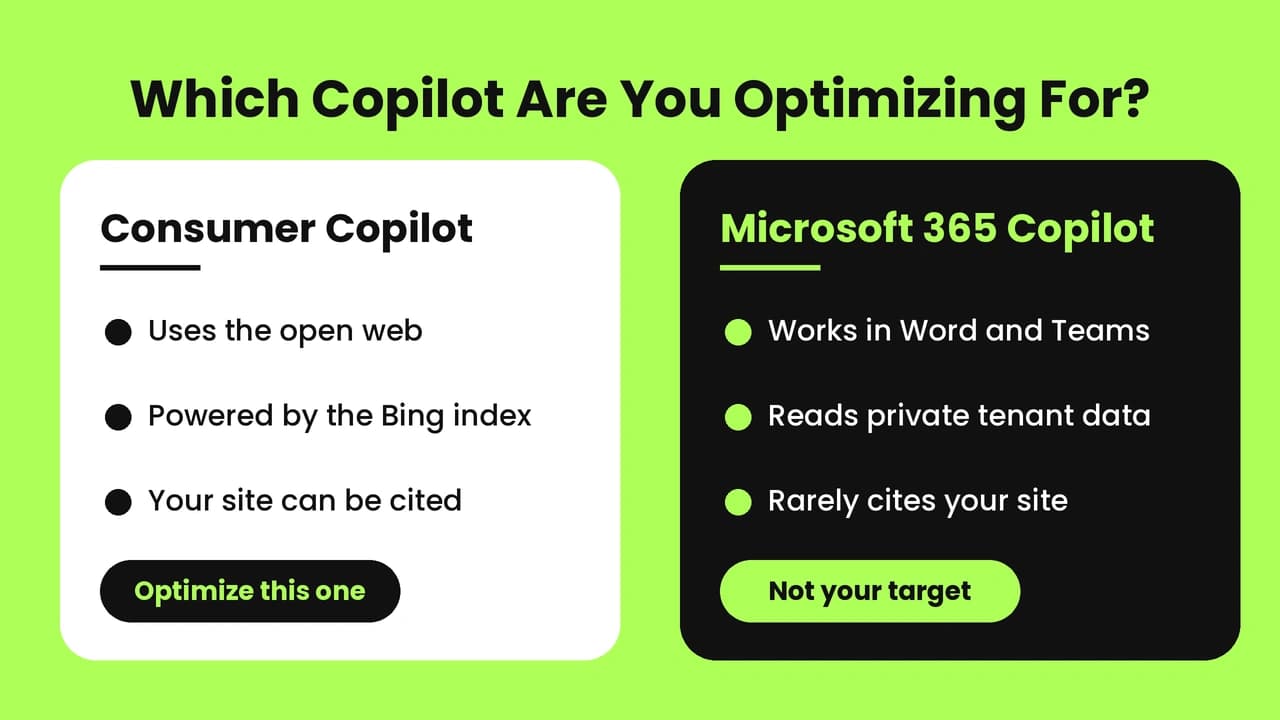
Consumer Copilot runs on the open web. You reach it at copilot.microsoft.com or bing.com/copilot. It also lives in the Copilot app, Windows Copilot, and Copilot in Edge. Microsoft Edge adds Copilot Mode. Copilot Search, Copilot Chat, and Copilot Pages use public data, so your site can appear.
Microsoft 365 Copilot, or M365 Copilot, works inside Word, Excel, PowerPoint, Outlook, and Teams. It reads SharePoint files through Microsoft Graph, and Work IQ adds context. Microsoft Purview sets data rules, and Power BI feeds reports. Each tenant stays private, so enterprise tenants rarely cite your site.
Copilot Optimization vs Bing SEO, GEO, and AEO
Classic SEO ranks pages. AI SEO earns mentions inside answers. GEO means generative engine optimization. AEO means Answer Engine Optimization. LLM optimization, or LLMO, targets the models. Bing Chat and Bing AI were early names, and Bing Search still feeds Copilot. Microsoft Start and MSN also distribute content. Semantic search and entity-based SEO focus on meaning.
How Microsoft Copilot Decides What to Cite
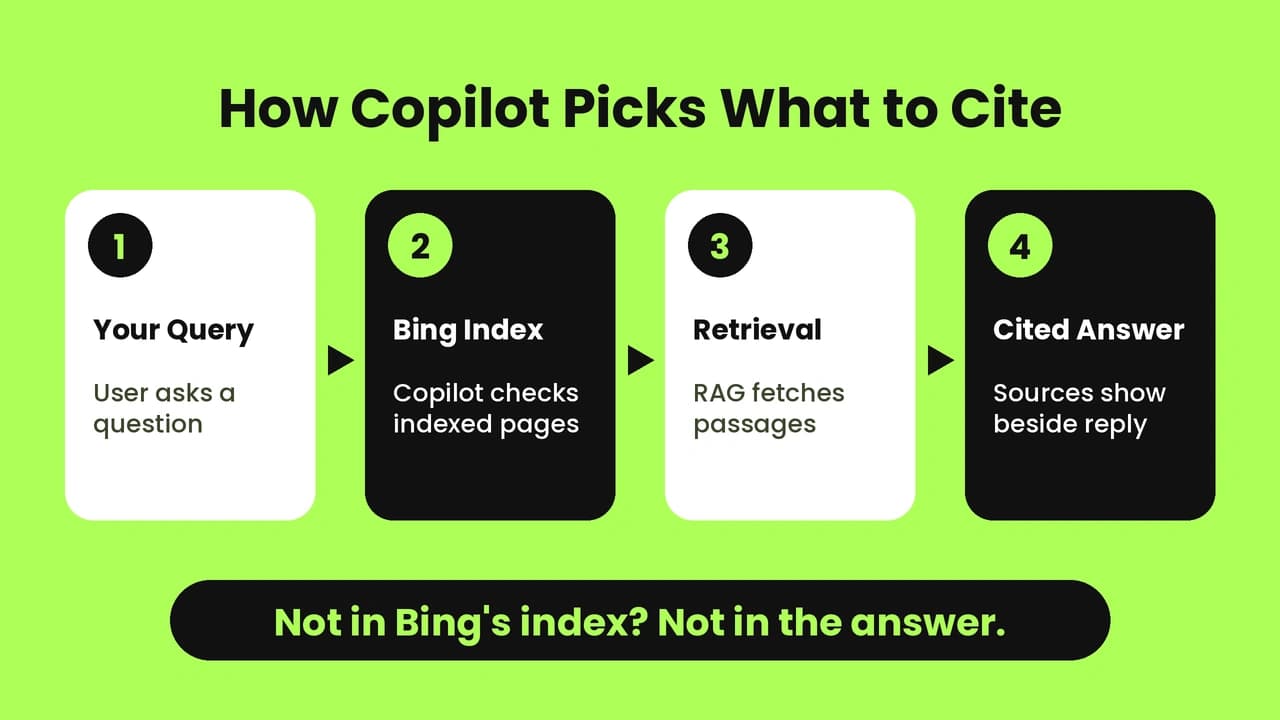
Here is how Copilot chooses sources. It uses retrieval-augmented generation, or RAG. The retrieval layer fetches candidate pages, and only retrievable pages qualify. The model then reads what it retrieved and writes grounded answers. That is answer synthesis. Source selection happens along the way, and source attribution shows citation sources beside the reply.
OpenAI GPT models sit behind Copilot, and Prometheus joins search with the model. Azure OpenAI and Azure AI Search support similar setups for business. Copilot also splits one question into several searches. That is query fan-out. Multi-turn conversations and follow-up prompts add more queries. Citations and cited sources can change each turn.
The Role of Bing's Index and Web Grounding
Bing grounding links Copilot to live web results. With web grounding, the model checks the Bing index first. Adhering to official Bing Webmaster Guidelines ensures pages meet crawl and index standards. A grounded reply reaches only pages it can see. Web-grounded answers cite only what Bing holds, so content indexing comes first. Indexing alone wins nothing, yet without it nothing counts.
Content Formats and Signals Copilot Prefers
Copilot lifts passages, not whole pages. Build extractable content in extractable formats:
- Short lists and tables.
- Tight paragraphs.
- Content chunking into clear blocks.
Passage-level optimization lets each block stand alone. Lead with concise answers and definition paragraphs. Content freshness shows a page is current. Information gain comes from original research and proprietary data. Statistics and expert quotes back claims. Use semantic keywords and related entities to build semantic relevance and contextual relevance.
Entity Clarity, Authority, and Earned Citations
Entity clarity tells machines who you are. Entity recognition matches your name to one known company. Entity salience shows how central you are on a page. Entity disambiguation separates you from lookalike names. The Bing Knowledge Graph and Google Knowledge Graph store these facts. A knowledge graph entry can earn a brand knowledge panel.
E-E-A-T shapes authority signals, trust, and credibility. Understanding how to build topic authority ensures models recognize your expertise across related clusters. Copilot leans on credible sources. Owned content states your claims, and first-party pages host them. Third-party sources and earned media prove them. Authoritative sites and reputable sites weigh more. Authoritative sources and trusted sources get repeated.
How We Picked the Best Copilot Optimization Tools
We score every tool on one checklist. Ease of use comes first:
- Accuracy and data freshness.
- Scalability.
- A solid API gives API access, integrations, and export.
- Dashboards, reporting, reports, and alerts.
- Multi-engine tracking.
Each review lists pros and cons and honest limitations.
Quick Comparison of the Best Copilot Optimization Tools
This tool comparison serves readers in commercial investigation mode. The feature comparison groups tools by job. Pricing, plans, and tiers change, so confirm with each vendor. Many paid tools offer free trials.
Features, Copilot Coverage, Best For, and Pricing at a Glance
These side-by-side comparisons show best for and watchouts:
- Visibility Tracking: Best for citations and mentions. Watchout: Check Copilot coverage.
- GEO Platforms: Best for large teams. Watchout: Higher cost.
- Content Tools: Best for citation-ready pages. Watchout: Needs human review.
- Technical Tools: Best for crawling and indexing. Watchout: Setup time.
Best Microsoft Copilot Visibility Tracking Tools
AI tracking shows where your brand stands. AI monitoring and AI brand monitoring repeat checks on a schedule. AI answer tracking logs each reply. AI search tracking software and AI search analytics chart the data. Prompt research picks what to test, then prompt tracking and prompt monitoring run it. Citation tracking and brand monitoring show which pages win and how you sound. Peec AI, Searchable, LLMBear, Anvil, Limy, Algomizer, and Gumshoe also fit this group.
1. Profound
Profound fits large brands. Expect enterprise pricing. It suits regulated industries.
2. LLM Pulse
LLM Pulse offers Copilot Pulse. Start on a starter tier. Per-tier pricing limits seats.
3. Otterly AI
Otterly AI, or Otterly.AI, suits small teams. Monthly pricing is low, and annual billing may cost less.
4. Rankscale AI
Rankscale AI may sell Copilot as an add-on. Some plans promise unlimited seats, so verify.
5. Scrunch AI
Scrunch AI, shortened to Scrunch, maps prompts to the buyer journey. It shows which buyer questions name you.
6. Ahrefs Brand Radar
Ahrefs Brand Radar suits teams already on Ahrefs.
7. Similarweb
Similarweb adds competitive intelligence and analytics.
8. SE Ranking
SE Ranking and SE Ranking AI Search suit agencies. Semrush, the Semrush AI Visibility Toolkit, and Semrush One compete. Moz, Moz Pro, and Search Atlas do too.
9. Promptmonitor
Promptmonitor, or PromptMonitor, tracks long-tail prompts. Rank Prompt is similar. Start with 20 prompts.
10. Cognizo
Cognizo delivers citation reports and cross-platform AI visibility.
Best GEO and Enterprise AI Visibility Platforms
GEO platforms suit an enterprise brand with many products. AthenaHQ, xFunnel, Bluefish, Geostar, and Relixir also compete here. Two more follow.
1. Conductor
Conductor serves large SEO teams. BrightEdge, BrightEdge Generative Parser, and seoClarity target the same buyers.
2. Goodie
Goodie, or Goodie AI, joins tracking and content. Brandlight, Evertune, and Gauge compete.
Best Content Optimization Tools for Earning Copilot Citations
Content optimization covers on-page SEO and page-level optimization. Content marketers use these tools to shape pages for citation.
1. DeepSmith
DeepSmith, or Deepsmith, drafts publish-ready pages in your brand voice. They are citation-ready after review.
2. Writesonic
Writesonic adds Writesonic GEO. Jasper also writes at scale.
3. Frase
Frase builds outlines. Clearscope and MarketMuse grade coverage.
4. Surfer SEO
Surfer SEO, or Surfer, scores pages. Surfer AI Tracker watches AI answers.
Best Technical and Bing Tools for Copilot Readiness
Technical SEO keeps Copilot able to reach your pages. Run a technical SEO audit each quarter. Screaming Frog and Sitebulb check site health. Watch site speed, Core Web Vitals, and mobile-friendliness. A CDN can speed delivery, yet bad rules can block bots, so test after any move.
1. Bing Webmaster Tools (AI Performance Report)
Bing Webmaster Tools is free. The Bing Webmaster Tools AI Performance report shows how your pages appear in AI answers. Check index coverage and crawl activity weekly.
2. IndexNow
IndexNow pings Bing when a page changes. Pair it with an XML sitemap and sitemap submission. A URL submission API makes it automatic. It also saves crawl budget.
3. Schema Markup Generators and Validators
Schema App and Schema Pro generate markup. Yoast SEO and Rank Math add it in WordPress. Merkle Schema Generator outputs JSON-LD from schema.org types. Run markup validation with Rich Results Test and Schema Markup Validator.
4. Microsoft Clarity
Microsoft Clarity is free. Heatmaps and session recordings show visitor actions. Behavior analytics reveals which pages hold attention.
How to Choose the Right Copilot Optimization Tool
Pick by use cases, not hype. Build a shortlist of three.
Best Tools for Enterprise Teams
Enterprise teams need governance. Ask about compliance, security requirements, and audit trails. An MCP server lets AI agents reach tools through connectors. Agentic workflows then run steps for you. Copilot agents and Copilot Studio agents, built in Copilot Studio, can use those links. Power Platform supports workflow automation. A natural language, conversational interface helps staff ask without code. Agents handle repeat tasks.
Best Tools for Agencies
Agencies and marketers juggle many clients, and SEO professionals need clear reports. Stackmatix suits growth teams. Adstellar handles campaign management and bulk launch of campaigns on Meta and Facebook. It also offers creative generation for ad creative, ad copy, and UGC. Performance reporting closes the loop.
Best Tools for Startups and Small Businesses
Startups and scaleups need speed. In-house teams lack time for ten dashboards. Analysts can run one tracker and one technical tool.
Best Free and Budget-Friendly Tools
Free tools go far. Set a budget for one paid tracker. Use a free trial, since a 7-day trial can test Copilot data. Pay-as-you-go plans suit low volume.
Best Tools for B2B SaaS and Ecommerce Brands
B2B and SaaS brands win with comparison pages. SaaS brands build B2B brand visibility through reviews. B2C brand visibility leans on shopping. Ecommerce teams with retail catalogs should watch Copilot Shopping and Copilot Checkout. Clean product feeds and product data help. Structured product information and Merchant Center feeds flow through Bing Merchant Center.
Which Tool to Pick for Each Job
- Track Visibility: A tracking tool.
- Write Pages: A content tool.
- Fix Crawling: Bing Webmaster Tools.
- Push New URLs: IndexNow.
- Check Markup: Schema Markup Validator.
- Watch Behavior: Microsoft Clarity.
Paid reach adds to organic work. Microsoft Advertising, also called Microsoft Ads, offers Copilot ads and ad placements. Showroom ads and conversational ads run in Microsoft Advertising Copilot placements. Shopping ads and Performance Max extend reach. Ad extensions and audience targeting sharpen results. Microsoft Designer offers an image generator and a video generator for creative.
How to Optimize Your Brand for Microsoft Copilot: Step-by-Step
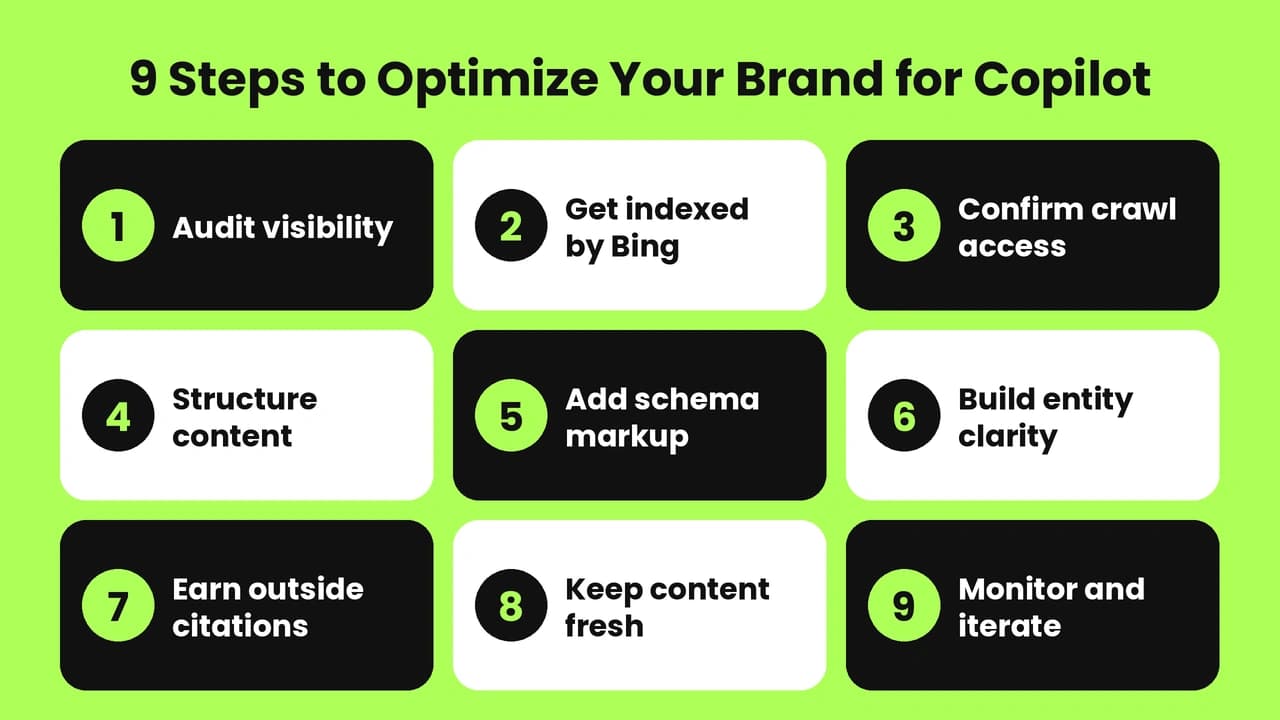
This implementation guide has nine steps. Follow these best practices in order. Treat the list as your optimization checklist.
Step 1: Audit Your Current Copilot Visibility
Set a baseline first. Reviewing how to check my brand helps you establish clean testing prompts across conversational engines. Write 20 prompts your buyers ask. Use conversational queries, question-based queries, and natural language queries. Most carry informational intent. Run them in Copilot and log results.
Step 2: Get Crawled and Indexed by Bing
Check indexability. Count indexed pages in Bing. Set canonical tags, meta tags, and metadata. Add links from old pages to new ones.
Step 3: Confirm Crawl Access (Bingbot, Robots.txt, and llms.txt)
Bingbot must reach your pages. Test crawlability in robots.txt. Look for any user-agent line with a disallow rule. Other crawlers read it too. Add llms.txt if you want. Use data-nosnippet with care.
Step 4: Structure Content for Extraction (Answer-First, Headings, Tables, FAQs)
Write answer-first content. Open each section with an answer capsule. Direct answers help Copilot lift your words. Use clear headings. Question-form headings match how people ask, and question-based headings help query matching. Add subheadings, tables, comparison tables, and FAQ sections. Clean HTML and well-structured content improve content structure. Internal linking connects pages. Content clusters, pillar pages, and topic clusters build topical authority. A topical map guides topical coverage.
Step 5: Add Schema Markup That Matters to Bing and Copilot
Schema markup gives Copilot facts as structured data. Start with these types:
- Organization schema for your brand.
- FAQPage, also called FAQ schema, for questions.
- Article schema and author schema for posts.
- Product schema, AggregateRating, and Review schema for products.
- LocalBusiness schema for local firms.
- ItemList for ranked lists.
Add datemodified to show freshness. Use sameAs to link your profiles.
Step 6: Build Brand and Entity Clarity
Entity clarity starts with your message. Align brand messaging, brand positioning, and brand narratives. Brand consistency and consistent naming build a coherent identity. Keep NAP consistency across the web. Brand associations grow from topic pages. Claim profiles, local listings, and local citations. Listings management tools include Yext, Yext Scout, BrightLocal, Moz Local, and Birdeye. Use Bing Places for Business, Google Business Profile, LinkedIn, GitHub, YouTube, Wikipedia, and Wikidata where they fit.
Step 7: Earn Third-Party Citations (Digital PR, Reviews, Forums, Listicles)
Earned mentions carry weight. Digital PR, link building, and backlinks bring them, and off-page SEO covers the work. Collect reviews and ratings on G2, Trustpilot, Capterra, Clutch, and SourceForge. Join forum threads on Reddit and Quora. User-generated content and social proof add trust. Aim for listicles that name you. Wikipedia citations and industry directories help too. Third-party mentions count, even unlinked mentions. Co-citations and co-occurrence tie you to known names. Muck Rack, Meltwater, and Cision support outreach.
Step 8: Keep Content Fresh, Attributed, and Consistent
Run fact-checking before you publish. Factual accuracy protects trust. Add author bios to show experience, expertise, authoritativeness, and trustworthiness. Include case studies, original data, and proof. Quotes from named experts help. External links back each claim.
Step 9: Monitor and Iterate
Review results monthly. Watch brand reputation and brand perception. Brand safety and brand protection matter when answers go wrong. Reputation management and misinformation monitoring catch errors early. Brand24, Mention, Brandwatch, Talkwalker, and Sprout Social can send alerts. Then fix pages and repeat.
How to Measure Copilot Optimization Results
Measurement turns effort into proof. Set KPIs first. AI SEO KPIs differ from rank reports. Measuring AI visibility takes new metrics. Tie them to ROI.
Key Metrics: Citation Frequency, Mentions, Share of Voice, and Sentiment
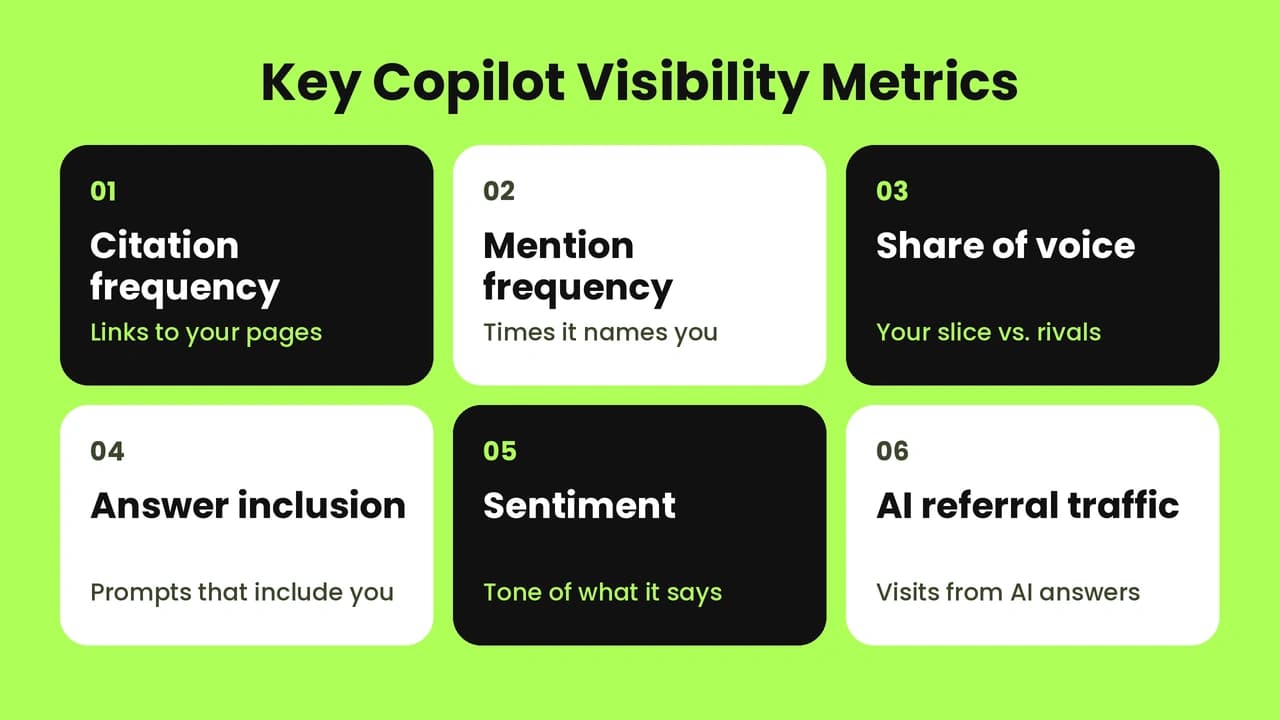
- Citation frequency shows how often Copilot links you.
- Mention frequency counts your name.
- Position tracking shows where you sit.
- Answer inclusion rate is the share of prompts that include you.
- Recommendation frequency counts suggestions.
- Top-of-answer placement marks the first spot.
- Share of voice compares you with rivals, and AI share of voice limits it to AI answers.
- An AI visibility score rolls these up.
- Sentiment analysis reads tone, and brand sentiment is the result.
Tracking AI Referral Traffic and Conversions
AI referral traffic is visits that start in an AI answer. Referral traffic reports may hide it, so tag it clearly. Traffic tracking in Google Analytics 4 shows landing pages. Attribution links visits to sales, and AI traffic attribution needs care. Conversions from AI search need conversion tracking. Platform-reported data can differ from your own, so compare. Cometly can connect ad and organic paths. Looker Studio, Google Search Console, and Microsoft Power BI can pull it together. Revenue is the number that matters.
Competitor Benchmarking and Citation Gap Analysis
Competitor tracking shows who Copilot names instead of you. Competitor analysis explains why. Competitor citations point to pages you need. Competitive benchmarking sets targets. Gap analysis lists missing topics. Citation gaps show sources that cite rivals but not you. Visibility gap analysis and citation gap analysis turn those findings into tasks.
How Often to Track and How Long Results Take
Run daily tracking for key prompts and weekly tracking for the rest. Expect results in weeks, not days. Your growth strategy should plan for that.
How Optimizing for Copilot Differs from ChatGPT, Perplexity, and Google
Copilot leans on the Bing index. Google, Google AI Mode, and AI Overviews lean on Google's index. Gemini and Google Gemini belong to that family. ChatGPT and Perplexity use their own retrieval setups. Claude, Grok, and DeepSeek add more engines.
Cross-Platform Optimization Tips
Cross-platform work starts with shared basics. Clean pages, clear entities, and strong citations help every engine. A multi-model view and multi-engine tracking show where you win. Naver, Seznam.cz, Yandex, and Yep matter if you sell in those markets.
Common Mistakes That Keep Brands Out of Copilot Answers
- Blocked pages: Bots cannot read them.
- Misconfigured rules: One wrong line can hide a site.
- Inaccurate AI answers: Check them and fix your pages.
- AI hallucinations: Clear facts leave models less room to guess.
- Brand misrepresentation: Consistent profiles correct it.
Evaluating the best tools to optimize your brand for Microsoft Copilot gives your team the exact monitoring and technical foundation needed to stay visible across every major conversational search platform.
Frequently Asked Questions
Is Optimizing for Microsoft Copilot the Same as Optimizing for Bing?
Mostly no. Microsoft Copilot optimization builds on Bing SEO, and GEO adds passage, entity, and citation work.
Does Copilot Use Bing for Its Answers?
Yes, for web answers. Copilot relies on the Bing index and Bing grounding, so web grounding starts there.
Does Microsoft 365 Copilot Use My Website's Content?
Not directly. Microsoft 365 Copilot works inside your tenant. Public data can still reach web answers.
How Do I Check If My Site Is Blocking Copilot?
Open robots.txt and look for rules that block Bingbot. Then test crawlability. Blocked pages cannot earn citations.
What Is IndexNow, and Does It Help with Copilot?
IndexNow tells Bing about changed URLs fast. Bing Webmaster Tools confirms receipt. Faster content indexing gives Copilot fresher pages.
What Schema Markup Should I Add for Copilot?
Start with schema markup as structured data. Organization schema and FAQPage cover most sites.
Does Content Freshness Matter for Copilot Citations?
Yes. Content freshness signals a current page. Update datemodified only after real edits, and track citations.
Can I Track How Often Copilot Cites My Brand and My Competitors?
Yes. Citation tracking shows your mentions, and competitor tracking shows rivals. AI visibility tools automate both.
Can a Newer Website Earn Copilot Citations Without Domain History?
Yes. Build authority signals through earned media and third-party mentions.
How Long Does It Take to See Results After Optimizing for Copilot?
Plan for weeks. Take a baseline measurement, then use weekly tracking to watch citation frequency.
Need a Technical SEO Audit or Strategy Call?
Connect directly on WhatsApp to review your site speed, topical architecture, and organic growth roadmap.