
SEO website migration audits protect your rankings when a site changes. The best SEO website migration audits in 2026 check every URL, tag, and tracking code before and after the move.
What Is an SEO Website Migration Audit?
A website migration SEO audit checks your site before, during, and after a move. A site migration audit finds what could break. A regular SEO audit reviews one stable site. A website migration changes the site itself, and a site migration often swaps URLs, code, and hosting together. Technical SEO sits at the center. Search engines must still crawl your pages. Google needs the same signals, and every search engine reacts to change.
SEO Migration Explained
SEO site migration means moving a site without losing search value. Migrations vary in size. When you migrate, you may change the domain, platform, or design. Migrating a blog is easy, but a site move on a big store is not. Tickets may spell it sitemove. A relaunch or website relaunch counts too. The old build is your legacy site. Reviewing our dedicated SEO migration services guide explains how custom roadmaps prevent catastrophic traffic drops.
Website Migration SEO Audit vs. Standard SEO Audit
A standard audit checks one site. A migration audit compares two. Our audit process has three layers:
- The technical SEO audit covers crawling and speed.
- The on-page audit covers tags and on-page SEO.
- The off-page audit covers links.
Content SEO runs through all three.
Pre-Migration, Staging, Launch, and Post-Migration Audit Phases
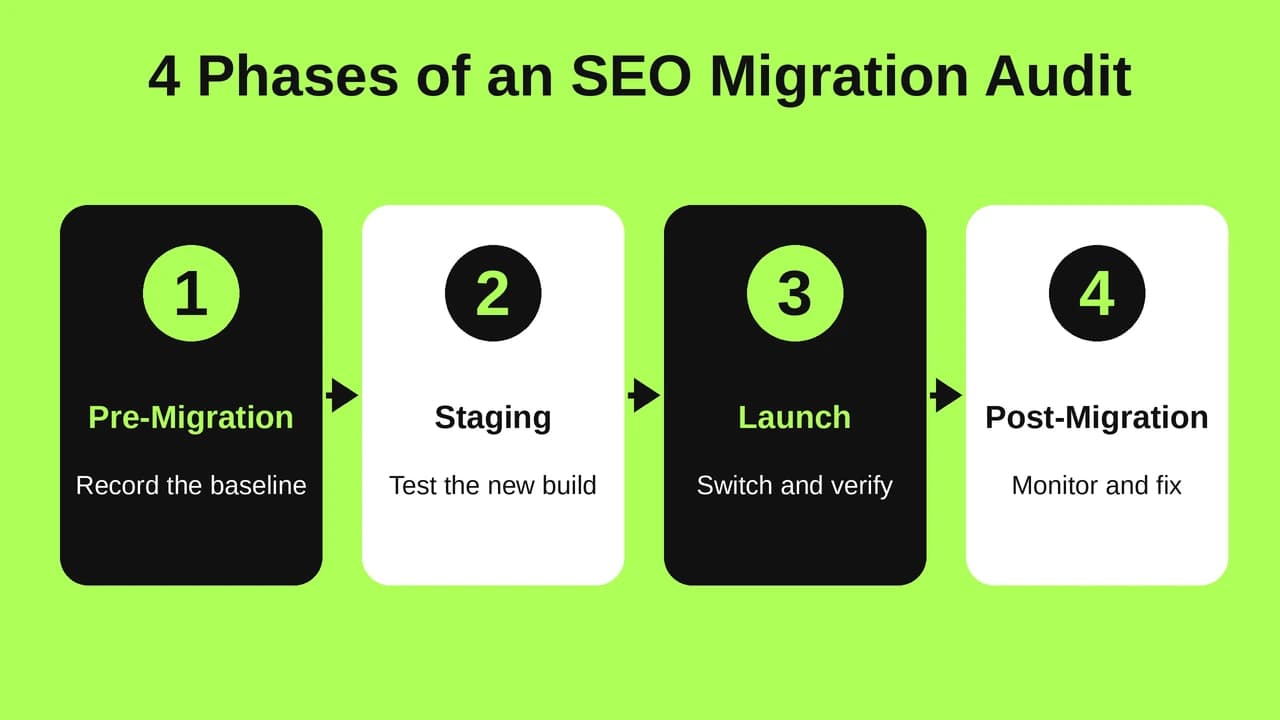
Four phases cover the move:
- The pre-migration audit records today's site. Some reports call it premigration.
- Staging tests the new build.
- Launch is the switch.
- The post-migration audit starts at post-launch hour one. Some reports call it postmigration.
Why SEO Website Migration Audits Matter
Every page answers a search intent. A move can break that match. Good user experience keeps visitors reading, so we check UX and usability too.
How Website Migration Affects SEO
A move can shift organic traffic within days. Rankings slip when URLs change, and each ranking rests on page signals. Search visibility and organic visibility fall together. Google algorithm updates can blur the data, and Google core updates can too. Keep E-E-A-T signals and topical authority steady. AEO and AI search also favor clear pages.
Risks of Website Migration
Migration risks grow with site size. No move is risk-free, but audits cut the odds. Small problems stack up. One missed rule can become a disaster. Losses show up in traffic first.
Common Causes of Traffic and Ranking Loss After a Migration
Most traffic loss has a short list of causes:
- Missing redirects cause a traffic drop.
- Broken titles cause a ranking drop.
- A blocked robots file causes sudden drops.
- Visibility loss follows, and revenue loss comes last.
When we ask what went wrong, the answer is rarely one thing. Fragmented ownership is common. If traffic drops unexpectedly, running a structured website traffic loss audit pinpoints which redirects broke or which pages deindexed.
When SEO Should Get Involved in a Migration
Bring SEO in at kickoff. Teams brought in too late fix errors after launch. Developers need SEO rules before they build. Your dev team should name an SEO strategist. The project manager should book the audit dates.
Types of Website Migrations That Need an SEO Audit
Every move needs an audit, and risk rises with size. An e-commerce migration touches product pages and category pages. Each e-commerce store also has template limits. Ecommerce SaaS adds its own rules. Enterprise sites on AEM have many owners. Large sites have many URLs. A blog migration looks simple, but it still needs a check.
Domain Name Change and Rebranding Migration
A domain migration moves your whole address. A domain change needs a 301 plan. A domain name change often comes with a rebranding migration. Confirm domain ownership first. Local SEO needs care too. Keep NAP consistency across listings. Update your Google Business Profile at launch.
HTTP to HTTPS Migration
An HTTP to HTTPS migration moves every URL to a secure version. HTTPS needs a valid SSL certificate. An SSL migration looks small but reaches every page. Treat any protocol migration like a full move. Add HSTS after redirects work.
CMS and Platform Migration (WordPress, Shopify, Wix, Webflow, Headless CMS)
A CMS migration changes how pages are built. Any platform migration needs the same audit. Replatforming resets templates, so every replatform plan needs a template check:
- WordPress migration: permalinks
- Shopify migration: product URLs
- Magento migration: category URLs
- Wix to WordPress: metadata fields
- Webflow: titles
- Headless CMS migration: rendering
- Next.js migration: rendering
- JavaScript framework migration: routing
Collaborating with a skilled SEO web developer ensures that dynamic routing and server-side rendering deliver clean static HTML directly to search crawlers without client-side script hurdles.
Website Redesign and URL Structure Change
A website redesign changes layout and often URLs. A site redesign needs the same audit, so treat each redesign like a move. Start the pre-redesign review before designers begin. Web design choices affect headings and links. Design and development share the load, and web development shapes the code. A URL structure change carries the most risk. URL migration follows from it. Keep the old URL structure where you can. Check URL paths in each template. Reviewing the official Google site move guidelines confirms that consistent URL mapping is vital for preserving crawl signals.
Hosting, Server, and CDN Migration
A hosting migration moves files to a new home. A server migration changes response behavior. A CDN migration changes how pages are delivered. Plan any hosting change with an IP list. AWS and other clouds need the same checks. Test CDN rules before launch.
Subdomain, Subfolder, and Multi-Site Consolidation Migration
A subdomain migration moves a section to its own host. A subdomain to subfolder migration merges it into the main site. A subfolder to subdomain move does the reverse. Multisite setups need a plan per site. Multi-brand and multi-property groups need one owner each. A multi-brand portfolio needs one shared map.
International and Multilingual Site Migration
International SEO needs extra checks. A multilingual migration touches each language version. A ccTLD migration changes country domains. Geotargeting must still match each market. Regional pages keep their own signals.
Types of SEO Migration Audits and How to Choose the Right One
Pick the audit that fits your move. This step-by-step guide follows a 7-step audit. Use the guide in order, and the process works at any size:
- Set goals.
- Crawl the old site.
- Map URLs.
- Test staging.
- Check launch.
- Watch rankings.
- Close gaps.
Manual vs. Automated vs. Hybrid Audits
Automated audits scan thousands of URLs fast. A manual review adds context. A hybrid audit uses both. Pair them with SEO tools your team already uses.
Audit Scope Based on Migration Complexity
Set the audit scope early. A small site may need one pass, and a large site needs more. A written scope keeps outcomes clear.
Aligning the Audit With Your Migration Timeline
Put audit dates on your migration timeline. A timeline without audits fails. Add them to the migration roadmap.
Pre-Migration SEO Audit
This audit feeds your migration plan. It also shapes your migration strategy.
Set Migration Goals and Success Metrics
Write your goals first. Pick KPIs you can count. List the metrics and the measurement method for each.
Crawl and Inventory Your Existing Website
Crawl the old site first. A site crawl lists every page. A crawl audit shows what crawlers can reach. Check crawlability, then export every crawled URL. These legacy URLs feed your redirect map.
Benchmark Baseline Performance (Traffic, Rankings, Conversions)
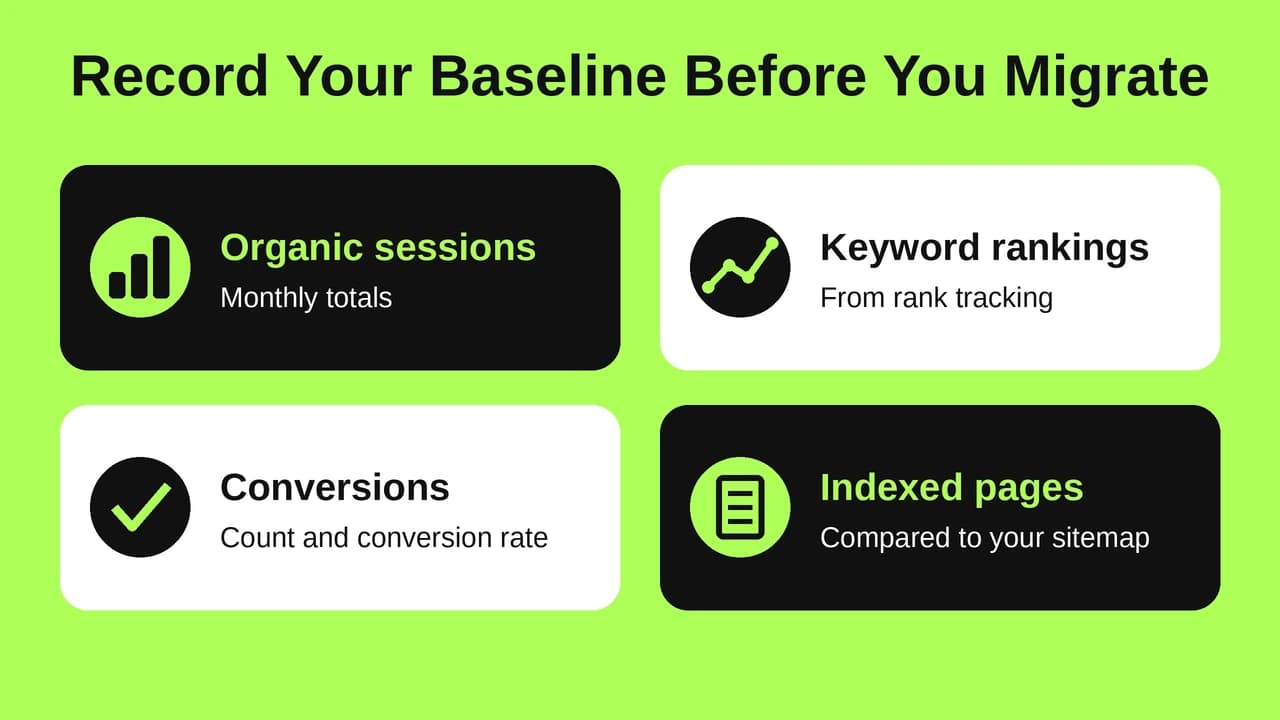
Record a baseline before you change anything. Baseline data is your proof later. Save baseline metrics in one sheet:
- Organic sessions: monthly totals
- Keyword rankings: from rank tracking
- Conversions: count and conversion rate
Benchmarks show what changed. Benchmarking now saves weeks later. This pre-migration benchmark is your reference.
Document Current Site Architecture, Metadata, and URLs
Get the current site documented. Save the taxonomy, information architecture, and site graph. Note the existing site's titles and templates.
Identify High-Value Pages and Top Backlinked URLs
List high-value pages first. High-traffic pages lead. Add top landing pages and landing pages from ads. Priority pages and revenue pages come next. Mark top performing pages. Rank each by priority.
Assess Risks and Plan for Rollback
Run a risk assessment on each change. Pair each one with a risk mitigation step. Keep a rollback plan and an emergency protocol. Know how to restore the old site.
Align Stakeholders and Build a Realistic Timeline
Name your stakeholders early. Build a project plan, which we call the migration project plan. Project management and coordination keep dates real. Share it with the client and all teams.
URL Mapping and Redirect Audit
Redirects carry old rankings to new pages. A redirect rule needs URL mapping first. Redirect mapping ties each old URL to a new one. Review every URL in the list.
Build a Complete URL Inventory and Redirect Map
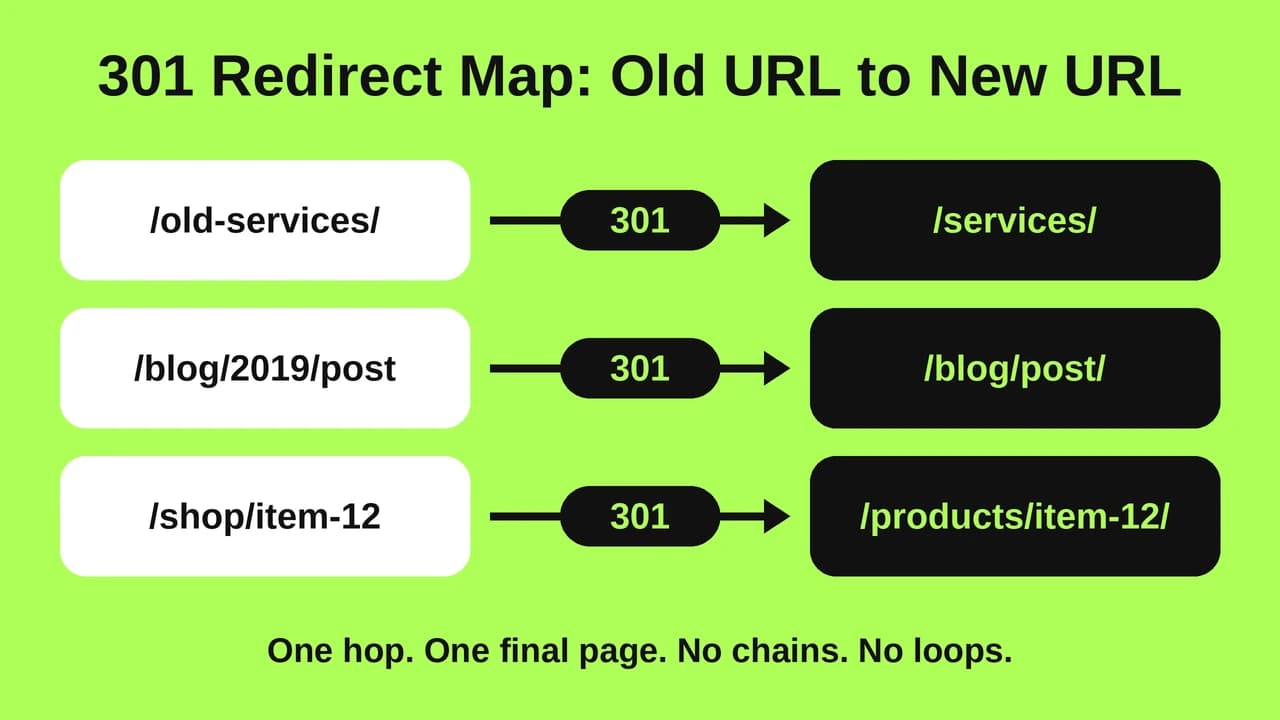
Start with a URL inventory built from your crawl. Then build the redirect map. Run bulk redirects only after the map is clean. Keep one shared map.
Map Old URLs to Final Destination URLs
Use one-to-one mapping. Send each old page to its final destination. Destination URLs must return a normal page. Match trailing slashes, URL case, and lowercase URLs. Watch URL length and URL slugs. Set rules for URL parameters.
Decide Which Pages to Redirect, Consolidate, or Remove
Not every page earns a redirect. Content pruning removes weak pages. Removed pages may return 404 errors. Review 404s and 4xx errors in the crawl. Fix soft 404s. Repair or redirect broken pages.
301 vs. 302 Redirects
Use permanent redirects for permanent moves. Those are 301 redirects. Keep a 301 in place. Use 302 redirects for short tests only. A 302 should not stay live. Temporary redirects need an end date. Meta refresh redirects and JavaScript redirects are weaker options.
Redirect Chains and Loops
Redirect chains add hops. Chains slow users down. Redirect loops never end. Loops break pages.
Test and Validate Redirects Before and After Launch
Run redirect testing before launch and after. Redirect validation checks the status code and final URL. Wildcard redirects and regex redirects need extra tests. Test server-side redirects in each environment. .htaccess redirects and Nginx redirects follow their own syntax.
Content Audit and Content Mapping
A content audit shows what you have. Build a content inventory from your crawl. Content migration needs a content mapping sheet. Editorial owners decide what stays.
Score and Prioritize Legacy Content
Score each blog post and article. Mark stale content and outdated content. Keep winners. Update or retire the rest.
Content Parity Between Old and New Site
Content parity means the new page matches the old one. Content preservation covers text, images, and links. Check top pages first.
Consolidating Thin and Duplicate Content
Content consolidation joins weak pages into one strong page. Consolidations need redirects. Merged content should keep the best parts. Thin content and duplicate content blur your message. Review thin/duplicate pages in one pass. Duplicated text across templates needs a fix too.
Archiving vs. Deleting Pages
Archive pages with value. Delete pages with none. Out-of-stock pages and old product URLs need a rule. Preservation beats deletion when a page still earns links.
Orphan Pages and Content Gaps
Orphan pages have no internal links. Orphaned pages are easy to lose in a move. Link them or retire them.
Technical SEO Audit of the Staging Site
Test the new build on a staging site. A staging environment keeps risk off your live pages. A development environment alone is not enough. UAT confirms the build works for users. Migration QA confirms SEO rules hold. Testing finds errors while they are cheap.
Staging Environment Setup and Access Blocking
Build a dev environment and a test environment. Use password protection to keep them private. Add disallow rules as a backup. Share preview links with stakeholders.
Crawling the Staging Site for Technical Issues
Crawl the staging site. Watch crawl budget on large builds. Log all issues. Hand them to QA. Quality assurance signs off before launch.
Giving Googlebot Temporary Access for Testing
Give Googlebot temporary access only when needed. Open the URL Inspection tool to see what Google sees. Use URL Inspection on key templates. Remove access when testing ends.
JavaScript Rendering and Content Rendering Validation
Rendering decides what search engines see. JavaScript-heavy pages need extra care. Test JavaScript rendering on key templates. Server-side rendering puts content in the HTML. Check content rendering on mobile and desktop.
Robots.txt, Noindex Tags, and Indexability Checks
Check robots.txt first. Remove noindex tags from the final build. One stray noindex can hide a page. Confirm indexability on each template. Indexation control belongs with one owner. Review meta and canonical tags too.
Final Staging Checks Before Launch
Run final checks the day before launch. Test redirects, titles, and links. Record verification in your sheet. Validate each fix. Verify that every issue is closed.
On-Page and Site Architecture Audit
Site architecture shapes how pages connect. Good architecture keeps key pages close to home. Site structure should match user paths. Metadata should match the old page.
Canonical Tags and Duplicate Signals
Canonical tags name the preferred URL. Each canonical must point to the new URL. Old-site canonicals cause problems. Canonicalization fixes duplicate paths. Use self-referencing canonicals on indexable pages. Keep canonical consistency across templates.
Internal Linking and Site Architecture
Update internal links to final URLs. Internal linking should not rely on redirects. Check the internal link structure per template. Fix broken internal links. Test pagination and faceted navigation.
Navigation, Breadcrumbs, and URL Hierarchy
Keep navigation simple. Use breadcrumbs on deep pages. Keep the URL hierarchy clean. Walk the user journey from home to checkout.
Title Tags, Meta Descriptions, and Heading Tags
Compare title tags and meta descriptions on old and new pages. Heading tags should follow order. Each page needs one H1. Match H1 tags to the topic. Fix empty titles and missing headings.
Metadata Template Drift and SERP Preview Validation
Drift happens when a new template overwrites metadata. Spot drift early. Check meta tags and Open Graph tags. Preview the SERP snippet for top pages. Validate the preview before launch.
Hreflang Tags for International Sites
Hreflang tells search engines which language version to show. Hreflang tags need return links. Check them on each language set.
Structured Data and Schema Markup Validation
Structured data should carry over. Schema and schema markup must match page content. Schema.org types drive eligibility. Use JSON-LD where possible. Check markup on each template. Test rich results, rich snippets, and snippets.
Image SEO, Alt Text, and Media Files
Image SEO needs care in a move. Keep alt text. Update image URLs. Check assets and media files. Move PDF files too.
Mobile Optimization, Page Speed, and Core Web Vitals Audit
Speed shapes rankings and visits. Check page speed and performance on the new build. Core Web Vitals and mobile checks come before launch.
Mobile-First Indexing and Mobile Usability
Google uses mobile-first indexing. The mobile page counts most. Test mobile usability. Use responsive design to keep one version.
Core Web Vitals Readiness (LCP, INP, CLS)
Core Web Vitals readiness covers three metrics. They are LCP, INP, and CLS. Run synthetic testing before launch. Track vitals with RUM after launch.
Server Response Time, Caching, and Image Optimization
Check server response time. TTFB shows how fast the first byte arrives. Test caching on the new host. Run image optimization. Limit third-party scripts. Remove old scripts.
Backlink and Link Equity Preservation Audit
Backlinks carry link equity. Each backlink you lose costs equity. Run a backlink audit and review your backlink profile. Authority moves only when redirects work.
Identify the Strongest External Links
Find the strongest external links first. High-authority links lead. Sort by referring domains. Note domain authority and PageRank. Review anchor text. Spot toxic backlinks. Use a disavow file only for clear harm.
Verify Redirects Pass Link Equity
Verify that each redirect keeps the link. Preserve equity by pointing to the closest page. Link juice flows best through direct redirects. Backlink preservation depends on clean paths. Broken backlinks need fixes.
Update External Links and Backlink Outreach
Ask site owners to change links. External link updates last longer than redirects. Send link updates in batches. Backlink outreach should start with top domains. Backlink reclamation wins back lost links.
Analytics, Tracking, and Search Console Setup Audit
Analytics must work on day one. Tracking should match the old setup. Analytics tracking gaps hide losses. Analytics setup needs tests. Reporting should compare old and new.
Google Analytics 4 and Tracking Code Validation
Install Google Analytics 4. Google Analytics data must start on launch day. Name it GA4 in your reports. Copy your tracking codes and deploy them with Google Tag Manager.
Conversion and Event Tracking Continuity
Conversion tracking must run at launch. Event tracking should match the old setup. Test events like forms and carts. Add annotations to mark launch. Build dashboards. Reports should compare before and after.
Google Search Console and Bing Webmaster Tools Property Setup
Add the new property in Google Search Console. GSC shows crawl and index data. Search console reports lag, so check daily. Keep the old property. Add Bing Webmaster Tools too. Bing data helps cross-check the console.
XML Sitemap Updates and Submission
Update the XML sitemap with final URLs only. Sitemaps should list indexable pages. Submit them in Search Console. Sitemap submission starts discovery. Do a sitemap update after each batch.
Change of Address Tool
Use the Change of Address tool for domain moves. Run it after redirects work.
Launch Day SEO Audit
On launch day, staging rules must go. Production should match what you tested. Check the production environment first.
DNS, TTL, and Hosting Switch Checks
Lower the TTL before the switch. Update DNS. Confirm the IP address.
Removing Temporary Blocks and Enabling Redirects
Remove password protection and disallow rules. Enable redirects. Watch for regressions, such as a leftover noindex.
Live Site Validation Checklist
Walk the live site with a launch checklist. Check status codes, titles, canonicals, and tracking.
Launch Timing and Code Freeze
Choose launch timing with traffic in mind. Declare a code freeze. A freeze period keeps changes from muddying the data.
Post-Migration SEO Audit and Monitoring
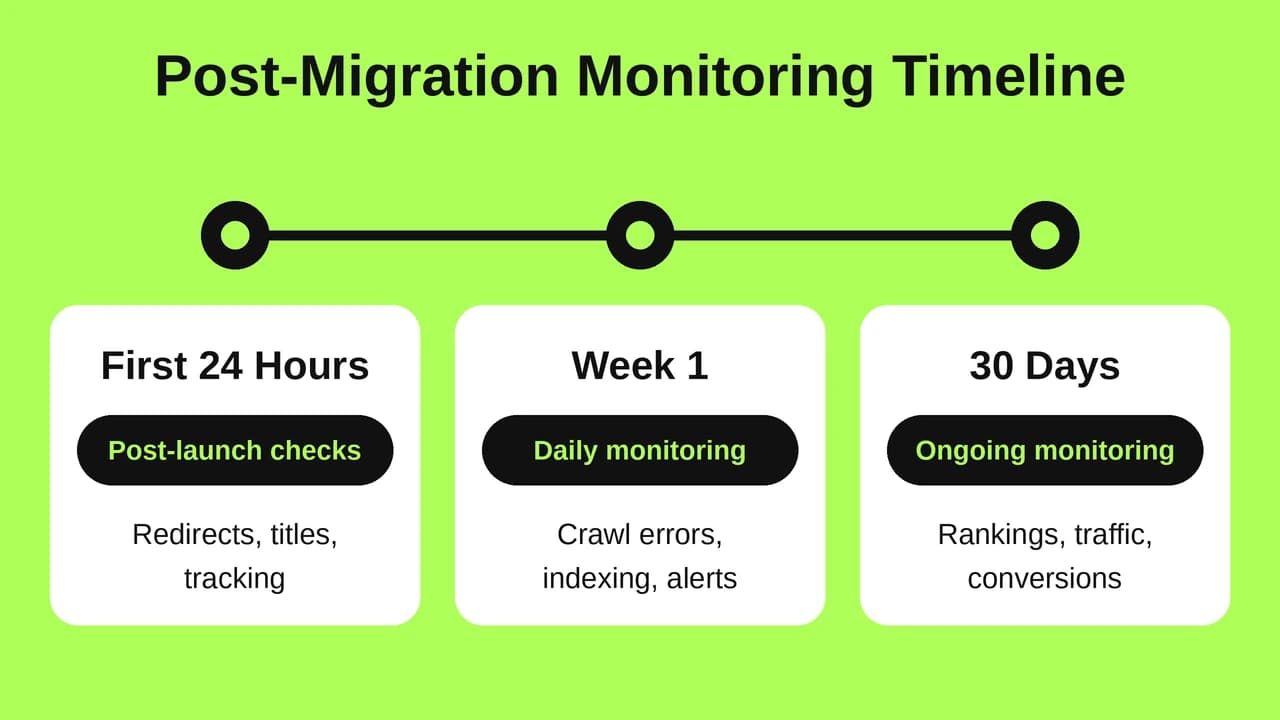
Post-launch monitoring starts at hour one. Monitoring stays daily at first.
First 24 Hours and First Week Checks
Run post-launch checks in the first 24 hours. Use daily monitoring for week one. Set alerting for errors. Rapid remediation fixes issues fast. Watch recrawl and reindexing.
Crawl Errors, 404s, and Broken Links
Check crawl errors daily. Fix 5xx errors first. Repair broken links.
Indexing and Crawl Stats Review
Track indexing weekly. Compare indexed pages to your sitemap. Index coverage shows gaps. Use the Index Coverage report or the Page indexing report. Read the Crawl Stats report for crawl stats trends. Index bloat adds junk. Deindexing hides good pages. Check the discovered not indexed and crawled not indexed statuses.
Comparing Old vs. New Rankings, Traffic, and Conversions
Make a comparison against your baseline. Compare each metric below:
- Impressions and clicks: drops by page type
- CTR (click-through rate): title changes
- Average position: rank shifts
- SERP features and featured snippets: lost features
- Bounce rate and engagement rate: page experience
Log File Analysis and Googlebot Behavior
Log file analysis shows real bot visits. Server logs list every request. Check crawler behavior. Spot bot activity shifts. Watch crawl frequency.
30-Day and Ongoing Monitoring
Keep 30-day monitoring as the minimum. Ongoing monitoring follows. Continuous monitoring catches late drift.
Troubleshooting a Migration and Recovering Lost Traffic
Recovery needs facts. Your baseline helps you recover faster.
Expected Fluctuation vs. Real Traffic Drops
Expected fluctuation is brief. A dip that keeps falling needs action. Ranking fluctuations that grow week over week are a red flag.
Running a Parity Audit After a Drop
Run a parity audit when numbers fall. Compare old and new pages. Look for failure points. Failures often hide in templates. Check visibility by page type.
When to Hold, Fix, or Roll Back
Hold when the dip is small. Apply fixes when you find a cause. Technical fixes go first. Log each remediation. Roll back if damage grows.
Traffic and Ranking Recovery Steps
Traffic recovery follows a short plan:
- Find the cause.
- Fix it on one template.
- Re-crawl and re-test.
Ranking recovery follows traffic recovery.
SEO Website Migration Audit Checklist
Here is our seo website migration audits checklist. Think of it as an SEO migration checklist you run by phase. A small site needs one checklist. Large sites need several checklists. This audit checklist keeps teams aligned. Our seo website migration audits list stays short on purpose:
- Before Migration: Save baselines. Finish the redirect map. Test staging.
- During Migration: Run the cutover. Confirm go-live.
- After Migration: Start postlaunch checks. Review daily data.
Free Template and PDF Download
Get the seo website migration audits PDF. The free template is a spreadsheet. Download the audit template, then copy the templates for each phase. Spreadsheets keep owners and dates in one place.
SEO Website Migration Audit Tools
Tools speed up the work. Pick audit tools that fit your site. Free tools cover small sites.
Screaming Frog and Sitebulb
Screaming Frog crawls both versions. Sitebulb adds a second view.
Semrush Site Audit and Ahrefs
Semrush Site Audit flags technical issues. Ahrefs helps with backlinks.
Google Search Console and Google Analytics 4
Export data from both before launch. Use the API for large sites.
Looker Studio, Robots.txt Testers, and the Wayback Machine
Use Looker Studio for charts. Test robots.txt rules with a tester. The Wayback Machine shows old pages.
Audit Deliverables and Prioritized Action Plan
Deliverables should be clear. Every audit ends with a report and a plan.
Audit Report and Findings
The audit report lists audit findings in plain words. Each finding links to URLs.
Issue Prioritization: Critical Issues, Quick Wins, and High-Priority Fixes
Use issue prioritization to rank work. Critical issues come first. Quick wins come next. Group high-priority fixes by owner. Share prioritized recommendations. Recommendations need dates.
Integrating Audit Findings Into Your Migration Strategy
Turn findings into an action plan. List action items by owner. Insights from the audit should shape your next sprint.
Hiring an SEO Website Migration Audit Service
Some teams hire SEO services. An SEO agency adds senior eyes. Agencies differ, so compare scopes.
What You Get From a Migration SEO Audit
Migration SEO audit services include a report and a plan. Audit services also cover testing. Some migration services add launch support.
How Much Does an SEO Migration Audit Cost?
Pricing depends on site size. Cost rises with URL count. Costs for rework run higher. Savings come from catching errors early.
How to Choose the Right SEO Expert or Agency
Choosing an SEO expert starts with proof. Selecting an agency starts with scope. SEO professionals should explain the plan. An SEO specialist focuses on one area. An SEO consultant advises. Consulting teams may lead a long move. A consultant or principal consultant should join kickoff. Marketers need plain reports. SEOs and developers must share one sheet.
Can ChatGPT Do an SEO Audit?
LLMs can draft checklists and summaries. They cannot crawl your site. Verify every output.
DIY Audit vs. Professional Audit
A DIY audit works for small sites. A larger move needs an SEO team. Compare skills, time, and risk.
SEO Website Migration Best Practices and Common Mistakes
Our best practices are simple. Follow the practices in order. Case studies teach faster than rules. Each case study shows what changed. Examples help new teams.
Migrate During Low-Traffic Periods
Plan the switch for low traffic. Less traffic means less risk.
Back Up the Old Site and Document All Assets
Back up the old site. Keep documentation for every asset.
Keep Developers and Stakeholders Informed
Hold a handoff before launch. Governance keeps one owner per task.
Mistakes to Avoid
Common mistakes include late audits, missing redirects, and blocked crawlers.
Frequently Asked Questions
How Do I Do a Website SEO Audit?
Learning starts with the 7-step list above. Training your team on the steps helps. Use the resources on this page.
How Can I Migrate My Website Without Losing SEO?
Follow the phases in order. A webinar or on-demand session can walk your team through it. Webinars work best before kickoff.
How Long Should a Website Migration Take?
Timelines depend on site size and team count.
What Is the 80/20 Rule in SEO?
The 80/20 rule says a small set of work drives most results. In a move, redirects, indexing, and analytics are that set. Pick strategies that protect them first. SEO website migration audits turn that rule into a plan, so you launch with proof, not hope.
Need a Technical SEO Audit or Strategy Call?
Connect directly on WhatsApp to review your site speed, topical architecture, and organic growth roadmap.