
A SaaS marketing budget should match your stage. This guide shows how a B2B SaaS team can set its spend for 2027. It uses the 2026 benchmark data as the base.
How Much Should a SaaS Company Spend on Marketing?
The short answer is 8% to 25% of ARR. That range is a starting point, not a rule.
Here’s why the number matters. Every dollar is buying growth, and investors expect proof of it. Funded startups spend more than bootstrapped ones. A SaaS company at scale cannot copy what SaaS startups do at seed. Company spend should follow stage, not habit.
What’s defensible is a range your board can test. If you’re a funded founder, pick the range first. Then show how startup marketing spend turns into pipeline.
SaaS Marketing Budget Benchmarks
SaaS Capital’s March 2026 survey covered 1,000 private B2B companies. The survey found a median B2B spend of 8% of ARR on marketing. Equity-backed companies spent more than bootstrapped ones.
The official Gartner CMO spend survey adds a second data point. Data from 700 companies sits behind these medians. Read all of it as a range, not a target.
Marketing Budget as a Percentage of Revenue (ARR)
Most SaaS companies spend 8% to 18% of ARR on marketing. The median sits at 8%. Mature companies fall between 8% and 12%. Companies at an earlier ARR stage push toward 15% and sometimes 25%. Track sales cost on its own line, since it follows a different percent-of-ARR band.
Marketing Budget Percentage by Company Stage
Funding stage sets the benchmark. The percentage peaks at seed. Efficiency improves as you scale.
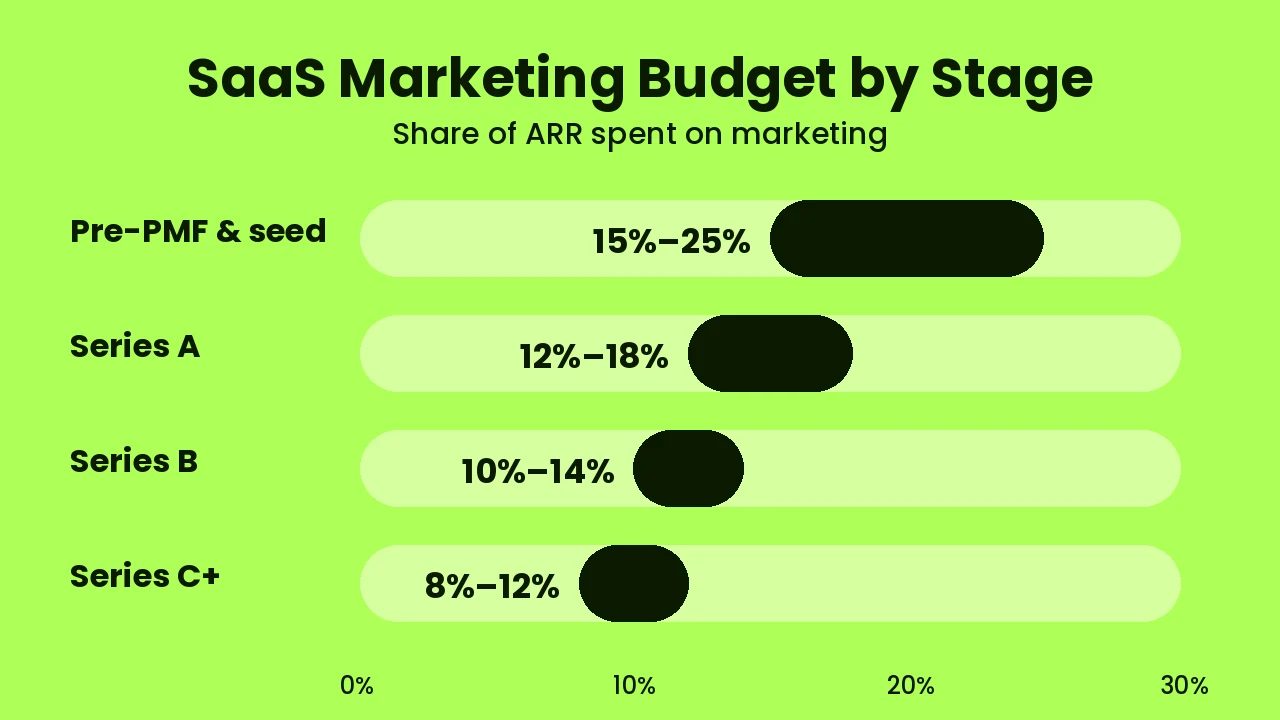
- Pre-PMF and Seed: 15%–25% of ARR
- Series A: 12%–18% of ARR
- Series B: 10%–14% of ARR
- Series C and Later: 8%–12% of ARR
Marketing Budget as a Percentage of Funding Raised
Venture-backed companies often tie marketing to the round. Your funding type sets the band. Set a percent of the raise, then map it to months. Most funded B2B teams plan for 12 to 24 months. An 18 to 24 month runway is common. Stretching past 18 months means you cut spend or slow hiring.
Benchmarks vs. Reality: Why Your Budget Won’t Match the Average
Benchmarks differ by industry. Cybersecurity, fintech, and enterprise sales often need more trust and longer cycles. Those deals can justify spend in the top range. The top range only works when unit economics support it. Your actual number will rarely match the average. Globally, the spread is wide.
Choosing the Right SaaS Marketing Budgeting Model
Pick a budgeting approach that fits your team. The Zulu method fits startups that must show investors a clear plan with limited resources. Each model below suits a different situation.
Percentage-of-Revenue Model
Treating a percentage as your budget is the fastest path. Take a share of revenue, such as 12%, and set it. This model is simple. It ignores goals, though.
Goal-Based (Bottom-Up) Model
Start with a revenue target. Turn that target into number targets for leads, deals, and customers. Apply conversion rates. Then check payback. The result is a budget with a deadline.
CAC and Growth-Goal Model
Use a CAC ratio to test the plan. Track CAC by channel. Compare what customers cost in each one. Fund the channels with the lowest cost first. Once CAC stabilizes, scale up. Clear goals also make your pitch stronger.
How to Build a SaaS Marketing Budget Step by Step
Building a budget takes four steps. Planning in this order turns marketing into a number you can defend.
Start With Business Objectives and Growth Goals
Businesses set strategic goals first. Pull your GTM plan. Write the growth goal in dollars. Then ask what marketing must deliver.
Use Unit Economics and Customer Acquisition Cost (CAC) to Drive Decisions
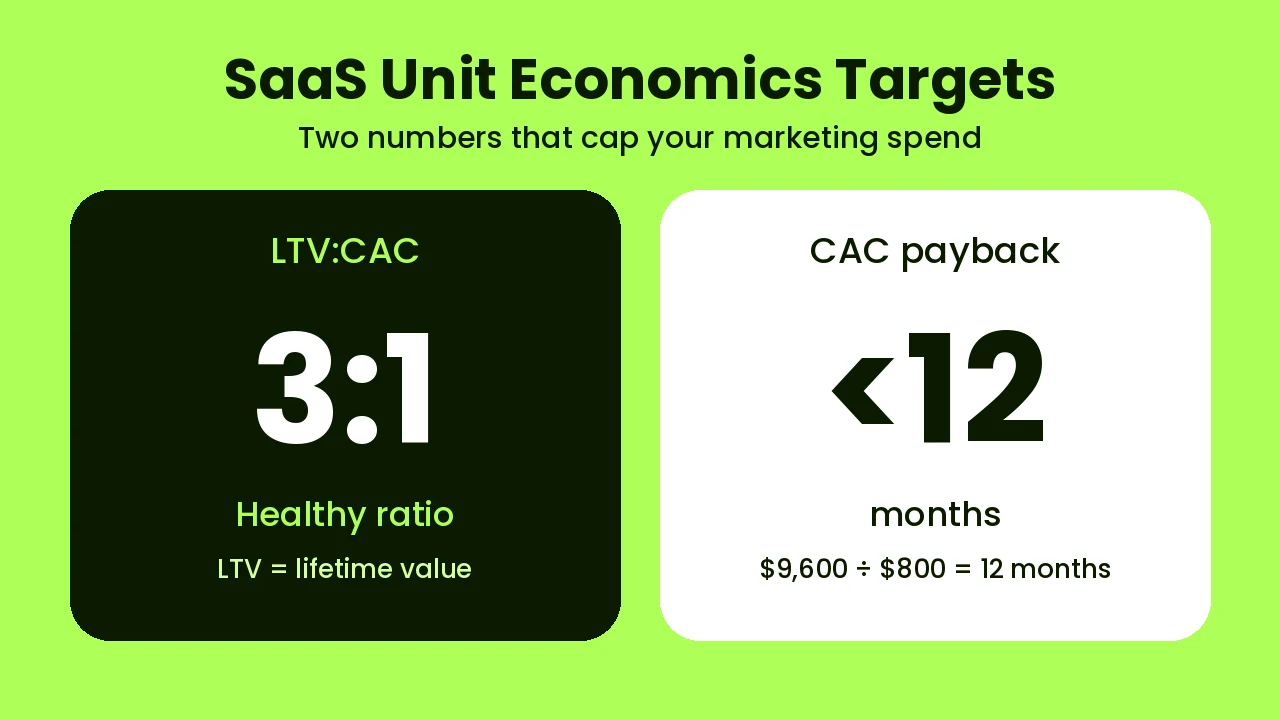
Unit economics set the ceiling. Customer acquisition cost is the marketing cost to win one paying customer. Compare it to LTV. A healthy LTV:CAC ratio is 3:1. Aim for payback in under 12 months. Let these numbers drive every buying decision.
Break Down Spend by Funnel Stage
Split spend by funnel stage. Demand capture reaches buyers already searching. Demand generation builds new pipeline. Lifecycle work keeps the engine running. A full-funnel motion fits most Series teams. Add full-cycle reporting once you can measure it.
Forecast and Phase Your Spending
Plan the first 30 days in detail. Review at 90 days. Use a realistic timeline, since results lag. Forecast by year. Then split the annual number by period.
SaaS Marketing Budget Allocation by Stage
Allocation shifts with stage. Use benchmarks as a starting point. Then turn the percent-of-ARR bands into dollar ranges.
Pre-Product-Market-Fit Budget
Keep seed and pre-PMF spend small. Your job is to learn about the product and the market. Lean on founder-led sales and high-intent search campaigns. Run 10 experiments and one pricing pilot.
Seed and Early-Stage Budget
Seed startups often begin with $15,000 to $50,000 a month. Fund campaigns and content first. Content answers buyer questions. Search and SEO bring that content traffic, as seen across proven case studies where organic channels lower blended acquisition costs.
Series A Budget
A typical Series A company has $1M to $5M ARR. Series A marketing needs a clear monthly budget. Use the first channels to find and prove what works. Then shift money into proven paid channels.
Growth and Scale-Up Budget
Growth-stage Series B companies run at $5M to $15M ARR. Compounding channels carry a lower marginal cost. Brand and organic work start to pay off. High-growth teams then keep scalable channels and grow them.
Worked Example: A $3M ARR Series A Budget
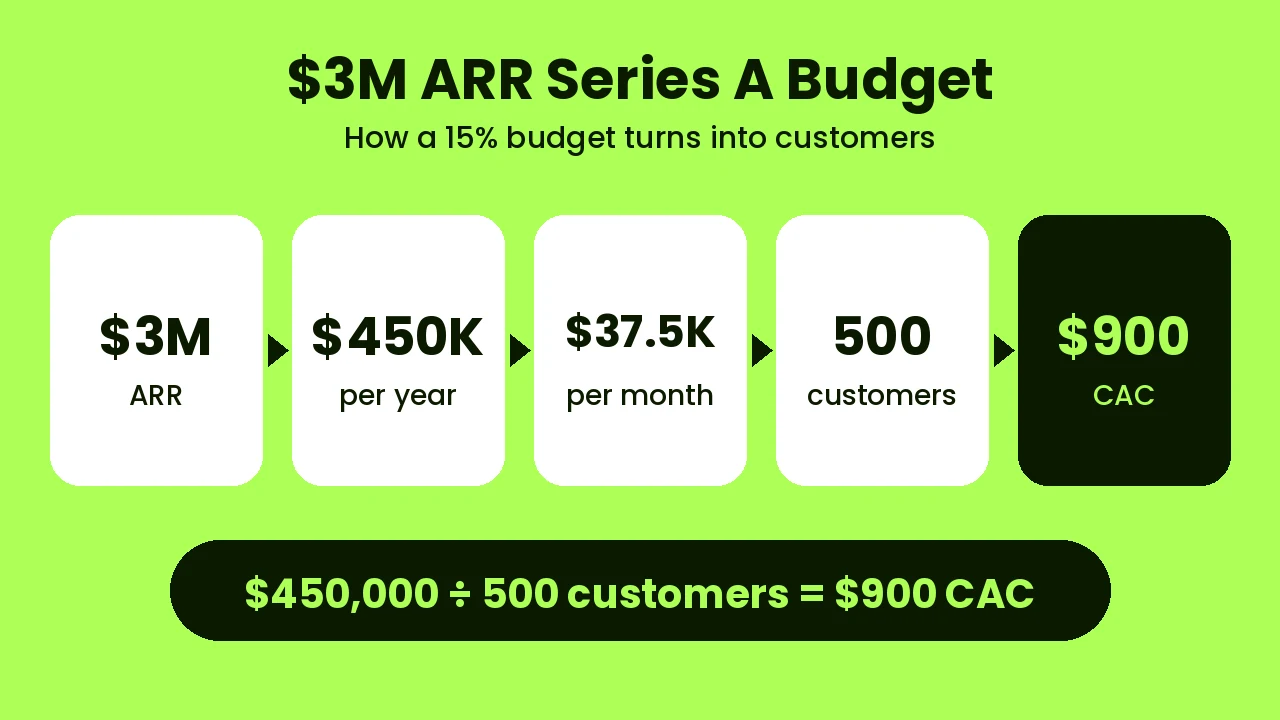
Take a Series A company with $3M ARR. At 15%, the yearly budget is $450,000. That is $37,500 a month. The goal is $1M in new ARR. With a $2,000 average contract, that means 500 customers. The team builds $2M in pipeline and closes half. The CAC is $450,000 ÷ 500, or $900.
Real-World Example: DocuSign
DocuSign shows what scale looks like. They’ve treated marketing as a real, annual line item for years. At that size, the percent of revenue is lower than at a startup. The dollars are still large.
Where the Money Goes: SaaS Marketing Budget Breakdown
Money flows into three places. Spending follows the channel split, then people, then tools. In B2B marketing, inbound builds traffic and visibility. ABM, webinars, and comparison pages support deals. Press and blog work add reach. Together, these campaigns make up the plan.
Channel Mix and Prioritization for B2B SaaS
You cannot cover 10 channels well. Choose two or three. Then set how much to spend on each:
- Paid Search: PPC on Google captures buyers who already want a fix.
- Paid Social: It builds awareness with a defined audience.
- Social Video and Content Creators: Creators paid by the post can drive demand creation.
- Content and SEO: These compound over time through strategic semantic content writing that captures high-intent organic searches.
Marketing Headcount and Salaries
Team cost should use fully loaded numbers, not base pay. Days loaded into the budget should include benefits and taxes. A lean team can start with a couple of mid-level salaries. A senior hire can lead them. Add a writer as content grows. A fractional head of growth can cover strategy work until you need someone full time.
Tools and Tech Stack
Martech should earn its place. Audit it every year. Cover these areas:
- Automation software.
- Data systems.
- Digital platforms.
- Engineering solutions for tracking, CMS infrastructure, and integrations, often scaling with a dedicated programmatic content strategy.
In-House vs. Agency Allocation
An in-house team gives control. Pick the in-house model when work is steady. In-house hires also learn your product faster. Hire a marketing agency for peaks or special services, comparing transparent pricing options before committing to retainer contracts. A fractional CMO can fill a leadership gap. Some teams now pair with an AI-native marketing partner. That partner can run AI marketing work for a SaaS company.
SaaS Marketing Budget Template
Copy this template into a slide or sheet. Give each line a budget:
- Paid Channels: Set monthly budget allocation.
- Content and SEO: Organic compounding channel budget.
- Events and Webinars: Mid-funnel pipeline acceleration.
- Team (Fully Loaded): Base salaries, taxes, benefits, and bonuses.
- Tools & Software: Martech stack, automation, and analytics.
- Agency or Contractors: Specialized external execution partners.
Simple SaaS Marketing Budget Estimator
This cost calculator uses one formula. Multiply ARR by your percent. The math is short:
- $3M ARR × 15% = $450,000.
- $450,000 ÷ 12 = $37,500 monthly spend.
Check the numbers against your template. Then compare the total to your goal.
Who Should Own the SaaS Marketing Budget
Founders own it in small teams. A CMO or marketing manager takes over as the team grows. Leadership should review the number before it reaches the board. Ownership brings obligation and pressure. That pressure is healthy when the data is clear.
Tracking KPIs, Monthly Reviews, and Quarterly Reforecasting
Track performance every month. A monthly review checks spend against pipeline. Do a monthly reset when a channel slips. Quarterly, reforecast the full plan. Measure CAC and ROI. Use those insights to move money to what works. Keep optimizing, and don’t wait for year end.
Common SaaS Marketing Budget Mistakes
Most mistakes come from guessing. A budget isn’t a promise. Don’t spread spend across every channel. Fix conversion before you add traffic. Cut working spend last, not first.
Questions to Ask to Right-Size Your Budget
Ask these questions to right-size your budget:
- What growth goal does this spend support?
- What does one customer cost today?
- Is payback under 12 months?
- What is a good result for this channel?
SaaS Marketing Budget Checklist
Use this checklist as a key guide. Each step is crucial. Follow the list in order, and save the resources for review time:
- Set the growth goal.
- Pick a percent range.
- Check LTV:CAC and payback.
- Split spend by funnel stage.
- Assign an owner.
- Review monthly.
Why a SaaS Marketing Budget Is a Hypothesis
A budget works like a test. It lets you set a bet, measure the result, and adjust. Once a budget is set, your strategy shows up in the numbers. Review it often and refine your strategies. A SaaS marketing budget stays useful when you treat it as a hypothesis.
Frequently Asked Questions
What percentage of revenue should a B2B company spend on marketing?
Most B2B companies spend 8% to 18% of revenue. Early teams that chase customers aggressively spend more. Marketing share drops as you scale.
How should you allocate a SaaS marketing budget?
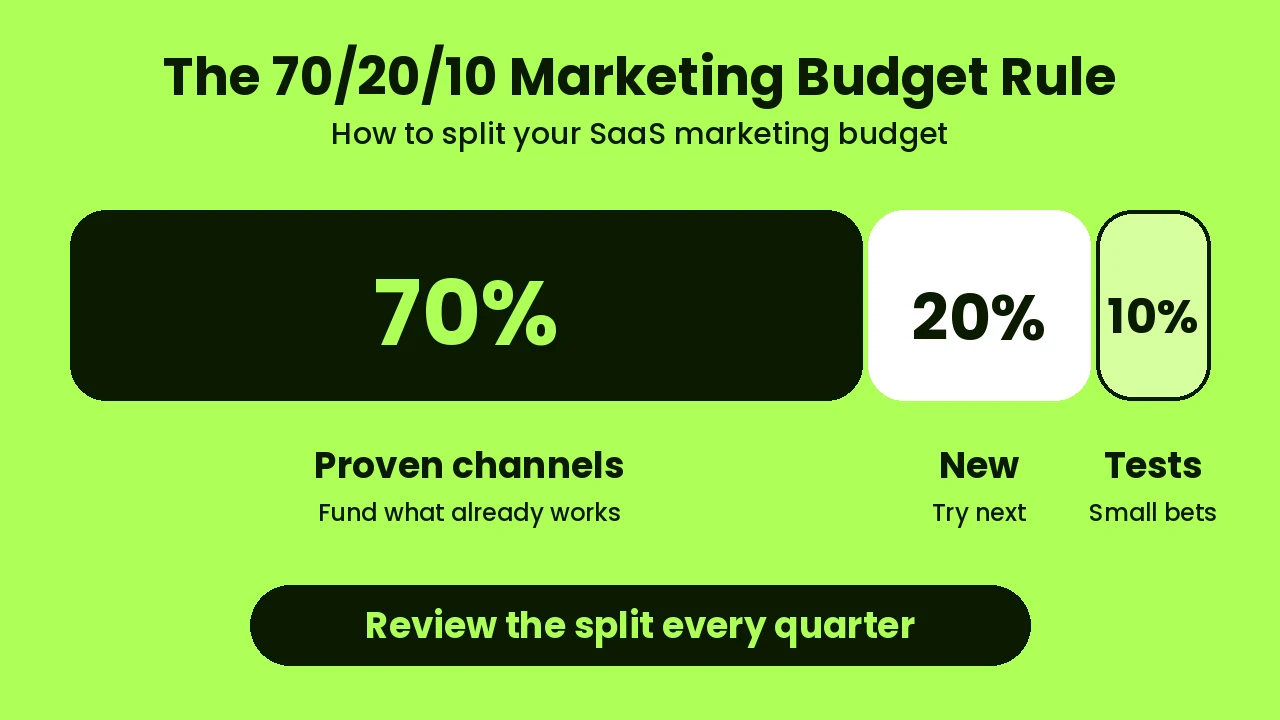
Allocate by source of pipeline. Fund proven channels first. Keep a small share for tests. Review budgets every quarter.
Should salaries be included in the marketing budget?
Yes. Include salaries at loaded cost. This shows the true price of each customer.
How do you calculate CAC payback?
Divide CAC by monthly gross profit per customer. Say a customer brings $1,000 a month at an 80% gross margin. That is $800 in gross profit. A CAC of $9,600 pays back in 12 months. The payback period tells you how fast the money returns, month by month, based on margin.
How much should a SaaS startup spend on marketing before product-market fit?
Spend little. Use founder-led sales and a few tests. Add budget after you see product-market fit.
What is the 3-3-2-2-2 rule of SaaS?
It is a growth pattern. ARR triples twice, then doubles three times. Pick one rule as a check, not a law.
What is the 70/20/10 rule for marketing budget?
Put 70% into proven channels. Put 20% into new ones. Put 10% into tests. Some teams cap tests at 5% to 10%.
What is the Rule of 40 in SaaS?
Add your growth rate and profit margin. A total of 40 or more is the goal.
Need a Technical SEO Audit or Strategy Call?
Connect directly on WhatsApp to review your site speed, topical architecture, and organic growth roadmap.