
Multilingual link building sits at the center of AI SEO today. AI systems and search engines now pull answers from sources in many languages, so international link building and multilingual SEO work side by side to build trust in every market you target.
What Is Multilingual Link Building?
Multilingual link building means earning backlinks from native-language websites and local-language websites in the markets you want to rank in. This process relies on multilingual outreach to secure multilingual backlinks built from real native language content, not machine translation.
International link building looks similar on the surface, but the difference between multilingual and regular link building comes down to depth. Regular link building often stops at any site with authority. Targeted off-page SEO goes further, securing cross-border backlinks and foreign language backlinks that match the exact language your customers speak.
This is not international SEO with a translate button. It is a global link building strategy built on localized link building, where every placement fits the local audience and search habits of that country.
Why Is Multilingual Link Building Important?
Multilingual link building builds topical authority and topical relevance in every language you serve. Search engines read international backlinks as ranking signals that prove real trust in a market.
More links from the right countries mean stronger organic traffic and better search visibility abroad. These links also raise brand recognition and credibility with local audiences who may never trust a foreign-only site. The payoff shows up as direct revenue impact, since trusted local links turn into real visits and sales.
Growing Importance of Multilingual Link Building in 2026
By 2026, AI search will answer most non-English queries directly from sources written in the user's own language. An AI-first strategy needs multilingual capabilities from day one. Global SEO teams that skip this step will lose visibility fast.
Impact on Google's Country-Specific Ranking Algorithms
Google runs country-specific ranking algorithms that weigh geographic signals heavily. Links from country-code top-level domains send strong geo-signals about where you serve customers. A smart ccTLD strategy pairs country-code domain extensions with country-code domain backlinks to boost local ranking signals.
How Multilingual Links Power AI Search Rankings Globally
AI search rankings depend on more than links in one language, connecting directly to generative engine optimization where platforms scan entity signals and linguistic context across sources before formulating synthesized responses. Appearing in AI overview results as a trusted AI knowledge source teaches AI systems to cite you in every language.
Local Entity Recognition
Local entity recognition depends on steady entity signals across native sites. Geo-targeted entity signals tell AI systems where you truly operate, turning your brand into a cite-worthy entity in that market.
Native Language Authority Signals
These signals come from local-language authority sources publishing in the market's own tongue. Local-language authority building takes time, but native language backlink acquisition from these sources builds market-specific authority no translation can copy.
Knowledge Graph Localization
Knowledge graph localization connects your localized content to the right entity in each region. Localized pages and localized versions help search engines place your brand correctly on the local map.
LLM Market Grounding
LLM market grounding relies on foreign domain relevance signals from sites AI models already trust. Market-specific content freshness keeps that trust alive, so your brand stays a reliable AI knowledge source.
Which Businesses Need Multilingual Link Building?
Multilingual link building fits any brand with a target audience outside its home country. If your target markets search in another language, this strategy earns the trust needed to reach them.
eCommerce Businesses
Ecommerce businesses gain the most from multilingual link building. Ecommerce link building drives qualified buyers straight to product pages in their own language. As cross-border shopping grows, shoppers build a shopping shortlist from sites they trust.
Buyer behavior shifts by country, so links that trigger branded queries help with demand capture early. This matters most for competitive keywords, where local trust often decides the sale.
Wholesale & Import/Export
Wholesale businesses and import/export businesses depend on trust built in the buyer's own language. B2B businesses, manufacturing companies, distributors, and suppliers all need local-language links to prove they operate in that region, not just ship products there.
SaaS & Online Consultancy
SaaS companies and software platforms grow faster when local reviewers link to them in-market. A consultancy offering professional services abroad needs the same trust, since clients rarely hire experts they cannot find in their own language.
Travel, Hospitality & Tourism
Travel, hospitality & tourism brands live on visibility in home-country search results. International visitors research destinations in their native language before booking. Links on trusted local travel sites capture that early research stage.
Apps & Digital Products
Apps and digital products need app store visibility built on local-language reviews. Education and e-learning platforms face the same challenge, since international students search for courses in their home language first.
How Does Multilingual Link Building Work?
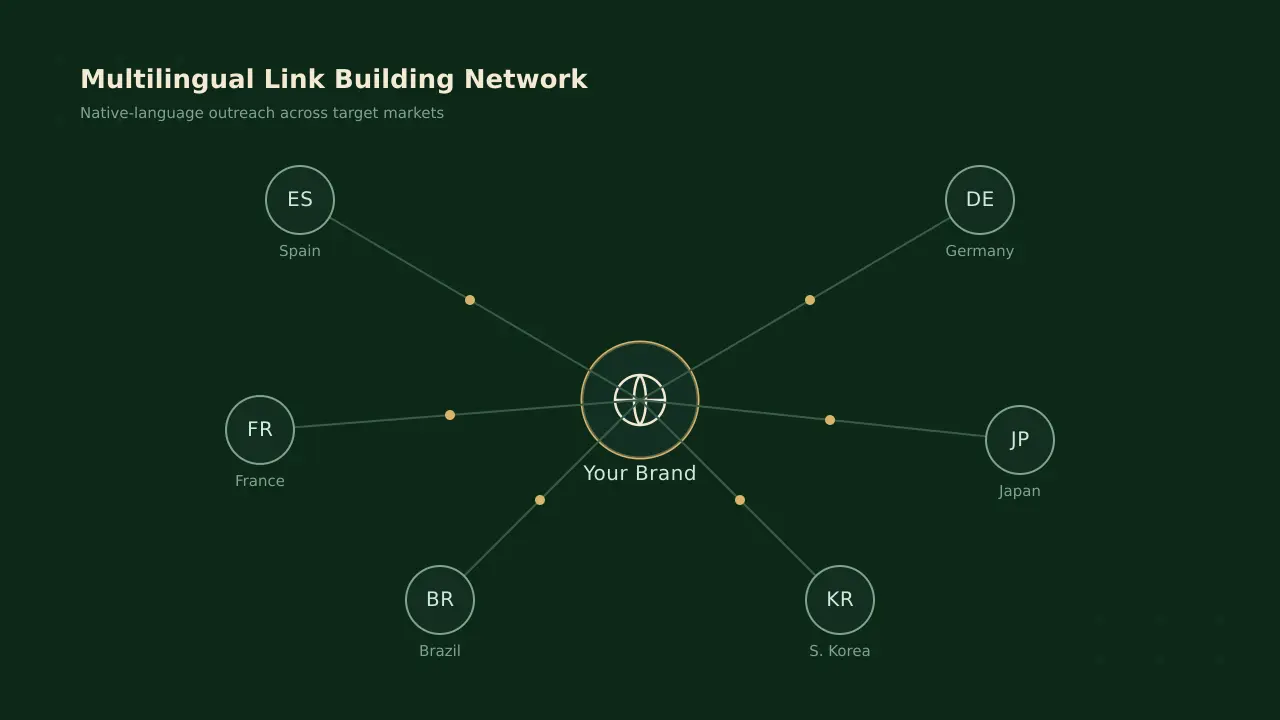
A working link building strategy for global markets follows a clear path. Multilingual outreach connects every step, matching each link to its market's language and culture.
Market Research and Link Inventory Mapping
Every project starts with market research to find winnable markets worth the effort. Search intent mapping and keyword research reveal what local buyers type.
This stage covers local search behavior, local link ecosystems, and competitor backlink analysis of local competitors through region-specific link prospecting. We run competitor backlink analysis by locale to build a local serp map, then pull prospect lists from backlink discovery, local keyword research, language-specific long-tail keywords, native keyword variation, and semantic keyword mapping per locale.
Native-Language Outreach and Relationship Building
Native language outreach pairs in-language content marketing with real editorial outreach. We send cold emails that follow local email etiquette and respect time zone considerations for outreach.
This is relationship-based link building, not a numbers game. Cross-cultural collaboration with native speakers makes local journalist outreach feel natural, helping us build relationships that last.
Native Content Creation
Native content creation relies on native-speaking copywriters who write seo-optimised content people enjoy. Transcreation goes beyond word-for-word translation to keep the message intact.
Formats include translated guest posts, guest blogging in native language sites, and foreign guest posting on niche platforms, plus native language press releases with foreign press release distribution and translated infographics shared through native content syndication.
Placement, Verification, and Reporting
Every campaign ends with placement reports you can check yourself. We confirm live placement through live URL verification and screenshot verification, so nothing stays a promise on paper.
We track indexed backlinks and keep transparent pricing throughout. Each link counts as editorial links, giving real editorial coverage and local editorial coverage in-market, arriving mostly as dofollow links, often permanent dofollow links, with anchor text that matches natural local phrasing.
Types of Multilingual Link Building Services
Not every brand needs the same setup. We offer a few core service types, including white-label link building for partners who want to resell without doing the work.
Curated Link Inventory
Our curated inventory gives fast access to pre-vetted inventory across dozens of languages. Every listing shows verified backlinks, checked as Moz verified and Ahrefs verified before you pay for a spot.
Bespoke Outreach for Niche Markets
Some markets need bespoke outreach built just for them. Custom outreach covers niche edits, guest posting, and press releases on sites that never appear in any public inventory.
White-Label Multilingual Link Building for Agencies
Agencies get white-label reports and full white-label fulfillment under their own name. We stay a silent partner behind unbranded reports, so your agency or reseller business keeps the credit. Every account gets a dedicated account manager, and larger accounts work with a VIP manager directly.
How to Build a Multilingual Link-Building Strategy
Building a real strategy takes more than buying random links. Follow these six steps in order.
1. Pick Markets You Can Win
Start by picking target markets you can actually win, not every country at once. Winnable markets share real demand for your product. Focus your first budget on two or three target languages before expanding.
2. Map Search Intent, Not Just Keywords
Keywords alone miss the point. Search intent changes by country, even for the same product. Per-locale intent mapping shows what buyers in each market want before they click.
3. Get Hreflang and Canonicals Right
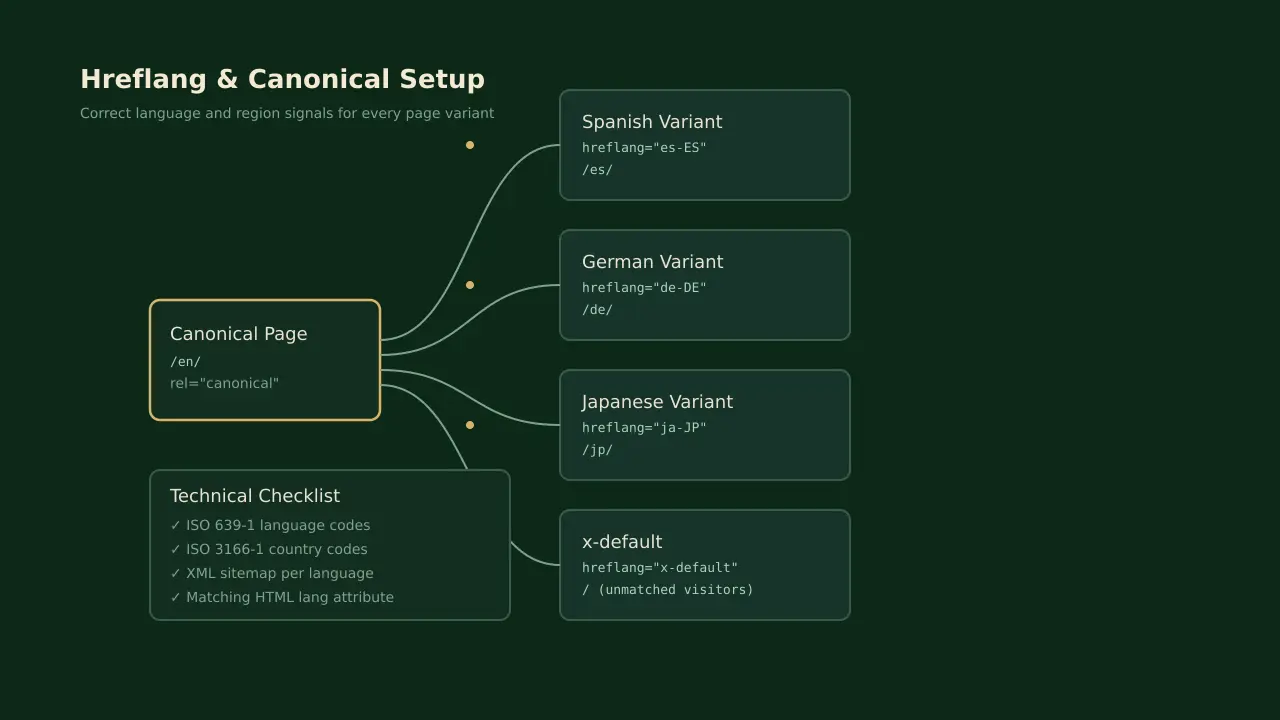
Hreflang holds the technical side of multilingual link building together, requiring rigorous technical SEO implementation to prevent duplicate content flags and align with official Google international site guidelines.
Check for:
- Correct hreflang tags and a working x-default hreflang for unmatched visitors
- Alternate language tags free of hreflang errors
- Canonical tags, canonical tags for multilingual pages, and canonicalization for translated pages
- Accurate ISO 639-1 language codes and ISO 3166-1 country codes
- Matching HTML lang attributes and clean HTTP headers
- No invalid language codes or language and region annotation errors
- Fixes for duplicate content across languages
- Google Search Console international targeting set correctly
- XML sitemaps by language listed inside your main sitemaps
Consult the official Google hreflang documentation to confirm language and regional URLs are validated properly across search indexes.
4. Understand Local Link Ecosystems
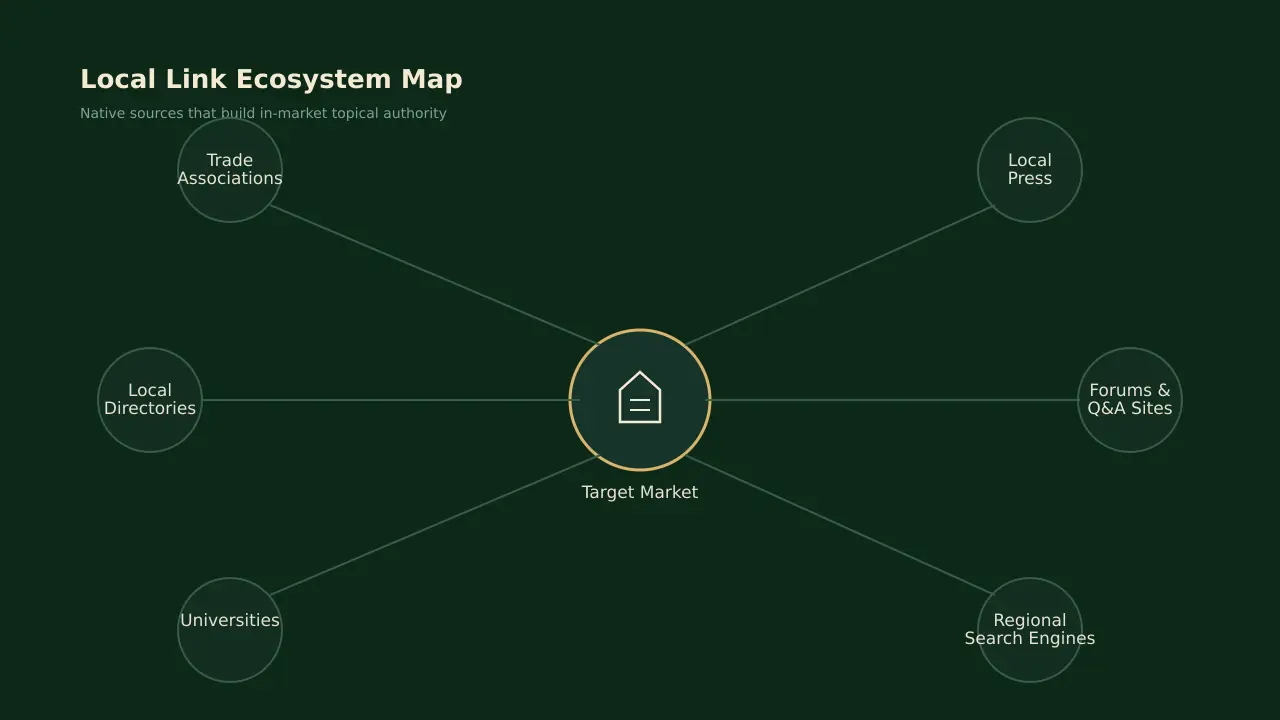
Every country has its own link ecosystem, built long before you arrive. Learn the players:
- Local chambers, trade associations, and universities with member directories
- Industry associations open to listings
- Local press and regional news sites in your niche
- Local influencers on local social media platforms like WeChat, LINE, and VKontakte
- Local forums and communities, plus local Q&A platforms
- Local niche directories and local business associations
- Local search engines such as Baidu, Yandex, and Naver, plus other regional search engines and language-specific search engines
5. Prioritize Translation Quality and Cultural Nuance
Translation quality decides whether local readers trust you at all. Cultural context matters as much as grammar, so cultural adaptation should shape every message.
Cultural nuance in outreach means knowing local slang and idioms well enough to use them correctly, or not at all. Native proofreading and native speaker translators catch mistakes early, keeping the language translation barrier from blocking a placement.
6. Align Site Architecture and Internal Linking
Site architecture and internal linking need to support every language equally. International site architecture usually relies on subdirectories or folders, though the subdomain vs subfolder structure debate still comes up.
Whatever you choose, keep technical consistency across the board. Fix redirects early, use localized URLs, and link internally to the correct target language version.
Smart Link Building Strategies for Multilingual Websites
Beyond the basics, four smart moves separate average results from strong ones.
Building Local-First Linkable Assets
Linkable assets work best built local-first. Local-first linkable assets like long-form guides, calculators, and templates written for one market earn links faster than generic content.
Pair these with local directories and local directory listings. International citation building through local citations by country strengthens NAP consistency across every local business directories listing you claim.
Expert Seeding Before Outreach
Expert seeding gets your content in front of the right people before outreach starts. Early distribution to local consultants, professors, and niche creators adds real local insight before you ask for a link.
These contributors bring their own communities and followers. We use local expert roundups, native language case studies, local podcast guesting, and local HARO equivalents to build early credibility.
Reclaiming Unlinked Brand Mentions
Unlinked brand mentions sit on other sites right now, waiting for link reclamation. Broken link building, including broken link building in foreign languages, recovers value from dead pages.
We also chase unlinked product mentions and outdated resource pages, fixing nofollow links along the way. Mention discovery turns up reclaimable links fast, and brand mention reclamation pairs well with resource page link building by region.
Earning Links Through Trusted Local Partnerships
Real partnerships often outlast any single campaign. Sponsor pages, partner listings, and shared case studies build trusted links that stay live for years.
Look for topically relevant links from local blogs in your niche, brand authority built through steady regional presence, and compound authority from sponsorships in target markets. Add cross-border SEO partnerships, international link building agency partnerships, native language sponsorship links, reviews on local review platforms, and local Google Business Profile listings tied to real locations.
Multilingual Link Building Tools
The right link building tools keep a global campaign organized. A solid CRM tracks every outreach workflow from first email to live link.
Before any placement goes live, we run technical audits and site quality checks using international SEO tools like Ahrefs and SEMrush by country, plus lighthouse audits.
Domain authority and referring domains matter, but DA (Domain Authority score) and DR (Domain Rating) need context. Page authority per locale, trust flow by market, and referring domains diversity often tell a truer story.
Every link gets checked against your local backlink profile and domain authority by region, backed by regular international backlink audit work, competitor monitoring, and local competitor gap analysis for international SERP features.
Common Challenges and Risks
Multilingual link building carries real risks if you move too fast. Knowing where things break saves money in a new market.
Biggest Risks in Multilingual Link Building
The biggest risks of multilingual link building show up when quality checks get skipped. Applying disciplined backlink management best practices prevents toxic placements from harming your international footprint:
- Dead domains and ghost town sites sold as active
- DR-chasing that leads to low-quality placements
- Manipulative link patterns flagged by toxic foreign link detection
- No disavow strategy for spammy links already pointing at your site
- Broken natural link velocity from buying too many links too fast
- Prospecting blind spots, outreach mismatch, and technical leakage
Verifying DA/DR and Link Quality Across Markets
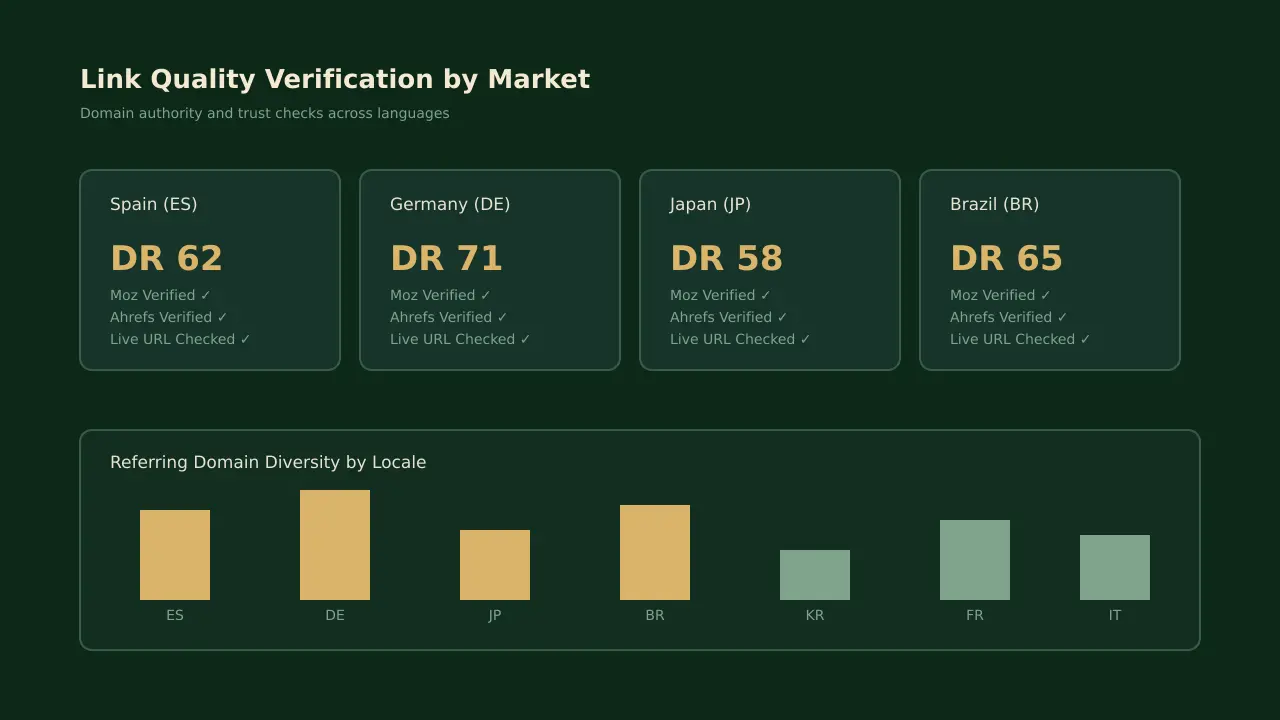
Authority metrics only tell half the story. Link relevance by locale and topical relevance in target language matter just as much as any score.
Check anchor text diversity across languages and cross-language anchor text ratios before trusting a site. High quality backlinks, or quality backlinks from high authority websites, only count when they come from trustworthy sites people actually read.
Avoiding Technical and Cultural Pitfalls
Small mistakes cost trust fast. Watch for wrong locale pages and IP-based redirection pitfalls sending visitors to the wrong version of your site.
Other common gaps:
- Missing GDPR compliance mentions or local legal and regulatory context
- Outdated shipping info and returns info
- No local examples or cultural references that fit the audience
- Weak native-feeling UX and poor dates/currencies/units localization
- Address forms built for the wrong country
- Poor audience fit in pre-purchase information, especially for higher-stakes purchases
- Low localization quality leading to trust-killing localization mistakes
- Missing localized proof and wrong local currency and units in content
- Rushed multilingual site migration without proper testing
Frequently Asked Questions
What's the difference between multilingual link building and regular link building?
The difference between multilingual and regular link building comes down to language and culture. Regular link building often stays within one market. Multilingual campaigns target native speakers directly, using local sites and local trust signals a single-language campaign never touches.
Do multilingual links help Google rankings in specific countries?
Yes. Country-specific backlinks send clear geo-targeting signals about where you serve customers. Most clients see ranking movement within a few months, with serp gains showing up first for long-tail terms.
Can I do multilingual link building myself, or do I need an agency?
DIY multilingual link building is possible if you speak the language and know the market well. Most brands still choose a link building service, since external link builders already hold relationships that take years to build.
Do I need fully translated content before I start link building?
Not fully, but you need enough localized content assets to prove you belong in that market. Local market entry SEO works better with a few translated core pages ready before outreach begins.
How are DA and DR verified for foreign-language sites?
We check every site as Moz verified and Ahrefs verified before adding it to our list. This keeps our verified backlinks accurate, even on sites written in a language our clients may not read.
What is the best CMS for multilingual link building?
There is no single best CMS for multilingual websites, since the right choice depends on your team's setup. What matters more is clean URL structure and proper language tagging, whatever platform you use.
How many links do I need per language or market?
Links per language depend on how competitive that market already is. A new market with light competition may need far fewer links than one where local brands already hold strong positions.
How long does it take to see results?
Every delivery timeline depends on the package you choose. Standard delivery time runs a few weeks, while priority processing speeds things up for an added cost. Our packages come with clear terms, no hidden fees, and flexible contracts. Ask about a discount for larger, ongoing orders.
Are multilingual backlinks permanent?
Most of our placements are permanent dofollow links, built as part of real international authority building. This creates compounding authority over time, first lifting long-tail keywords, then driving targeted traffic through language-appropriate anchor text that reads naturally to local visitors.
Need a Technical SEO Audit or Strategy Call?
Connect directly on WhatsApp to review your site speed, topical architecture, and organic growth roadmap.